
U.S. Treasury yields continue to rise: An underestimated global macro transformation

FX Street, August 25—— Essentially, this round of long-term rate hikes is not a short-term policy disturbance, but a structural reconstruction of the global capital pricing system. Over the past two decades, the surplus of global savings generated by globalization continually suppressed the global risk-free rate; now, high-quality long-term global capital has entered a period of scarcity, and US Treasuries are undergoing a systemic repricing.
In the last two years, the global market has shown a set of marked structural features: equity markets are increasingly volatile, international gold prices continue to strengthen, and US long-term Treasury yields remain elevated, holding above 4% for an extended period and reaching highs not seen in over a decade.
The mainstream market view mostly attributes the rise in yields to the Federal Reserve's monetary tightening and persistent inflation. However, this explanation only accounts for short-term cyclical fluctuations and cannot address the core contradiction: even as expectations for Fed rate cuts rise and inflation gradually subsides, US long-term Treasury yields remain rigid and are difficult to bring down.
In essence, this round of long-term yield increase is not due to short-term policy shocks, but a structural reorganization of the global capital pricing system. Over the past two decades, the surplus of global savings resulting from globalization consistently suppressed the risk-free rate worldwide; now, high-quality long-term global capital is in short supply, and US Treasuries are undergoing systemic repricing.
Understanding this underlying paradigm shift allows for a clear grasp of the pricing logic of global stocks, bonds, currencies, and gold, and can also serve as a long-term reference for asset allocation by ordinary investors.
Looking at core data, during the pandemic in 2020, the 10-year US Treasury yield dipped as low as 0.5%. As of 2024, the median has steadily climbed to 4.2%–4.5%, accumulating nearly a 400 basis point increase over four years—a significant rise in the rate ceiling.
Historically, capital markets have shown a stable hedging pattern: rising US Treasury yields mean higher risk-free returns, which suppresses the valuation of zero-yield gold, showing a significant negative correlation between the two.
However, since 2023, the market has deviated noticeably: both international gold prices and US long-term Treasury yields have strengthened in tandem. While gold broke through the $3,000/oz high, US Treasury yields remained elevated. This anomaly indicates that the core variables driving the current round of rate hikes have detached from the US domestic monetary cycle and instead originate from profound shifts in the global macro structure: global capital’s passive allocation to US Treasuries is weakening, while the demand for diversified safe-haven assets is rising, compelling US Treasuries to increase their risk compensation.
In short, the global capital landscape has completed a switch: from a past of surplus savings passively absorbing US Treasuries, to the current state where US Treasuries actively attract capital by raising yields.
The core support for the global low-interest environment over the past 20 years has been the high-efficiency cross-border capital flows driven by globalization’s dividends. Massive savings accumulated by surplus economies flowed into US Treasuries consistently and without friction, serving as a long-term suppressive force on long-duration rates. Currently, this mature and cheap capital supply system is steadily unraveling from three major dimensions.
During the height of globalization, East Asian manufacturing economies and Middle Eastern oil exporters amassed huge foreign exchange reserves through trade surpluses. In a world of limited global asset choices, US Treasuries became core assets, creating a stable cycle of "trade surplus—reserve accumulation—increased holdings of US Treasuries," which was also the root of the 'Greenspan Puzzle' from 2004–2006.
In recent years, intensified geopolitical competition, global supply chain restructuring, and rising trade protectionism have significantly increased the friction costs of cross-border capital flows. Capital allocation logic in many countries has shifted from "return-first" to "safety and self-control first," leading to a continuous contraction in passive demand for US Treasuries.
In terms of holdings, China’s US Treasury assets have fallen from a historical peak of $1.32 trillion in 2013 to around $770 billion in 2024; Middle East sovereign wealth funds are also reducing their holdings of US Treasuries, reallocating to local industrial upgrades, new energy, and Asian real assets.
Amid ongoing US fiscal expansion and a surge in Treasury supply, global incremental buyers are continuously missing, with supply-demand mismatches directly pushing up long-term yields passively.
2. Global Aging: Savings Structure Reversal Compresses Available Loanable Funds
Traditional market thinking holds that aging leads to higher risk aversion, thus benefiting bonds. However, this logic overlooks the systemic impact of demographic shifts on total global capital; the current reality runs counter to traditional theory.
Major economies such as China, Japan, and the Eurozone are already in deep aging stages, the share of working-age population is consistently decreasing, and the median national savings rate is structurally declining. This is contracting the market pool of loanable funds. Simultaneously, global pension systems have officially moved from accumulation to payout periods, heavily weakening the long-term capital supply.
Take GPIF, Japan’s government pension fund and the world’s largest, as an example—it has been reducing overseas bond assets to repatriate liquidity for domestic pension payouts. At the same time, demographic aging is sharply increasing inflexible fiscal outlays on healthcare and pensions, compelling governments to expand debt issuance and crowd out available market capital.
The dual divergence of shrinking capital supply and expanding debt supply continues to push up the global long-term capital price ceiling, thus raising long-term rates.
For more than ten years, Japan maintained negative rates and yield curve control, supplying abundant low-cost yen for arbitrage. Carry trades involving borrowing at zero cost in yen and converting into dollars to buy US Treasuries became an important but hidden force suppressing global long-term rates.
In 2024, the Bank of Japan ended its negative rates policy and started to scale back government bond purchases, signaling the end of this long-standing global arbitrage system. Rising yen financing and FX hedge costs have prompted Japanese financial institutions to drastically cut back on US Treasury investments, with some continuously selling. With around $1.1 trillion in US Treasuries, Japan’s marginal adjustments put persistent upward pressure on global long-term rates.
Besides a persistent contraction in global capital supply, rigid demand for long-term capital is expanding, further tightening the supply-demand balance. Two major sources of incremental demand have jointly raised the global price of long-term funds.
Unlike the internet era with its asset-light, low-investment model, the current AI technological revolution is extremely capital-intensive. Infrastructure for computing power, data centers, high-end chip manufacturing, and supporting energy facility upgrades all require hundreds of billions in long-term capital.
The combined 2024 capital expenditures of the 'Magnificent Seven' tech giants exceeded $200 billion, and are projected to approach $300 billion in 2025. Much of this is financed through the bond market. The large-scale financing of the tech industry and real-world infrastructure intensifies the competition for long-term market funds.
In a capital-scarce global context, real-sector financing rates systematically rise. As the global asset pricing anchor, US Treasuries must raise yields to maintain their attractiveness.
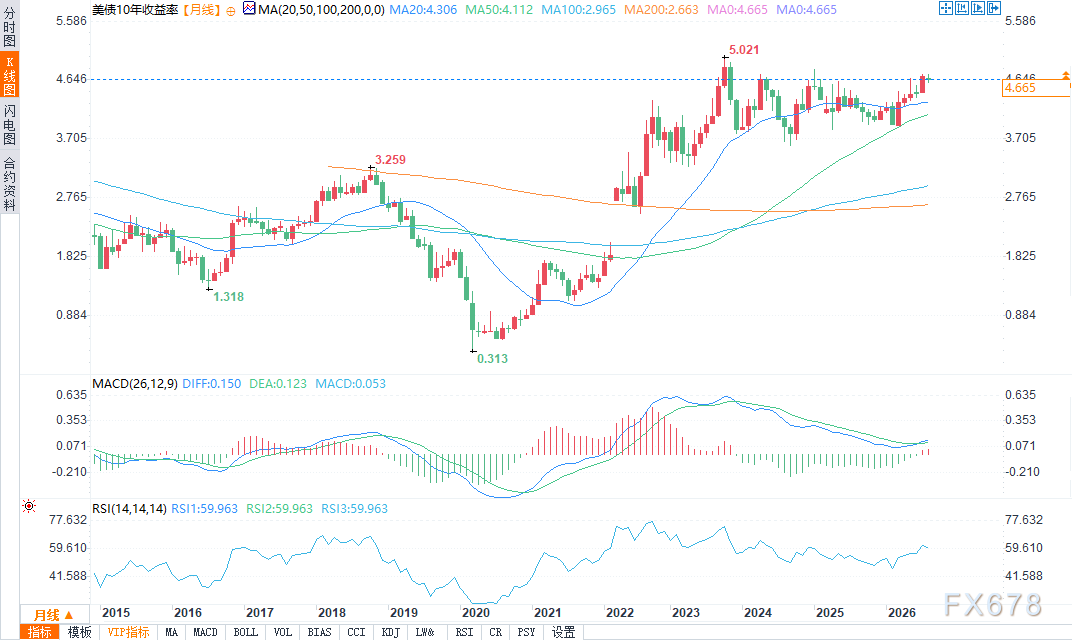
(10-year US Treasury Yield Monthly Chart, Source: Easy Forex)
The US fiscal deficit has transitioned from cyclical to structurally high, continually undermining fiscal sustainability. The current federal deficit rate has long been above 6%, far above the 3% international safety threshold; in 2024, US government interest payments exceeded $1 trillion, surpassing defense spending to become the core fiscal outlay.
Previously, the market regarded the US deficit as a short-term cyclical phenomenon; now, investors hold a long-term pessimistic outlook. As the US debt continues to expand and fiscal risks accumulate, the market proactively demands higher risk compensation, driving term premiums for US Treasuries to return to positive territory—this is the key structural driver behind rising long-term yields.
This round of sustained gold appreciation is not simply due to geopolitical hedging or inflation protection, but a core signal of the restructuring of global reserve assets.
For decades, US Treasuries dominated the global safe asset market thanks to high liquidity and low volatility. However, as US debt expands disorderly and the global geopolitical landscape shifts, the “risk-free” status of US Treasuries is steadily weakening, pushing global capital to seek diversified safe-asset alternatives.
From 2022 to 2024, annual global central bank gold purchases exceeded 1,000 tons for three consecutive years, transforming gold from a marginal hedge to a core strategic reserve asset for national central banks. The reallocation of global reserve funds continues to siphon demand away from US Treasuries, further reinforcing upward pressure on long-term rates.
The highly discussed “de-dollarization” does not mean a rapid collapse of the dollar system, but rather a move from a single dependence on US Treasuries to diversified and balanced reserve allocations, further eroding US Treasuries’ monopoly on pricing power and asset attractiveness.
In summary, Federal Reserve policy and economic cycles may only cause short-term volatility in Treasury yields. The retreat of globalization, demographic reversals, structural capital demand from AI, and the reshaping of safe assets are all long-term trends. The low-rate era for US Treasuries is over; a higher long-term yield ceiling is now set.
Looking ahead, three main market scenarios are likely:
Base case (50% probability): Economic soft landing, moderate sticky inflation, with the 10-year Treasury yield fluctuating at a high level between 4.0%–4.5% for the long term.
Upside risk (30% probability): Secondary inflation surge, ongoing fiscal expansion, and escalating geopolitical conflict boosting energy costs, pushing yields above 5.0%.
Downside risk (20% probability): A rapid economic downturn forces the Fed to sharply cut rates, resulting in yields briefly dropping to 3.0%–3.5%—but this would only be a transitory correction and cannot reverse the long-term upward trend.
Based on the above judgments, ordinary investors may consider three major allocation strategies:
First, optimize fixed income duration structure. With long-term Treasury volatility and risk premium rising, long-term holds become less cost-effective; focus on medium- and short-term fixed income to avoid long-maturity volatility.
Second, build a diversified hedging portfolio. As US Treasuries’ safety attribute weakens and global uncertainties rise, a “fixed income plus gold” mixed allocation can hedge debt and currency risks, enhancing portfolio stability.
Third, adapt to a high-rate market. Within a higher yield regime, growth asset valuations remain pressured, broad-market rallies become difficult to sustain, and structural opportunities prevail—focus on cost-effectiveness and risk control.
This surge in US Treasury yields is a paradigm shift, as global capital moves from a state of “surplus savings” to “capital scarcity”. Four major forces—declining globalization dividends, demographic reversals, capital-intensive AI expansion, and safe asset restructuring—have fundamentally rewritten the core pricing logic for US Treasuries.
US Treasuries remain the cornerstone of the global financial system, but the era of persistent low yields, low volatility, and stable returns is over. Only by recognizing this long-term structural transformation and ignoring short-term market noise can investors adapt to the new global asset pricing layout and build more robust long-term investment systems.
Disclaimer: The content of this article solely reflects the author's opinion and does not represent the platform in any capacity. This article is not intended to serve as a reference for making investment decisions.
You may also like
Before Cook steps down, is Apple playing its final trump card?
Apple has launched new Mac mini models equipped with M6 or M5 Pro chips, as well as an upgraded Mac Studio featuring M5 Ultra or M5 Max chips. The M6 chip is Apple’s first to use the 2-nanometer process, enhancing energy efficiency and on-device AI capabilities; the M5 Ultra focuses on professional-grade high-performance computing. These two new products mark the beginning of a new product cycle, while Tim Cook will step down as CEO on September 1st, to be succeeded by John Ternus.
AI Computing Power Capital Battle Upgrades Again! Nvidia-backed "New Cloud" Lambda Plans to Raise $3 Billion to Fuel Its Computing Power Landscape and Prepare for IPO
AI cloud computing service provider Lambda is in talks for a funding round of up to $3 billion, preparing for a potential initial public offering next year.

Net Profit Decline Can't Hide Core Momentum! Bank of Montreal (BMO.US) Q3 Adjusted Profit Beats Expectations, Plans to Launch Share Buyback Program for Up to 25 Million Shares
Due to the drag from one-time items such as the sale of transportation and supplier financing businesses, Bank of Montreal reported a year-on-year decline in Q3 net profit. However, adjusted earnings per share and revenue both exceeded market expectations, and pre-provision, pre-tax profit in all business segments reached record highs. The bank also announced plans to launch a share repurchase program of up to 25 million shares in the third quarter.

Dick's Sporting Goods Lowers Full-Year Outlook Following Second-Quarter Miss
Crypto prices
More


