
U.S. Treasury Repo Sparks "Dollar Depreciation Trade" Comeback, Gold Eyes $4,700 for Three-Month High

Traders weigh the movement of U.S. Treasury bonds as gold prices remain near a nearly three-month high.
According to Zhitong Finance APP, gold is experiencing a strong rebound ignited by Washington. In early Asian trading on Tuesday, spot gold was trading near $4,675 per ounce, continuing its upward trend. During Monday’s session, the gold price briefly touched $4,680.70, hitting a three-month high since May 14. Since August 19, when the U.S. Treasury announced the expansion of long-term bond buybacks, gold has risen for four consecutive trading days, with a cumulative increase of over 7%. Behind this rally is Treasury Secretary Scott Besant's "bazooka-style" intervention in the bond market—and deeper market anxiety about the erosion of the U.S. dollar's credit.

U.S. Treasury Repo “Bazooka”: From $2 Billion to $4 Billion and up to $1 Trillion Expectations
On August 19, the U.S. Treasury announced that it would at least double the size of long-term Treasury (10- to 30-year) liquidity support repo operations, from $2 billion to $4 billion per operation. Just days later, even more significant signals followed—according to CNBC, the U.S. Treasury is considering tapping nearly $1 trillion from the Treasury General Account (TGA) to fund the buyback plan.
This series of actions is interpreted by the market as the U.S. government artificially suppressing long-term rates to backstop massive debt. Bloomberg macro strategist Simon White noted that if TGA funds are used for buybacks, such operations are no longer strictly “twist operations” but are closer to a net liquidity injection. As a result, gold has become a more direct “QE-like” trading target compared to U.S. Treasuries.
However, the effects of the buyback lasted only a day before long-dated bond yields reversed nearly all their declines. After a brief pullback, the 30-year U.S. Treasury yield still remained above 5%. Market concerns about the long-term U.S. fiscal outlook have not disappeared—in a context of persistently high inflation and ongoing fiscal deficits, traders are refocusing on U.S. fiscal sustainability.
The Dollar Becomes the “Sacrificial Lamb”: Devaluation Trades Return
The cost of Besant’s bond market intervention is being paid by the dollar. The U.S. Dollar Index recently fell to a three-month low; though it saw a modest rebound to 98.99 on Monday, it remains overall weak. Shaun Osborne, Chief FX Strategist at Scotiabank, stated bluntly: “There has to be a cost—either in the form of higher U.S. yields, or the dollar has to make a concession.”
Efforts to suppress U.S. Treasury yields are reigniting the “currency devaluation” narrative—a theme that fueled a 65% gold surge in 2025. Justin Lin, analyst at Global X ETFs, commented: “I see macro funds reallocating heavily towards precious metals on the back of this currency devaluation story.”
For gold, a weaker dollar means that dollar-denominated gold becomes relatively cheaper for non-dollar investors, directly reducing purchase costs and spurring buying interest. More crucially, concerns about the sustainability of U.S. fiscal policy are fundamentally shaking the dollar’s credit foundation.
Iran Sanctions “Add Fuel to the Fire”: Comprehensive Surge in Precious Metals’ Safe-Haven Demand
Beyond fiscal interventions, geopolitical risks are providing additional momentum for gold. U.S. Treasury Secretary Besant announced “unprecedented” economic sanctions against Iran, targeting nearly 60 Iran-linked entities in sectors such as digital assets, technology, gold, aviation, and shipping.
This operation, dubbed “Outcast,” aims to cut off every potential revenue source for Iran’s Islamic Revolutionary Guard Corps. The latest developments in the Middle East have significantly increased the appeal of gold as a safe-haven asset.
As of press time, gold prices were up 0.5%. Silver prices rose 0.9% to $69.53 per ounce. Platinum and palladium prices also gained. The Bloomberg Dollar Spot Index, which measures the value of the dollar, edged lower.
Technical Signal Turns Bullish: 200-Day MA Break & ETF Influx
Gold’s technical picture has turned decisively bullish. Last week, prices broke through the key resistance of the 200-day moving average (around $4,510–4,520). Société Générale points out that the next resistance levels for gold are at $4,730, $4,770, and the April high of $4,890.
Capital flows are sending equally strong signals. Bloomberg-tracked gold ETFs added more than 28 tons last week, the largest weekly increase since January. Global gold ETFs saw the biggest weekly inflow in ten months (46.7 tons, approximately $6.4 billion), led by funds listed in North America and Europe.
More notably, Bridgewater founder Ray Dalio posted on LinkedIn last week, advising investors to reduce bond holdings and allocate up to 15% of assets to gold as a hedge against the U.S. debt crisis.
Challenges Ahead: Walsh’s Debut at Jackson Hole Sets the Tone
The path higher for gold is not without obstacles. Federal Reserve Chair Kevin Walsh will deliver his inaugural keynote address since taking office at the Jackson Hole central bank symposium on August 28. The market is closely watching how he interprets inflation, employment, the path of interest rates, and policy response mechanisms.
If Walsh signals a dovish tone and rate hike expectations cool, precious metals could get new impetus; if he stresses inflation risks and sounds hawkish, the dollar and U.S. Treasury yields may strengthen, putting short-term pressure on precious metals.
Before that, Wednesday’s upcoming PCE price index release will provide key short-term guidance for the market. ING commodity strategist Ewa Manthey cautions that inflation remains stubborn, and the Fed still may hike further, meaning that gold’s upward path may not be smooth sailing.
Disclaimer: The content of this article solely reflects the author's opinion and does not represent the platform in any capacity. This article is not intended to serve as a reference for making investment decisions.
You may also like
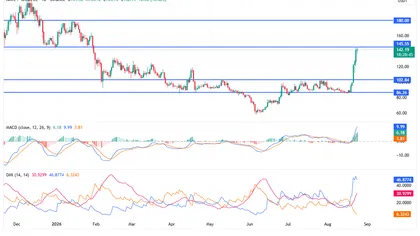
AAVE’s 11% rally meets $145.55 resistance – $180 breakout or rejection?
Gold retreats from mid-May highs; fails ahead of $4,700 as Fed risks support USD
Citadel: Compute Power Scarcity Remains the Biggest Bottleneck for AI, Hyperscale Cloud Providers May Emerge as Ultimate Winners
The latest analysis by Citadel Securities reveals the competitive logic of AI: what determines the winner is not model capability, but "already powered-on and readily available computing power." Grid access and approval cycles often span years, and the shortage of computing power cannot be resolved in the short term. The rise of AI agents further multiplies the computational demand for single tasks, causing demand to continually outpace supply. Whoever controls the underlying physical computing infrastructure will reap dual benefits—from cutting-edge models and low-cost execution layers alike. Ultra-large-scale cloud providers are likely the most certain winners in terms of risk-reward ratio in this arms race.
Major Rotation in US Stock Sectors: AI Tech Stocks Decline, Financials and Consumer Stocks Lead Gains
The strongest-performing stocks this year are experiencing sell-offs, while other sectors remain resilient, with increasingly obvious sector rotation.

Crypto prices
More


