
Foreign media: CRV tests $0.20 support after pullback

After a rapid surge, CRV retraced as its price previously approached the $0.29 to $0.30 resistance zone. Foreign media believe whether this correction will turn into a deeper pullback depends largely on whether the area around $0.20 to $0.21 can continue to hold.
Resistance Encountered After Price Surge
The article states that CRV had long fluctuated within the $0.20 to $0.29 range, and the recent upward movement pushed the price toward the top of this range, temporarily lifting the trend out of a consolidation at low levels. However, selling pressure reappeared near $0.29 to $0.30, leading to a subsequent retracement in price.
According to the indicators cited in the article, the cumulative trading volume delta strengthened during the rally, indicating a significant increase in buying. Meanwhile, the CMF remains near positive levels, showing that capital inflows have not fully reversed. This suggests the current pullback is more of a test of the previous breakout’s strength rather than a complete trend reversal.
$0.20 to $0.21 as the Key Area
The article suggests the $0.20 to $0.21 zone remains the most crucial demand area for now. If the price can stabilize here, CRV may have another opportunity to test higher resistance; if this level is lost, the sustainability of the recent rebound will be significantly weakened.
In terms of support and resistance, $0.25 is viewed as the first observation level for short-term correction, $0.27 is the level that needs to be reclaimed before price can resume its upward trend, and $0.29 to $0.30 remains the main resistance zone that capped the last rebound.
- $0.20 to $0.21: Main support zone
- $0.25: Short-term observation level for halting decline
- $0.27: First resistance during a rebound
Open Interest Surpasses $90 Million
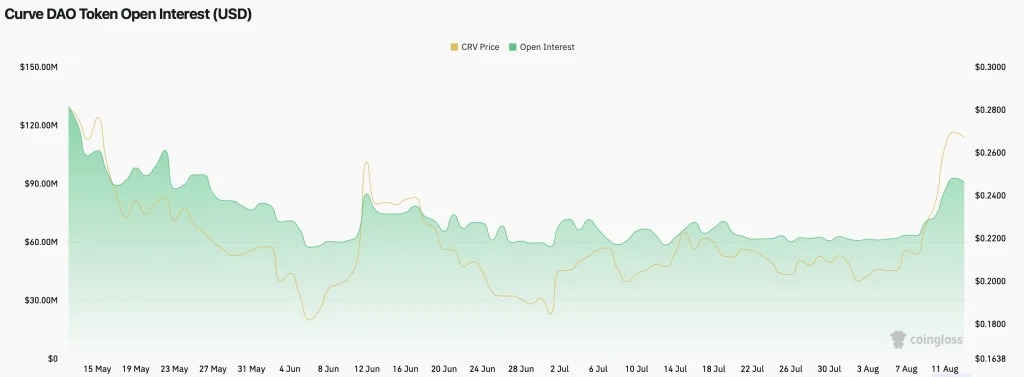
Besides spot price, derivatives positions are also seen as an important clue for future trends. The article notes that during the CRV rally, aggregate open interest rose from around $60 million to above $90 million, indicating new leveraged positions entering the market during the rebound phase.
Going forward, the change in open interest will influence how the market interprets this correction. If both price and open interest fall, it usually means some leveraged positions are closing and pressure from the pullback may ease; if open interest remains high as price drops, it indicates opposing positions are still building, and volatility could intensify.
The article suggests that if CRV reclaims the $0.27 level and further breaks through $0.30, the structure of the recent rebound will be reinforced; conversely, if it breaks below $0.20, sellers may regain short-term control.
Disclaimer: The content of this article solely reflects the author's opinion and does not represent the platform in any capacity. This article is not intended to serve as a reference for making investment decisions.
You may also like
Analyst Gu Jingci: Follow the trend and adapt flexibly
XRP Ledger adds account control feature, enabling enterprises to manage assets offline.

BUZZ - Goldman Sachs says the price cap on cancer drugs has limited impact on Indian hospitals
October 9 – Goldman Sachs pointed out that India's implementation of a 30% profit margin cap on non-scheduled anticancer drugs (link) will have limited impact on hospitals. The report states that, based on preliminary discussions with hospital chain groups, such drugs account for less than 5% of hospital revenue and 2% to 2.5% of operating profit. The report adds that hospitals can offset the losses by slightly adjusting service charges, such as administration fees. According to a government notice, an expert committee will finalize the list of drugs to be brought under regulation. Driven by the anticipated price cap, the share prices of Max Healthcare MAXE.NS, Apollo Hospitals APLH.NS, and Fortis Healthcare FOHE.NS rose by 1.6% to 2.5%. Previously, since September 30, these stocks had collectively declined by 11% to 11.5%. Year-to-date, FOHE and MAXE are down 11.7% and 14.8%, respectively, while APLH has risen by 11%. (To assist non-English speakers, Reuters provides automated translations of its reports into several other languages. Due to potential errors or missing context in automated translations, Reuters does not guarantee the accuracy of automatic translation texts and offers them solely for readers’ convenience. Reuters accepts no responsibility for any damage or loss caused by using these automated translation features.)
Adding insult to injury! Japanese electronics giant Nidec downgraded by UBS, stock price plunges over 9% and approaches an 11-month low
UBS has downgraded Nidec's rating from "Buy" to "Neutral" and lowered its target price from 2,800 yen to 2,400 yen, citing a more challenging market environment.
Crypto prices
More


