
web3: BSV rose 13% this week, with the price approaching the $15 resistance level

BSV performed strongly this week, with its price briefly rising to around $14.66, marking a cumulative increase of about 13% within the week. After months of pressure, the price has broken through the previous downward trend line, showing improved short-term performance. The market's focus has shifted to the resistance zone above $15.
Price breaks downward trend line
From the current movement, BSV has climbed above its short-term moving averages, with buying activity picking up compared to earlier periods. The report notes that this round of growth is first reflected in changes to chart structure, namely the price breaking through the downward trend line that had been continuously suppressing rebounds, strengthening the short-term momentum.
Currently, the 20-day exponential moving average is around $13.71, and the 50-day exponential moving average is around $13.48. These two levels are regarded as the main support areas below the current price, providing a buffer for short-term fluctuations.
$15.30 to $15.40 becomes a key range
The most immediate resistance is concentrated in the $15.30 to $15.40 area. This zone has previously served as resistance multiple times and is the first point of observation for whether the current upward movement can continue.
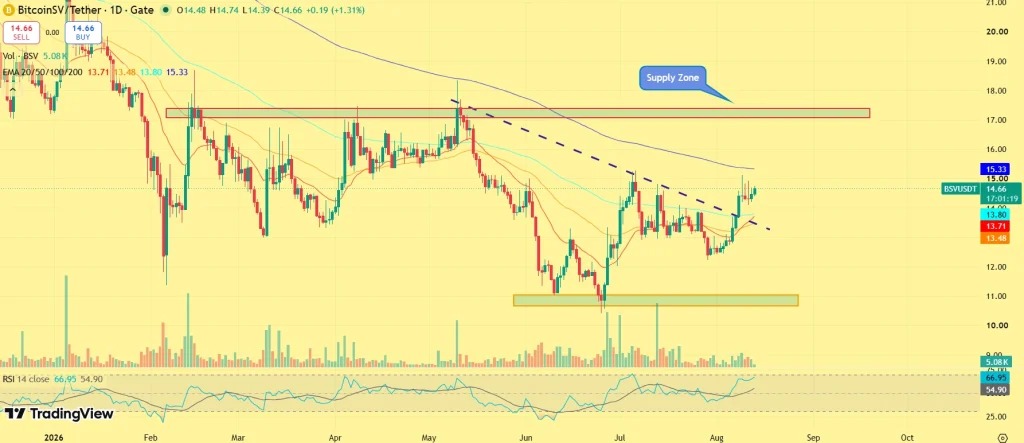
- Current price is around $14.66
- 20-day moving average is around $13.71
- 50-day moving average is around $13.48
If the price can hold above $15.40, the market's focus could shift upwards to the $17.50 to $18 area. Conversely, if resistance is encountered in this zone, the price may revisit the support area of $13.70 to $13.50.
Short-term momentum remains
The report also notes that BSV's daily Relative Strength Index (RSI) is about 67, indicating strong buying momentum, but it is also approaching the overbought range, suggesting that subsequent volatility may increase.
If the price completes a retest after breaking out and holds near $15.40, the short-term structure will improve further; if it falls back below the previously broken trend line, it would signal that this breakout may be difficult to sustain.
Disclaimer: The content of this article solely reflects the author's opinion and does not represent the platform in any capacity. This article is not intended to serve as a reference for making investment decisions.
You may also like
Morgan Stanley dampens Black Friday optimism: High base and weakening demand, soft-line retail may face a "promotion war"
Morgan Stanley warns that soft-line retail faces a high base and weakening demand during Black Friday, with concerns that increased promotions could intensify pressure; it holds a mildly negative outlook for the holiday season, but remains optimistic about Amer Sports, Tapestry, and urban outdoor apparel brands.

Entering the "trillion club"! South Korea's exports doubled year-on-year in the first 20 days of November, with chip exports surging by 294%.
Driven by the ongoing global artificial intelligence (AI) boom and rising demand for chips, South Korea's exports continued to increase in early November, with annual export value surpassing $1 trillion for the first time.

Bessent warns the Federal Reserve "not to over-tighten," traders lower rate hike bets, gold rebounds nearly 2% after its biggest weekly drop in eight months
As traders lower their bets on a near-term rate hike by the Federal Reserve, gold is rebounding from the largest weekly decline in eight months recorded last week.

Sell-off clouds emerging markets, erasing year-to-date gains; South Korean stocks fall 4%, Nasdaq futures rise 3%, gold rebounds 2%
The Korea Composite Stock Price Index fell 3.8% in early trading, with Samsung Electronics and SK Hynix down approximately 3% and 2%, respectively; the S&P/ASX 200 in Australia edged lower; Japanese markets are closed for a holiday. U.S. stock futures rebounded strongly. Nasdaq 100 futures rose 2.6%, S&P 500 futures increased 1.9%, and Dow Jones futures gained 0.9%. Gold rebounded 1.9%, climbing back to 3,600 USD.

Crypto prices
More


