
Foreign media: VIRTUAL faces resistance test after rising to $0.60

Foreign media analysis indicates that the Virtuals Protocol token VIRTUAL rose to around $0.60 on August 12, reaching the upper edge of the daily Bollinger Bands. The short-term trend is clearly strengthening, but from a longer-term perspective, the price has not yet reclaimed key long-term moving averages, so it remains to be seen whether the rebound can continue.
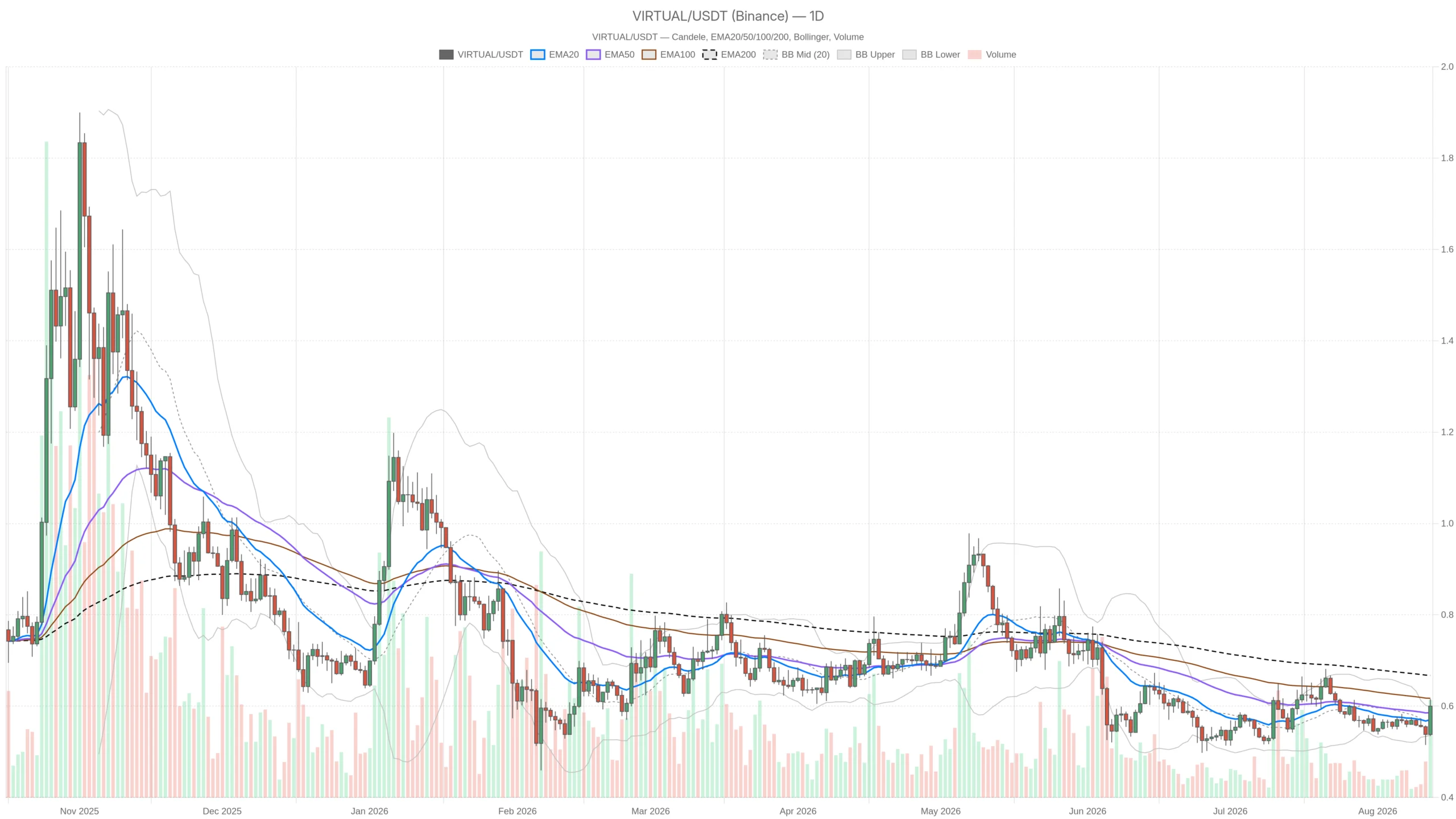
$0.63 becomes a key level
The article points out that VIRTUAL closed at $0.60 on the daily chart, above the 20-day and 50-day moving averages, which are around $0.57 and $0.59 respectively. However, the 200-day moving average is still above $0.67, meaning the medium- to long-term trend has not yet fully reversed.
The daily RSI is around 56, indicating that buying momentum prevails, though not yet strong enough to confirm a breakout. The MACD remains near the zero line, reflecting that higher time frame momentum is just starting to recover from weakness and has not yet provided a clearer signal of upward confirmation.
From a pivot point perspective, $0.58 is the current middle point, $0.63 is the first major resistance, while $0.55 is an important support below. The article believes that only if the daily chart decisively holds above $0.63 will it more clearly indicate that this rebound is evolving into a breakout.
Short-term momentum is strong but shows signs of overheating
On the 1-hour chart, VIRTUAL’s price has moved above the major short-term moving averages, showing a bullish short-term structure. Meanwhile, the 1-hour RSI has risen to around 70, entering the overbought zone, indicating this upward surge has already accumulated a significant increase.
The article suggests this does not necessarily mean the price will reverse immediately, but chasing the rally at the current level is riskier than a few hours ago. The 1-hour MACD remains positive, suggesting the short-term buying is not purely driven by noise but shows some persistence.
However, the even shorter 15-minute timeframe is starting to signal a slowdown. While the trend label is still bullish, the MACD momentum is flattening, indicating the upward pace is showing signs of cooling. This means the price is more likely to enter a period of consolidation next, rather than continue rising unilaterally.
Market sentiment still suppresses altcoin expansion
The article also mentions that the overall crypto market backdrop is not very optimistic. The Fear & Greed Index is at 27 in the "fear" range, and Bitcoin dominance remains around 56.19%, indicating that capital is still mostly concentrated in BTC and has not yet flowed on a large scale into altcoins.
On-chain trading activity is also mixed. Some DeFi trading platforms have seen a clear increase in fees over the past 7 days, showing a recovery in trading demand in certain areas; but other platforms have seen a significant drop in fees over the same period, indicating that risk appetite has not spread across the board.
The article believes that in this environment, tokens like VIRTUAL, even if they stage a rebound, are more likely to face tests near key resistance levels. If the price falls below $0.58, the market may retest the $0.57 to $0.55 area; if it holds above $0.63, there will be an opportunity to move closer to the $0.67 zone afterwards.
Disclaimer: The content of this article solely reflects the author's opinion and does not represent the platform in any capacity. This article is not intended to serve as a reference for making investment decisions.
You may also like
Analyst Gu Jingci: Follow the trend and adapt flexibly

XRP Ledger adds account control feature, enabling enterprises to manage assets offline.

BUZZ - Goldman Sachs says the price cap on cancer drugs has limited impact on Indian hospitals
October 9 – Goldman Sachs pointed out that India's implementation of a 30% profit margin cap on non-scheduled anticancer drugs (link) will have limited impact on hospitals. The report states that, based on preliminary discussions with hospital chain groups, such drugs account for less than 5% of hospital revenue and 2% to 2.5% of operating profit. The report adds that hospitals can offset the losses by slightly adjusting service charges, such as administration fees. According to a government notice, an expert committee will finalize the list of drugs to be brought under regulation. Driven by the anticipated price cap, the share prices of Max Healthcare MAXE.NS, Apollo Hospitals APLH.NS, and Fortis Healthcare FOHE.NS rose by 1.6% to 2.5%. Previously, since September 30, these stocks had collectively declined by 11% to 11.5%. Year-to-date, FOHE and MAXE are down 11.7% and 14.8%, respectively, while APLH has risen by 11%. (To assist non-English speakers, Reuters provides automated translations of its reports into several other languages. Due to potential errors or missing context in automated translations, Reuters does not guarantee the accuracy of automatic translation texts and offers them solely for readers’ convenience. Reuters accepts no responsibility for any damage or loss caused by using these automated translation features.)

Adding insult to injury! Japanese electronics giant Nidec downgraded by UBS, stock price plunges over 9% and approaches an 11-month low
UBS has downgraded Nidec's rating from "Buy" to "Neutral" and lowered its target price from 2,800 yen to 2,400 yen, citing a more challenging market environment.
Crypto prices
More


