
WEMIX Contract Ownership Compromised, 5.22M Tokens Illegally Minted

WEMIX has disclosed that its contract ownership was compromised and that more than 5.22 million tokens were illegally minted, an incident the project describes as a security issue now under active investigation.
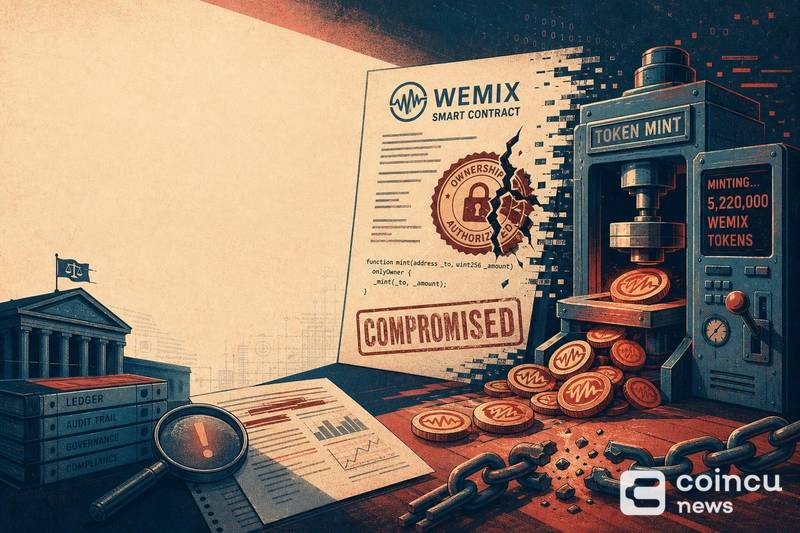
The disclosure appears on the project’s official channel, where WEMIX said it is investigating a security incident involving compromised contract control and unauthorized minting. The scale reported by WEMIX is more than 5.22 million tokens created through the illegal mint.
The event is centered on two linked failures: loss of control over contract ownership and the subsequent minting of tokens that were not authorized. Further technical details about how the ownership was compromised have not been published on the WEMIX news page at the time of writing.
Why the Reported Mint Size Matters to Holders
The most concrete figure available is the more than 5.22 million tokens WEMIX says were minted. That quantity is the main quantitative detail in the project’s disclosure, and it frames the potential supply impact holders will watch.
An illegal mint of that size raises the risk of new supply entering the market, which can weigh on price if the tokens are moved or sold. No confirmed market metrics, including price, market capitalization, or volume, are attached to this incident in the available research, so any effect on the token’s valuation remains unquantified here.
WEMIX has drawn scrutiny before. Its market standing was already tested when the delisting decision hit Wemade’s stock and the token’s value, and investors such as Alpha Asset Management reported losses tied to the WEMIX delisting. Confidence questions are not new for this ecosystem.
WEMIX Response and Containment Priorities
WEMIX has framed the disclosure as an ongoing investigation rather than a resolved case, based on its post titled regarding the WEMIX security issue and ongoing investigation. The project has not, in the available material, published a completed remediation summary.
For a contract-control incident, the priorities readers will look for are containment steps, monitoring of the affected wallet or contract addresses, and official updates confirming whether minting authority has been secured. Those details are not yet present in the disclosed evidence.
The GameFi Security Angle
WEMIX is closely associated with blockchain gaming, which makes contract control and token integrity central to trust in its ecosystem operations. When smart contract ownership can be taken over, the risk extends to treasury and token supply integrity across the projects that rely on it.
Compromised minting authority is a recurring security theme for onchain gaming platforms, where token economies depend on predictable, controlled supply. The WEMIX case fits that pattern of smart contract control risk rather than a market-driven event.
FAQ About the WEMIX Security Incident
How many WEMIX tokens were minted illegally? WEMIX reports more than 5.22 million tokens were created through the unauthorized mint.
Was contract ownership compromised? Yes, according to WEMIX’s disclosure, contract ownership was compromised, enabling the illegal minting.
What has WEMIX said so far? WEMIX has published a notice describing the security issue and stating that an investigation is ongoing.
What remains unconfirmed? The attack mechanics, the current status of containment, and any market impact are not detailed in the available disclosures.
Disclaimer: The content of this article solely reflects the author's opinion and does not represent the platform in any capacity. This article is not intended to serve as a reference for making investment decisions.
You may also like
Anthropic commits to about $900 billion in computing power expenditure; bond market expects its bonds to be junk-rated
Despite Anthropic raising over $100 billion in its public offering and reaching a market capitalization of $1.18 trillion, the company is widely expected by the debt market to be rated as BB-level "junk bonds" due to its lack of profitability and approximately $900 billion in massive computing power expenditure commitments. Amid pressure on tech giants in the debt market and chip companies planning to reduce loan guarantees, Anthropic will still need to rely on structured financing in the short term, facing about a three-year window to strive for an investment-grade rating.
JPMorgan Trading Desk Abandons Tactical Bullish Stance on S&P 500: Rebound May Occur, Bottom Not Yet Reached
J.P. Morgan's trading division has shifted from a tactical bullish stance to a cautious one, expecting stock market volatility in the coming weeks, but emphasizes that market fundamentals—from the economy to earnings—remain solid.

AI sell-off brings a "fat pitch"? Hedge funds "give up" and clear positions, Morgan Stanley loudly calls to buy
Hedge funds have shifted to a net bearish stance on momentum stocks, abandoning bets for the first time since April 2025 that recently outperforming stocks will continue to rise.

South Korea's 10 trillion rescue plan: why is it not working anymore?
The 10.76 trillion won stabilization fund has become comparatively insignificant against the current scale of the stock market. The National Pension Fund lacks further capacity to increase its holdings, and regulators are hesitant to restrict short selling. Meanwhile, semiconductor sell-offs triggered by the global retreat from AI trading continue to impact the Korean market, and the government's available tools for market rescue struggle to counter the outflow of international capital.

Crypto prices
More


