Bitget App
Trade smarter
Buy cryptoMarketsTradeFuturesStocksEarnInstitutionAI & more
Why Robinhood Chain’s memecoin boom has 63% of traders losing money

Why Robinhood Chain’s memecoin boom has 63% of traders losing money

AMBCryptoAMBCrypto2026/07/20 13:48
By:AMBCrypto

Robinhood Chain’s memecoin boom is creating plenty of activity. Despite that boom, there are fewer winners than many investors expect. Beneath the trading frenzy, profits remain concentrated, while losses spread across most participants.

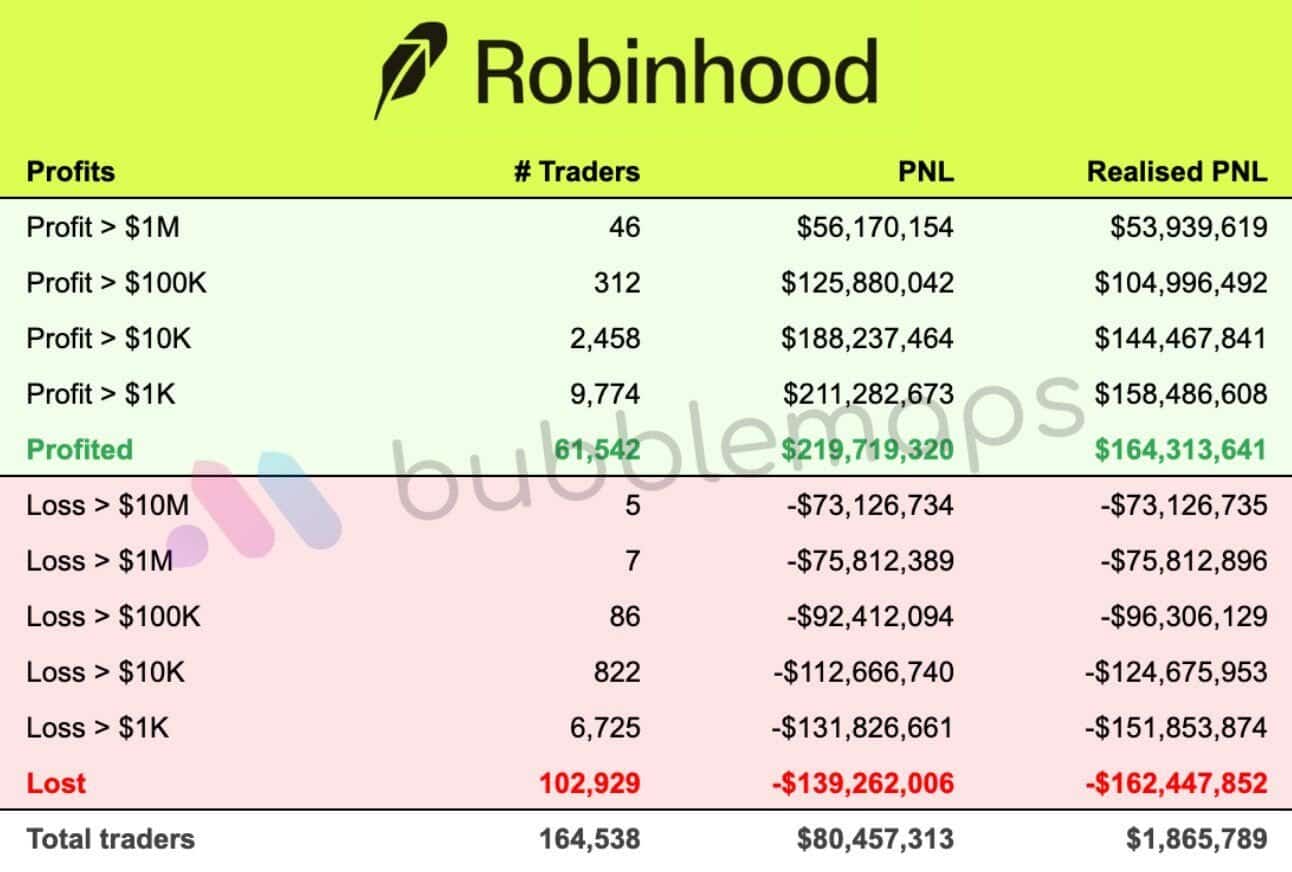
Of the 164,538 wallets tracked, 102,929 remain unprofitable, leaving 63% of traders at a loss. Meanwhile, just 61,542 wallets remain profitable, highlighting the market’s uneven reward structure. As a result, only 46 traders made more than $1 million, whereas five lost over $10 million.
Why Robinhood Chain’s memecoin boom has 63% of traders losing money image 0 Source: X

Consequently, profitable traders realized $164.3 million in gains, while losing traders realized $162.4 million in losses. That left only $1.87 million in net realized profit despite significant trading activity.

@media only screen and (min-width: 0px) and (min-height: 0px) { div[id^="bsa-zone_1774359638628-7_123456"] { min-height: 50px; transition: min-height 0.3s ease; } } @media only screen and (min-width: 640px) and (min-height: 0px) { div[id^="bsa-zone_1774359638628-7_123456"] { min-height: 90px; } }
AD

This imbalance suggests a small group continues capturing most returns as the majority provides exit liquidity.

Unless profitability spreads beyond a handful of traders, speculative enthusiasm could fade, weakening participation across Robinhood Chain’s memecoin market.

How narratives drive prices

That imbalance becomes even more apparent when external events suddenly reshape investor sentiment. The DADDY token demonstrated the fragility of narrative-driven tokens under headline risk conditions.

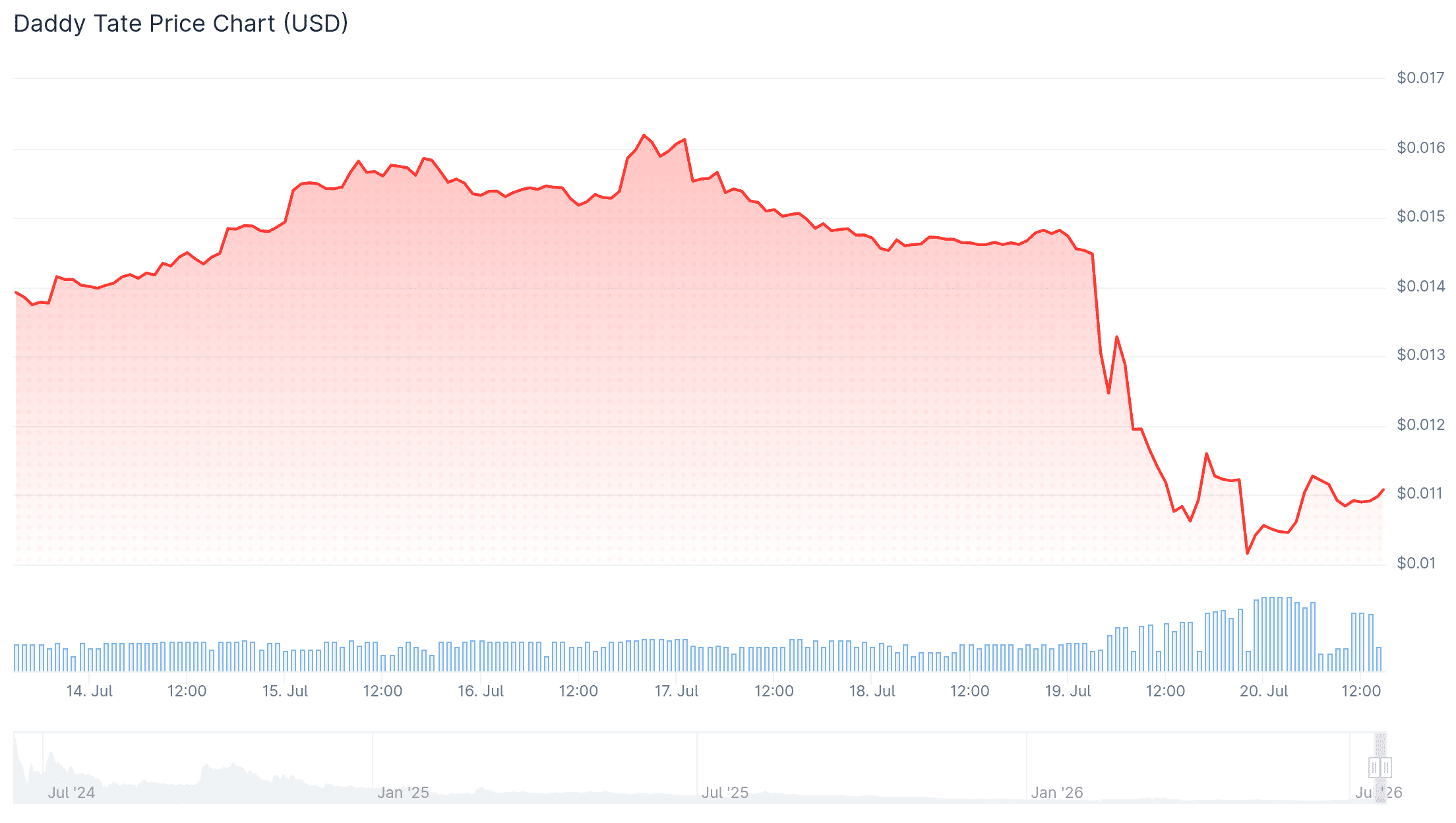
Reports linking Andrew Tate to renewed legal proceedings triggered immediate selling pressure after the token traded near $0.0145 and briefly tested $0.016. However, sentiment reversed sharply as DADDY declined by more than 20%, sliding toward $0.010.
Why Robinhood Chain’s memecoin boom has 63% of traders losing money image 1 Source: CoinGecko

The sharp increase in selling volume as the price declined indicated a loss of liquidity. After the token stabilized slightly to trade for approximately $0.011, buyers were unable to regain control of the price.

More importantly, DADDY remains down more than 95% from its peak, indicating that confidence in the token will take longer to recover.

This reaction reinforces how memecoin valuations often depend more on narrative than fundamentals. Consequently, headlines continue to generate volatility and influence short-term price discovery and liquidity flow through the entire sector.

As attention shifts, resilient memecoins increasingly outperform short-lived rallies. For instance, Pepe [PEPE] demonstrates resilient holder retention, active addresses, and whale accumulation.

Similarly, Dogecoin [DOGE] is supported by a large base of users who provide significant levels of liquidity. Meanwhile, Shiba Inu [SHIB] leverages Shibarium activity and whale inflows to stabilize demand.

Together, these strengths suggest future memecoin cycles will reward utility, community loyalty, and liquidity depth over temporary viral narratives and hype.

Final Summary

  • Robinhood Chain’s memecoin market remains concentrated, with most traders still unprofitable.
  • PEPE, DOGE, and SHIB show resilience now outweighing hype in memecoin cycles.

0
0

Disclaimer: The content of this article solely reflects the author's opinion and does not represent the platform in any capacity. This article is not intended to serve as a reference for making investment decisions.

Understand the market, then trade.
Bitget offers one-stop trading for cryptocurrencies, stocks, and gold.
Trade now!

You may also like

Anthropic commits to about $900 billion in computing power expenditure; bond market expects its bonds to be junk-rated

Despite Anthropic raising over $100 billion in its public offering and reaching a market capitalization of $1.18 trillion, the company is widely expected by the debt market to be rated as BB-level "junk bonds" due to its lack of profitability and approximately $900 billion in massive computing power expenditure commitments. Amid pressure on tech giants in the debt market and chip companies planning to reduce loan guarantees, Anthropic will still need to rely on structured financing in the short term, facing about a three-year window to strive for an investment-grade rating.

华尔街见闻•2026/11/23 13:51

JPMorgan Trading Desk Abandons Tactical Bullish Stance on S&P 500: Rebound May Occur, Bottom Not Yet Reached

J.P. Morgan's trading division has shifted from a tactical bullish stance to a cautious one, expecting stock market volatility in the coming weeks, but emphasizes that market fundamentals—from the economy to earnings—remain solid.

智通财经•2026/11/23 13:06
JPMorgan Trading Desk Abandons Tactical Bullish Stance on S&P 500: Rebound May Occur, Bottom Not Yet Reached

AI sell-off brings a "fat pitch"? Hedge funds "give up" and clear positions, Morgan Stanley loudly calls to buy

Hedge funds have shifted to a net bearish stance on momentum stocks, abandoning bets for the first time since April 2025 that recently outperforming stocks will continue to rise.

智通财经•2026/11/23 11:32
AI sell-off brings a "fat pitch"? Hedge funds "give up" and clear positions, Morgan Stanley loudly calls to buy

South Korea's 10 trillion rescue plan: why is it not working anymore?

The 10.76 trillion won stabilization fund has become comparatively insignificant against the current scale of the stock market. The National Pension Fund lacks further capacity to increase its holdings, and regulators are hesitant to restrict short selling. Meanwhile, semiconductor sell-offs triggered by the global retreat from AI trading continue to impact the Korean market, and the government's available tools for market rescue struggle to counter the outflow of international capital.

华尔街见闻•2026/11/23 07:46
South Korea's 10 trillion rescue plan: why is it not working anymore?

