Bitget App
Trade smarter
Buy cryptoMarketsTradeFuturesStocksEarnInstitutionAI & More
Decoding 2026 altcoin cycle: Is capital rotating away from high-caps?

Decoding 2026 altcoin cycle: Is capital rotating away from high-caps?

AMBCryptoAMBCrypto2026/07/08 20:03
By:AMBCrypto

Capital rotation shows no clear signs of leading into a broader altcoin cycle.

However, this cycle looks different. On-chain data shows that altcoins are seeing their worst underperformance against Bitcoin [BTC] on record. This suggests that liquidity is not spreading across the altcoin market but instead rotating into a few high-conviction sectors while most assets continue to lag BTC.

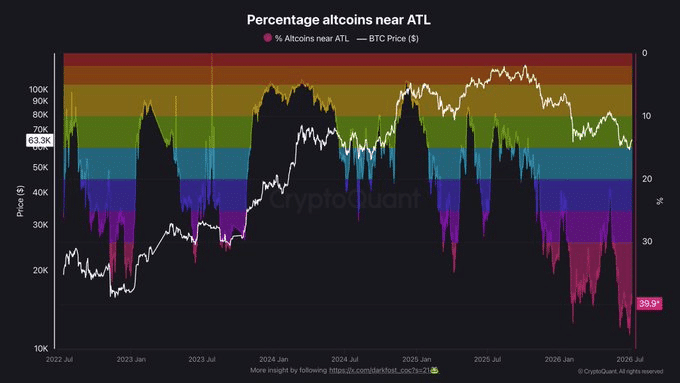
To put this into perspective, the total altcoin market cap currently sits around $870 billion, up 4% so far in Q3. However, a recent CryptoQuant report shows that 40% of altcoins are still trading below their all-time highs, showing that many assets have failed to recover even as some parts of the market continue to rally.
@media only screen and (min-width: 0px) and (min-height: 0px) { div[id^="bsa-zone_1774359638628-7_123456"] { min-height: 50px; transition: min-height 0.3s ease; } } @media only screen and (min-width: 640px) and (min-height: 0px) { div[id^="bsa-zone_1774359638628-7_123456"] { min-height: 90px; } }
AD

Decoding 2026 altcoin cycle: Is capital rotating away from high-caps? image 0 Source: CryptoQuant

Looking at it from a different angle, 60% of altcoins are still holding above their previous highs, suggesting that strength remains in specific sectors and assets rather than across the broader altcoin market. 

From a technical perspective, Ethereum [ETH] dominance has started Q3 on a strong note, rising over 4%, while Bitcoin dominance has increased by only 0.7%. As the largest altcoin, ETH’s stronger capital inflows compared to BTC suggest that investors are beginning to rotate into altcoins.

Historically, a rising ETH/BTC ratio during a volatile market is often viewed as an early signal of an altcoin cycle starting to take shape. However, altcoins are still seeing their biggest underperformance against Bitcoin on record, raising the question: Is this cycle different, with liquidity flowing into only a few major assets and ETH struggling to trigger a broader altcoin cycle?

Why sector-based altcoin rallies could leave high-caps behind 

Analysts are flagging warning signs across the market.

This follows the recent CryptoQuant report, where analysts urged investors to be more “selective” as altcoins face their strongest underperformance against Bitcoin on record. Going forward, the key question is whether investors regain the risk appetite to move back into altcoins, especially high-cap assets.

From a technical perspective, major high-cap assets are still trading well below their all-time highs. Ethereum, for example, remains down over 60%, while Solana is down more than 70%, showing that even leading altcoins have yet to fully recover. Meanwhile, TVL on Robinhood Chain has jumped over 150% in the past 24 hours to a record $108 million.
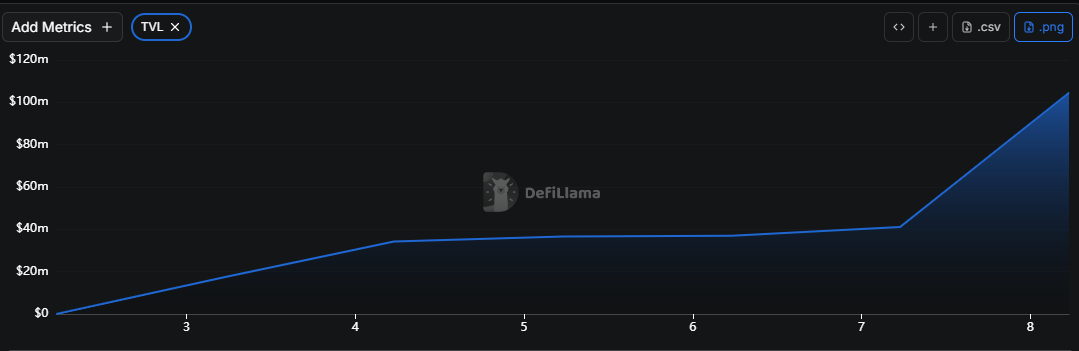
Decoding 2026 altcoin cycle: Is capital rotating away from high-caps? image 1 Source: DeFiLlama

By comparison, TVL across many major high-cap ecosystems remains near multi-month lows, showing where liquidity is actually flowing. More importantly, these inflows have come alongside ROBIN’s 30%+ rally so far in Q3, reinforcing the view that investors are rotating into high-conviction narratives.

That naturally puts Ethereum’s recent strength in focus.

While ETH has shown relative strength against Bitcoin, its on-chain fundamentals remain soft, suggesting the move may be more technical than structural. If capital continues flowing into selective altcoin narratives, pressure on major high-cap altcoins could keep building through the rest of H2.

Final Summary

  • Capital is flowing selectively, while many high-cap altcoins continue to lag behind.
  • Ethereum is showing technical strength, but high-caps could still face pressure if liquidity remains selective.
0
0

Disclaimer: The content of this article solely reflects the author's opinion and does not represent the platform in any capacity. This article is not intended to serve as a reference for making investment decisions.

Understand the market, then trade.
Bitget offers one-stop trading for cryptocurrencies, stocks, and gold.
Trade now!

You may also like

How much CPO demand will Nvidia Rubin Ultra generate? Bernstein: Optical value per Pod will increase fivefold

Bernstein believes that the co-packaged optics (CPO) and fiber demand driven by Nvidia's Rubin Ultra architecture will surge significantly, with the optical content per Pod rising from $1 million to $5.4 million. This will propel the size of Nvidia's optical ecosystem market to $46.8 billion by 2028 (a 91% annual increase). Although the industry faces supply bottlenecks with InP substrates, the outlook remains positive. The institution reiterates its “outperform” rating for Lumentum, Coherent, and Ciena.

华尔街见闻•2026/11/11 08:47
How much CPO demand will Nvidia Rubin Ultra generate? Bernstein: Optical value per Pod will increase fivefold

UBS Q3 implements a two-way strategy with gold options, heavily invests in technology stocks, and builds positions in SK Hynix (SKHY.US)

UBS Group (UBS.US) has submitted its Q3 holdings report (13F) as of September 30, 2026.

智通财经•2026/11/11 08:22
UBS Q3 implements a two-way strategy with gold options, heavily invests in technology stocks, and builds positions in SK Hynix (SKHY.US)

SpaceX (SPCX.US) reportedly attempts “de-Nvidiaization” at the rack level: developing Kessel cabinets to bypass L6 compute boards, purchasing only chips

SemiAnalysis: SpaceX has developed its own Kessel cabinet, bypassing Nvidia's L6 cards to provide more options for manufacturing its own hardware.

智通财经•2026/11/11 08:20
SpaceX (SPCX.US) reportedly attempts “de-Nvidiaization” at the rack level: developing Kessel cabinets to bypass L6 compute boards, purchasing only chips

$3.7 billion “data center power equipment prepayments” abandoned! What did "the most active buyer of gas turbines", SoftBank, see?

In the second quarter of fiscal year 2026, SoftBank reported a net loss of $7.1 billion, primarily due to a $3.7 billion impairment charge from a $9.5 billion advance payment for power generation equipment for US data centers—of which about $2.9 billion was non-refundable and effectively lost. The CFO admitted that SoftBank placed orders before the project plan was finalized, and is now conducting a comprehensive review of its procurement strategy. "The most aggressive purchaser of gas turbines has now written off the deposit in this way."

华尔街见闻•2026/11/11 08:19