
Base to activate B20 standard for stablecoins, RWAs and other tokens

Coinbase-backed Ethereum layer-2 network Base is set to activate its B20 token standard on mainnet, introducing a native framework for stablecoins, tokenized real-world assets (RWAs) and other fungible tokens.
According to Base documentation, B20 is scheduled to go live at 6 pm UTC on the mainnet, enabling developers to begin creating tokens under the new standard.
The activation will enable developers to use Base's native token standard to create stablecoins, RWAs, tokenized equities and other fungible tokens without requiring them to build and audit custom ERC-20 contracts.
The standard supports two variants: asset and stablecoin. The asset variant has configurable decimals between six and 18, while the stablecoin variant has fixed six-decimal formatting and requires issuers to specify a fiat currency denomination, such as the US dollar or euro.
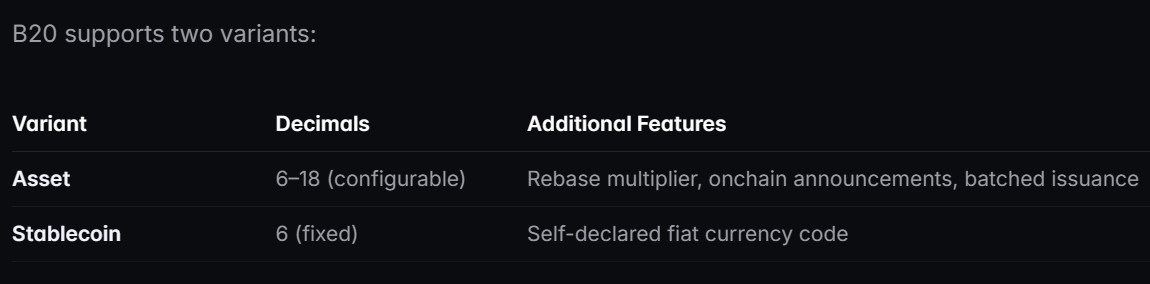
B20 supports two variants. Source: Base
B20 was introduced as part of the network’s Beryl upgrade, which went live on June 26. The upgrade shortened withdrawal waiting periods from seven days to five days and added technical changes aimed at improving network performance.
Base said B20 tokens are compatible with standard ERC-20 tokens but come with built-in issuer controls. Those features include supply limits, transfer rules, minting, burning, pausing and transaction notes.
B20 activation follows Base outages
The B20 activation follows back-to-back outages linked to its sequencer infrastructure.
On June 25, Base encountered an outage caused by a consensus issue. At the time, the network said an invalid block had been sequenced, preventing new blocks from being created. Base resumed block production on the same day, after a nearly two-hour halt.
Related: Coinbase restores trading after AWS outage disrupts markets
In a post-mortem, Base said that a sequencer bug caused back-to-back outages on June 25 and June 26. The first incident lasted for about 116 minutes, while a second outage lasted about 20 minutes after a race condition prevented sequencers from catching up after a system reset.
The initial outage occurred hours before the scheduled Beryl upgrade, which was delayed by one day due to a separate B20 activation registry timing issue.
Magazine: Has Bitcoin bottomed for this cycle? Analysts say 'not yet'
Disclaimer: The content of this article solely reflects the author's opinion and does not represent the platform in any capacity. This article is not intended to serve as a reference for making investment decisions.
You may also like
Rare "Three Firsts"! State Council's Major Moves to Stabilize the Market, How Do Institutions View It?
The State Council executive meeting has featured three "firsts": for the first time, the release time was advanced to trading hours; for the first time, the phrases "the capital market is crucial to the overall economic development" and "national team" were explicitly mentioned in the official statement. Analysts such as Tao Chuan from Guolian Minsheng and Wang Han from Industrial Securities believe that the market stabilization mechanism is evolving from short-term support to an institutionalized, diversified, and coordinated upgrade, with policy focus shifting to optimizing Huijin’s functions, introducing long-term funds into the market, and promoting dividends and share buybacks. Chen Guo from East Money regards this State Council meeting as an “important policy bottom.” CITIC Securities expects the market may see an oversold rebound in the short term. Going forward, key areas of attention will be Huijin’s actions and the implementation of fundamental policies.

U.S. Senate Democratic leader election to be voted on December 1, impacting AI regulation and tariff agenda
The election for the Democratic leader in the U.S. Senate will be held by secret ballot on December 1, and the winner must reach the threshold of 28 votes.

From Earning 20% Annually to Going Negative in a Single Month, Wall Street’s Favorite Arbitrage Trade “Fails”
After rising for six consecutive months, the Bloomberg FX Carry Index turned negative for the first time in November, falling by 0.9%. Cooling enthusiasm for AI has increased market volatility, and Brazil’s election led to an 8% single-day plunge in the real, nearly wiping out the carry trade's 18% annual return overnight. Industry giants such as Goldman Sachs and Citigroup have issued warnings: “The era of mindless long positions is over.” Although capital has not withdrawn, trading thresholds have surged, requiring defensive hedging and a shift toward selective strategies.

The global tobacco landscape is about to change! Marlboro's parent company Altria (MO.US) plans an all-cash takeover of Imperial Brands UK, targeting cigarette cash flow.
What Altria values is the overseas cigarette cash flow and the established distribution network. Since spinning off Philip Morris International in 2008, its cigarette business has been focused on the United States. Altria estimates that after adjusting for channel inventory changes, the U.S. cigarette industry’s sales volume declined by about 5% year-over-year in the third quarter. Acquiring Imperial Brands’ international business would allow Altria to instantly gain brands, retail channels, and operational scale in markets such as Europe, thereby reducing its dependence on the single U.S. market.

Crypto prices
More


