
Bitget App
Trade smarter
Buy cryptoMarketsTradeFuturesStocksEarnInstitutionAI & More
281 Billion Shiba Inu (SHIB) Recorded in 24 Hours: Breaking Down the Implications

281 Billion Shiba Inu (SHIB) Recorded in 24 Hours: Breaking Down the Implications

CryptoNewsNetCryptoNewsNet2026/06/27 06:21
By:CryptoNewsNet
Back to the list

281 Billion Shiba Inu (SHIB) Recorded in 24 Hours: Breaking Down the Implications

281 Billion Shiba Inu (SHIB) Recorded in 24 Hours: Breaking Down the Implications image 0  u.today  + 1 more 5 m
281 Billion Shiba Inu (SHIB) Recorded in 24 Hours: Breaking Down the Implications image 1

According to on-chain data, Shiba Inu experienced one of its biggest exchange outflow events recently, with a net exchange flow of about -281 billion $SHIB over the previous day. As $SHIB continues to struggle with a persistent bearish trend and waning market sentiment, traders have taken notice of the movement. When more tokens depart from exchanges than enter them, there is a negative exchange netflow.

Theoretically, this is frequently seen as a positive signal since assets moved off exchanges are typically harder to sell right away. To lessen short-term selling pressure, investors regularly transfer tokens into private wallets for long-term holding, staking, or self-custody. Context, however, matters. The price of $SHIB has been declining despite the substantial withdrawal. The token is still well below all major moving averages after breaking out of a minor consolidation pattern recently.
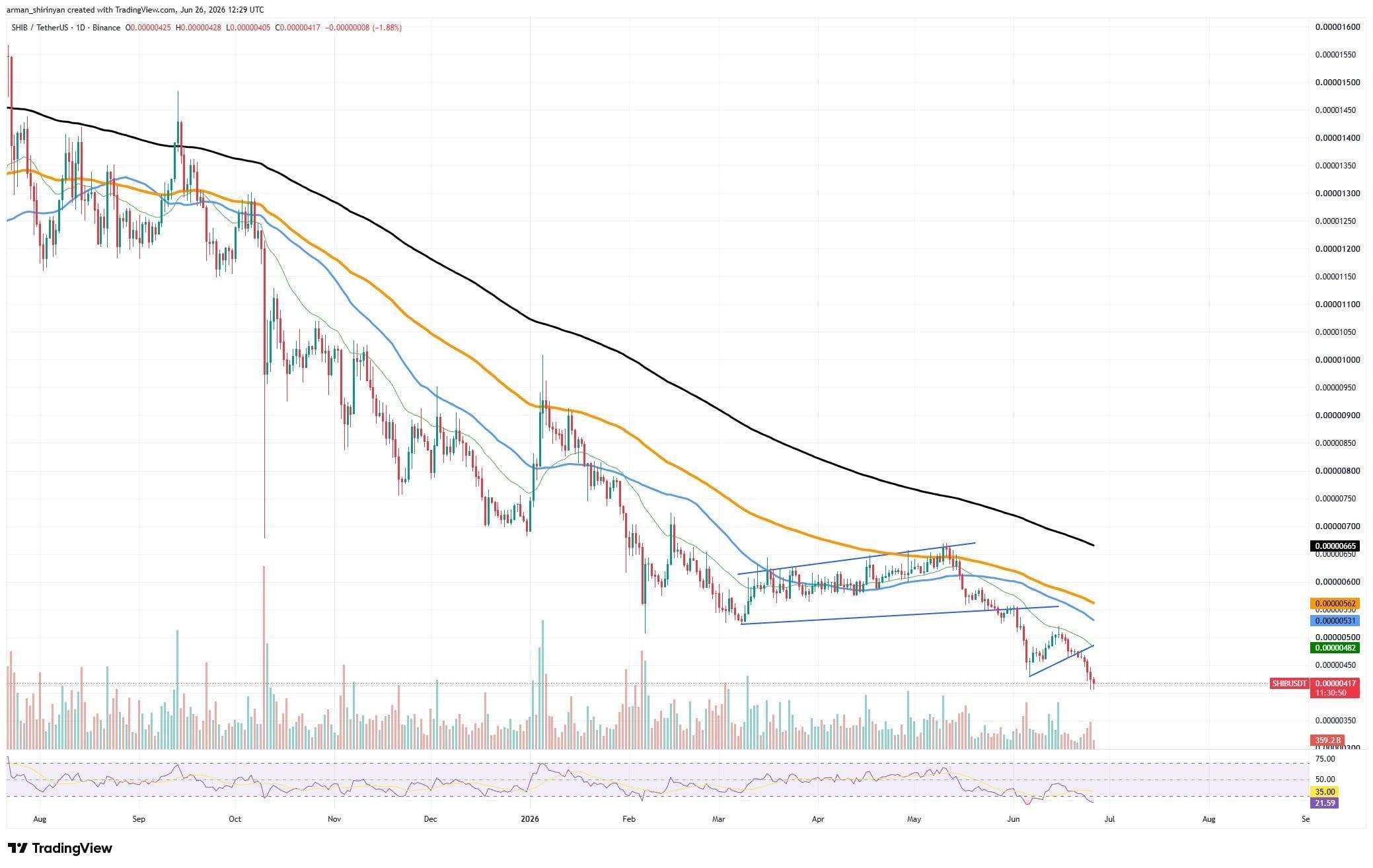
281 Billion Shiba Inu (SHIB) Recorded in 24 Hours: Breaking Down the Implications image 2 $SHIB/USDT Chart by TradingView

A sequence of lower highs and lower lows is still visible in the larger technical structure, suggesting that sellers are still in charge of the market. The gap between price action and exchange flows indicates that the outflow is insufficient on its own to buck the current trend. Although fewer tokens on exchanges may eventually improve supply dynamics, market players seem to be more concerned with weak momentum and dwindling speculative interest at the moment. It is interesting to note that other on-chain metrics present a somewhat contradictory picture.

Netflows decline

Over the previous 24 hours, there have been slight increases in the number of transactions, active addresses, and active sending addresses. This shows that despite the price decline, network activity has not entirely vanished. Rising network usage during a protracted decline can frequently indicate that an asset is about to enter an accumulation phase, though verifying this requires consistent improvement over a longer time frame.

The market still has access to a sizable amount of potential liquidity because exchange reserves are still high at more than 80 trillion $SHIB. Even if a single day's outflows are measured in hundreds of billions of tokens, the overall supply landscape is not significantly changed. The most important lesson for investors is that the -281 billion $SHIB netflow should not be viewed in a vacuum.

Although the metric is somewhat bullish in terms of supply, it is currently overshadowed by weak market structure and bearish price action. Exchange outflows by themselves are unlikely to signal an asset's final bottom until $SHIB can recover significant resistance levels and establish a higher-low pattern.

Similar news (1)
Add similar news

0
0

Disclaimer: The content of this article solely reflects the author's opinion and does not represent the platform in any capacity. This article is not intended to serve as a reference for making investment decisions.

Understand the market, then trade.
Bitget offers one-stop trading for cryptocurrencies, stocks, and gold.
Trade now!

You may also like

Midterm elections expose market vulnerability! AI trading faces rigorous scrutiny, U.S. stock earnings expectations may undergo major adjustments

The results of the US midterm elections and the subsequent market crash have exposed the vulnerability caused by the market’s excessive concentration of bets on artificial intelligence (AI). Investors may need to readjust their expectations for investment returns.

智通财经•2026/11/09 10:59
Midterm elections expose market vulnerability! AI trading faces rigorous scrutiny, U.S. stock earnings expectations may undergo major adjustments

SpaceX unlock wave meets index rebalancing! Goldman Sachs estimates: December rebalancing may bring $10.9 billion in passive buying

The proportion of SpaceX's freely tradable shares has increased from about 5% at the time of its IPO to one-third, and the expansion of index weightings is driving passive funds to increase their holdings. According to Goldman Sachs, the rebalancing of the Russell 1000 Growth Index on December 11 may trigger $10.9 billion in buy orders, with the main counterparts being insiders whose shares are unlocked. The S&P 500 inclusion window points to the second half of 2027, when the competition among passive funds will further intensify.

华尔街见闻•2026/11/09 10:46

Citigroup Q3 Holdings: Nvidia (NVDA.US) Remains Top Heavy Position, Expanded Both Index and Tech Stock Options

According to the disclosure by the U.S. Securities and Exchange Commission (SEC), Citigroup (C.US) submitted its third quarter holdings report (13F) as of September 30, 2026, on November 4, 2026.

智通财经•2026/11/09 09:18
Citigroup Q3 Holdings: Nvidia (NVDA.US) Remains Top Heavy Position, Expanded Both Index and Tech Stock Options

Carlyle still favors the healthcare sector in Q3, with Medline (MDLN.US) and StandardAero (SARO.US) accounting for over 98% of holdings

Carlyle (CG.US) has submitted its third-quarter holdings report (13F) for the period ending September 30, 2026.

智通财经•2026/11/09 09:17
Carlyle still favors the healthcare sector in Q3, with Medline (MDLN.US) and StandardAero (SARO.US) accounting for over 98% of holdings