
Taiko Bridge attack may have caused up to $1.7 million in losses

Taiko Bridge may have suffered an attack that caused up to $1.7 million in losses, but the evidence package available for this draft does not establish the exploit path, the affected wallets, or whether the reported damage was fully realized.
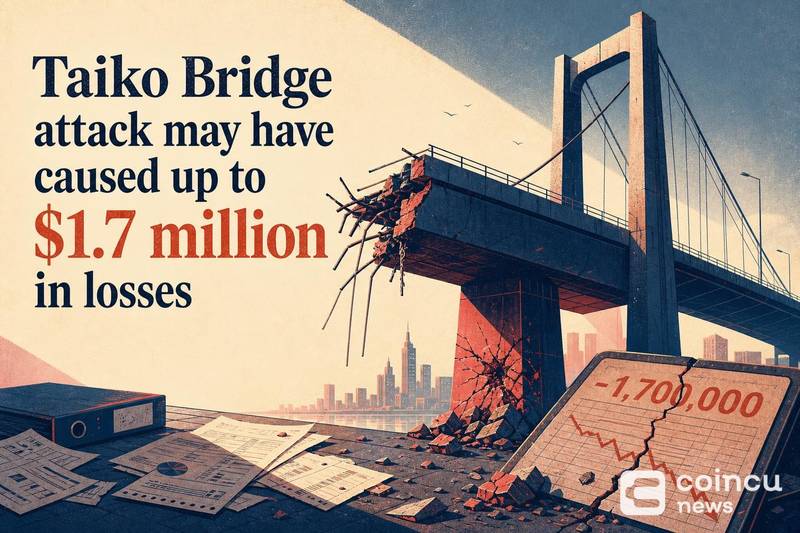
Only a narrow set of public signals is preserved in the brief
The brief identifies Taiko’s official X post as the primary source tied to the incident, and the current framing around that post keeps the event conditional rather than settled. In practice, that means the story can support the possibility of a bridge-related security issue and a reported loss ceiling, but not a verified explanation of how funds moved.
The clearest operational response preserved in the research set is KuCoin’s notice that it temporarily suspended Taiko deposits on the Ethereum network. That exchange action does not prove the bridge exploit path on its own, but it does show that the incident prompted at least one concrete service change outside Taiko’s own communication channel.
What the current record still does not prove
No block explorer entry, contract-level incident report, or reimbursement plan is preserved alongside Taiko’s incident-linked post. Because those records are missing from the brief, this article does not assign the reported losses to users, treasury funds, liquidity providers, or any named address cluster.
The source bundle also includes embed endpoints for posts linked to WuBlockchain and PeckShield, which shows that the incident had already drawn outside attention when the brief was assembled. Without readable quoted text or on-chain evidence attached to those entries, however, their value here is limited to showing that third-party monitoring existed while firmer confirmation was still absent; readers watching for that next layer of documentation can compare Coincu’s Taiko coverage, KuCoin coverage, and bridge attack reporting as more primary records appear.
FAQ about the Taiko Bridge attack
Are the losses confirmed?
Not yet. The available source set still frames the damage as up to $1.7 million, which is a ceiling rather than a finalized forensic total.
What is the clearest confirmed impact so far?
The clearest confirmed impact in the brief is KuCoin’s temporary suspension of Taiko deposits on Ethereum. That is a documented service-level response, even though it still does not identify the exact failure point inside the bridge flow.
What should users watch next?
The next meaningful confirmation would be a technical update tied to Taiko’s official incident post or a matching on-chain record that traces the loss path. Until one of those appears, the evidence supports a cautious incident report rather than a full reconstruction of the attack.

No tags available.

Other Posts









Disclaimer: The content of this article solely reflects the author's opinion and does not represent the platform in any capacity. This article is not intended to serve as a reference for making investment decisions.
You may also like
NEWMARK GROUP INC <NMRK.O>: KBW CUTS TARGET PRICE TO $16 FROM $17.50
NEWMARK GROUP INC : KBW CUTS TARGET PRICE TO $16 FROM $17.50
VALERO ENERGY CORP <VLO.N>: JEFFERIES CUTS TARGET PRICE TO $394 FROM $401
VALERO ENERGY CORP : JEFFERIES CUTS TARGET PRICE TO $394 FROM $401
Gold prices rise Rs 1,500/10g; silver up Rs 3,100/kg ahead of US economic data, softer yields. Buy, sell or hold?
The Shopify Stock Rally Isn't Done: Chart of the Week -- Barrons.com
By Doug Busch Shopify is no longer a pandemic-era growth story that simply failed to slow down. It is compounding at a pace few software platforms its size still manage. In the second quarter of 2026, sales on its platform rose 32%. That was the fifth straight quarter of growth exceeding 30%. Merchants are also using more of Shopify's own tools, from payments to Shop Pay, and new channels like AI shopping agents are starting to increase demand. The simple bull case is that the stock already commands a huge share of independent online commerce, and that position should become more valuable as more buying moves through its checkout. A rule of market mechanics is that the vast majority of an individual security's gain is driven by its underlying sector. Within technology, software has staged a robust recovery, joining semiconductors to power the broader sector higher. The iShares Expanded Tech-Software Sector ETF has maintained an upward trajectory since its mid-April lows, though the advance from $74 to $112 has been choppy as bulls repeatedly stepped in to defend when necessary. Breadth across large-cap software has expanded significantly, with 24 constituents surging over 20% over the past three months. During that same three-month window, Shopify generated outstanding relative strength, advancing 36%, more than doubling the IGV's 17% gain over the same period. Expect the stock's outperformance to persist as software momentum broadens. Let's examine the daily and monthly charts to outline the technical drivers behind this thesis. Looking at the daily chart, the ratio chart against the IGV shows persistent outperformance extending back to mid-May. The stock is riding an eight-session winning streak, during which price action cleared a double-bottom-with-handle pivot at $151.39. Within this broader base, the stock recorded a bullish golden cross in late August and successfully filled its Sept. 10 price gap, tracing back to its Aug. 4 session, the day before a powerful earnings reaction sent the stock surging 17% hi
Crypto prices
More


