

 invezz.com
After trading as high as $0.784 not long ago, $ASTER shed a significant portion of its value before finding a floor at around $0.588 on June 6th.
Since then, the token has recovered to around $0.6291, a gain of roughly 7% from the bottom, but the question now is whether that recovery has the legs to continue or whether it fades like many before it.
The answer depends on a few moving parts: technical structure, upcoming catalysts, and one looming risk that could complicate things.
The technical picture: promising setup, but trend still bearish
The micro-level chart structure for the Aster token is actually constructive right now.
The $0.588 low is holding as a firm structural bottom, and the token has been printing higher lows since then, a pattern that suggests buyers are stepping in before the previous support level each time sellers try to push lower.
More importantly, price is currently sitting inside a Fair Value Gap (FVG) that stretches from $0.629 up to $0.648.
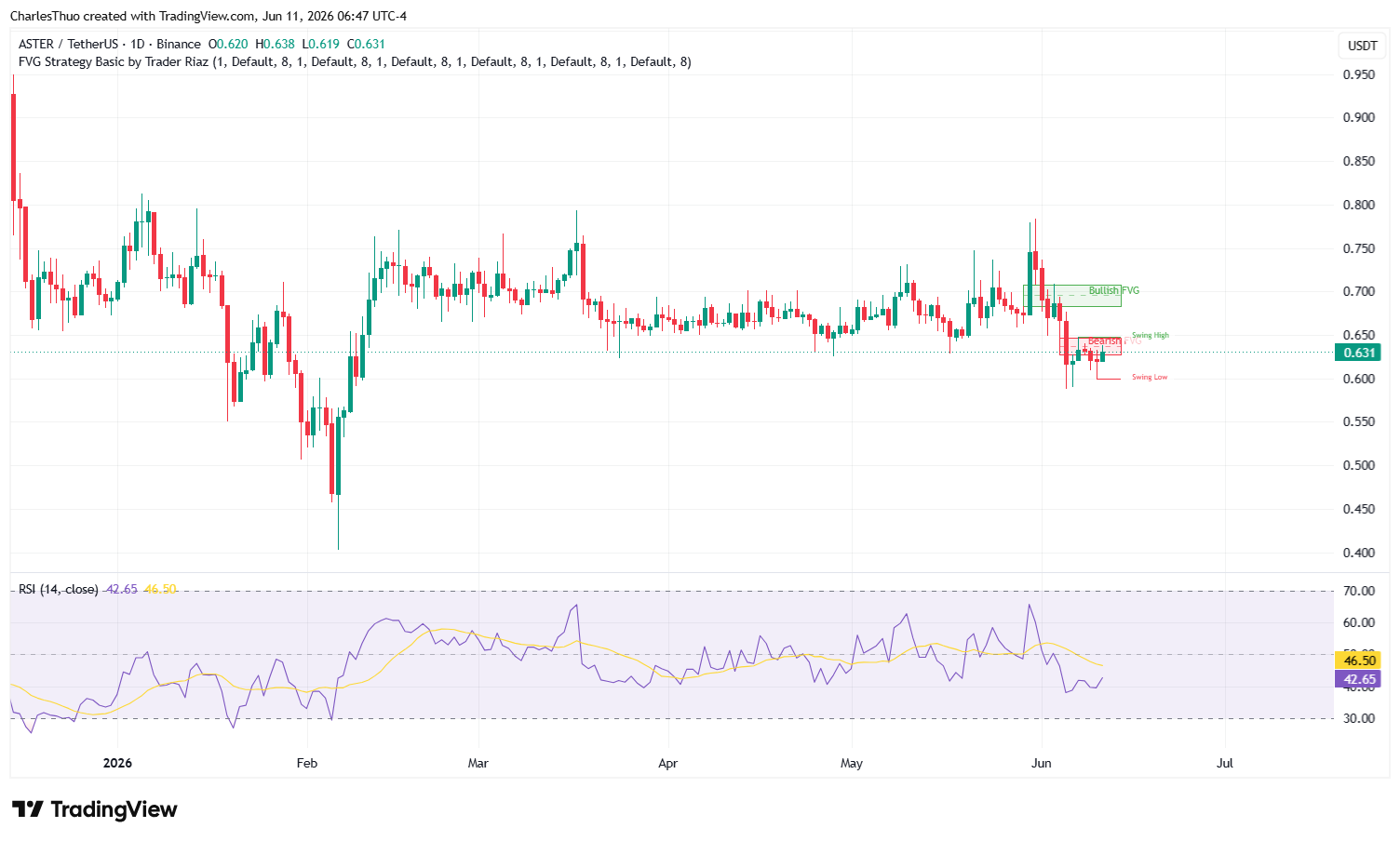 Aster token price analysis
FVGs are areas where price moved too quickly in one direction, leaving behind an imbalance that the market tends to return to fill.
With $ASTER trading right in the middle of this gap, the most probable short-term move, absent any external shock, is a grind toward the $0.648 ceiling to complete that fill.
That said, the bigger picture is harder to ignore.
$ASTER is still trading below both its 30-day and 200-day moving averages, which tells you the dominant trend remains bearish.
The RSI is sitting around 42, not oversold, not strong, just neutral and weak.
The MACD is marginally negative. Notably, none of these momentum indicators is flashing a strong buy signal yet.
For the recovery to be taken seriously beyond a short-term bounce, bulls need to reclaim the $0.67–$0.72 zone.
That's where the moving averages converge and where a sustained close would begin shifting the structure from bearish to neutral.
Below that, this is still a relief rally within a downtrend.
The key support levels to watch are $0.60, which has to hold to keep the rebound intact, and $0.588, which is the June 6th low.
A break below $0.588 would invalidate the current setup and likely open the door toward $0.55.
What's actually driving the Aster token recovery
The 0.7% gain in the last 24 hours looks modest, but it comes on the back of a specific fundamental catalyst that has been drawing fresh attention to the Aster token: the expansion of its real-world asset (RWA) perpetual futures offering.
Aster recently launched synthetic pre-IPO perpetual contracts for SpaceX, alongside Hong Kong-listed stocks, tapping directly into the wave of demand for on-chain exposure to high-profile private companies.
This has placed the platform at the centre of what traders are calling the "AI IPO wave" narrative, a theme that is pulling speculative capital into any platform offering leveraged access to names like SpaceX, OpenAI, and Anthropic before they go public.
If the SpaceX IPO, scheduled for June 12th, generates meaningful news flow and drives volume to Aster's pre-IPO perpetual markets, the platform gets a direct and measurable boost that could push the price toward the $0.65 resistance and potentially beyond.
The risk that could derail it
No price analysis of $ASTER right now is complete without flagging the upcoming token unlock.
Approximately $60.1 million worth of $ASTER tokens is scheduled to be released this week.
That is a meaningful amount of potential sell-side pressure, and if demand does not absorb it cleanly, it could cap or reverse the current recovery.
Token unlocks do not always result in immediate sell-offs. Much depends on who holds the unlocked tokens and what their intentions are.
But in a market where $ASTER is still below its key moving averages, and RSI is sitting at a weak 42, the environment is not exactly forgiving.
A large unlock hitting at the wrong moment could be enough to push the Aster token price back below $0.60 and potentially test $0.588 again.


