
Cardano Isn't Fading Away, DEX Aggregator Says As DeFi Metrics Rise

By:Newsbtc
Bitget offers one-stop trading for cryptocurrencies, stocks, and gold. Trade now!
A welcome pack worth 6200 USDT for new users! Sign up now!
Cardano’s total value locked dropped close to 30% in June, sliding from $129 million to $92 million — a fall that closely tracks ADA’s own price decline of 27% over the same stretch.
Yet one platform inside the ecosystem is pushing back hard against the idea that the network is finished.
DexHunter, a Cardano-based DEX aggregator, argued that the blockchain is more alive than ever, citing a sharp spike in trading activity as proof that user engagement remains strong despite ADA’s price weakness.
var rnd = window.rnd || Math.floor(Math.random()*10e6); var pid607465 = window.pid607465 || rnd; var plc607465 = window.plc607465 || 0; var abkw = window.abkw || ''; var absrc = 'https://servedbyadbutler.com/adserve/;ID=172179;size=0x0;setID=607465;type=js;sw='+screen.width+';sh='+screen.height+';spr='+window.devicePixelRatio+';kw='+abkw+';pid='+pid607465+';place='+(plc607465++)+';rnd='+rnd+';click=CLICK_MACRO_PLACEHOLDER'; document.write('
');
if (!window.AdButler){(function(){var s = document.createElement("script"); s.async = true; s.type = "text/javascript";s.src = "https://servedbyadbutler.com/app.js";var n = document.getElementsByTagName("script")[0]; n.parentNode.insertBefore(s, n);}());}
var AdButler = AdButler || {}; AdButler.ads = AdButler.ads || []; var abkw = window.abkw || ""; var plc366606 = window.plc366606 || 0; (function(){ var divs = document.querySelectorAll(".plc366606:not([id])"); var div = divs[divs.length-1]; div.id = "placement_366606_"+plc366606; AdButler.ads.push({handler: function(opt){ AdButler.register(172179, 366606, [728,90], "placement_366606_"+opt.place, opt); }, opt: { place: plc366606++, keywords: abkw, domain: "servedbyadbutler.com", click:"CLICK_MACRO_PLACEHOLDER" }}); })();

A Surge, Then A Pullback
Daily DEX trading volume on Cardano shot up from roughly 6 million ADA to 25 million ADA across four days, one of the steepest volume increases in recent months.
DexHunter attributed that spike to heavy trading in tokens including NIGHT, STRIKE, and SNEK, as well as stablecoins such as USDCx.
Volume has since retreated to around 7.45 million ADA, down 11% in the most recent 24-hour period.
var rnd = window.rnd || Math.floor(Math.random()*10e6); var pid607472 = window.pid607472 || rnd; var plc607472 = window.plc607472 || 0; var abkw = window.abkw || ''; var absrc = 'https://servedbyadbutler.com/adserve/;ID=172179;size=0x0;setID=607472;type=js;sw='+screen.width+';sh='+screen.height+';spr='+window.devicePixelRatio+';kw='+abkw+';pid='+pid607472+';place='+(plc607472++)+';rnd='+rnd+';click=CLICK_MACRO_PLACEHOLDER'; document.write('
');
if (!window.AdButler){(function(){var s = document.createElement("script"); s.async = true; s.type = "text/javascript";s.src = "https://servedbyadbutler.com/app.js";var n = document.getElementsByTagName("script")[0]; n.parentNode.insertBefore(s, n);}());}
var AdButler = AdButler || {}; AdButler.ads = AdButler.ads || []; var abkw = window.abkw || ""; var plc452518 = window.plc452518 || 0; (function(){ var divs = document.querySelectorAll(".plc452518:not([id])"); var div = divs[divs.length-1]; div.id = "placement_452518_"+plc452518; AdButler.ads.push({handler: function(opt){ AdButler.register(172179, 452518, [728,90], "placement_452518_"+opt.place, opt); }, opt: { place: plc452518++, keywords: abkw, domain: "servedbyadbutler.com", click:"CLICK_MACRO_PLACEHOLDER" }}); })();
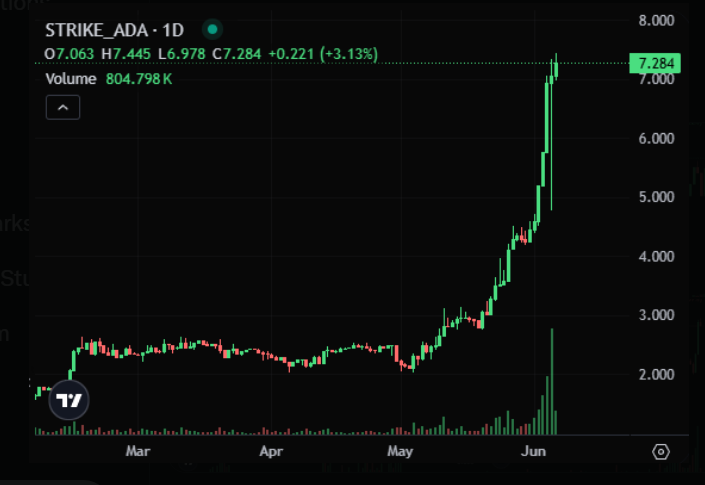 Source: DexHunter on X
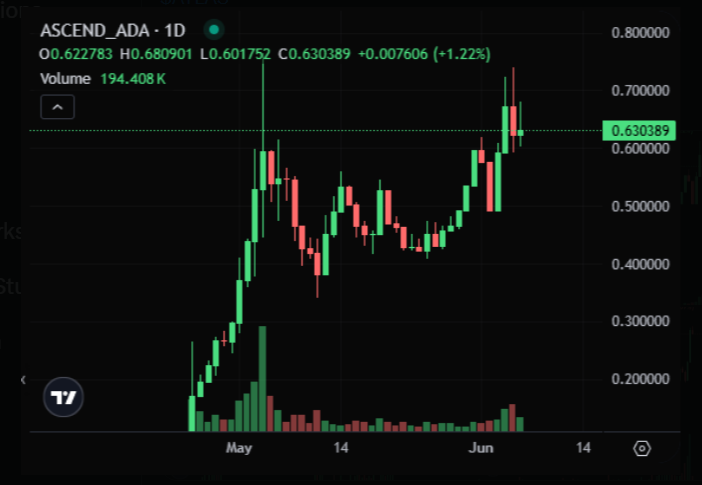
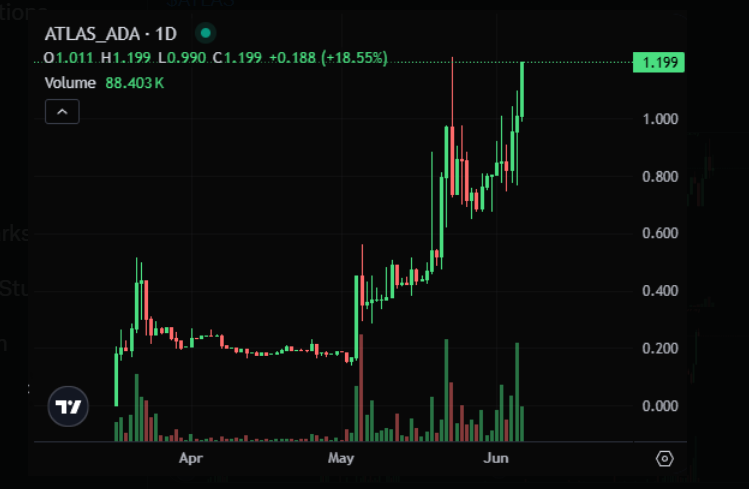
Alongside the volume data, DexHunter shared charts tracking the performance of several Cardano-native tokens. ATLAS rose 18% in a single day.
STRIKE gained 3%. ASCEND added 1.20%. SURF was the exception, falling 2.67% during the same window. Based on that activity, DexHunter declared the ecosystem is exploding.
var rnd = window.rnd || Math.floor(Math.random()*10e6); var pid607473 = window.pid607473 || rnd; var plc607473 = window.plc607473 || 0; var abkw = window.abkw || ''; var absrc = 'https://servedbyadbutler.com/adserve/;ID=172179;size=0x0;setID=607473;type=js;sw='+screen.width+';sh='+screen.height+';spr='+window.devicePixelRatio+';kw='+abkw+';pid='+pid607473+';place='+(plc607473++)+';rnd='+rnd+';click=CLICK_MACRO_PLACEHOLDER'; document.write('
');
if (!window.AdButler){(function(){var s = document.createElement("script"); s.async = true; s.type = "text/javascript";s.src = 'https://servedbyadbutler.com/app.js';var n = document.getElementsByTagName("script")[0]; n.parentNode.insertBefore(s, n);}());}
var AdButler = AdButler || {}; AdButler.ads = AdButler.ads || []; var abkw = window.abkw || ''; var plc452519 = window.plc452519 || 0; (function(){ var divs = document.querySelectorAll(".plc452519:not([id])"); var div = divs[divs.length-1]; div.id = "placement_452519_"+plc452519; AdButler.ads.push({handler: function(opt){ AdButler.register(172179, 452519, [728,90], 'placement_452519_'+opt.place, opt); }, opt: { place: plc452519++, keywords: abkw, domain: 'servedbyadbutler.com', click:'CLICK_MACRO_PLACEHOLDER' }}); })();
Broader Headwinds Weigh On The Network
The platform’s upbeat take comes against a backdrop of mounting pressure on Cardano. ADA hit a multi-year low of $0.14 earlier this year, and a string of setbacks has fed speculation about the network’s long-term prospects.
Analytics platform TapTools shut down. A major ecosystem contributor exited after declaring bankruptcy.
Input Output CEO Charles Hoskinson stepped back from public engagement for a period, and governance disputes have continued to draw criticism from within the community.
Against all of that, DexHunter maintains the underlying activity tells a different story — one of continued user participation even as ADA’s market performance has disappointed.
ADA market cap currently at $6.06 billion. Chart: TradingView

A 400 Billion Shiba Inu Surprise: Whale Wallet Springs Back To Life
Signs Of Life In A Difficult Market
ADA was trading at around $0.16 at the time of writing, still deep in the red compared to levels seen earlier this year.
Whether the recent volume spike reflects a genuine shift in momentum or a short-term burst driven by a handful of tokens remains an open question.
What the data does show is that trading activity on Cardano’s decentralized exchange layer is still moving, even if the numbers have pulled back from their recent peak.
Featured image from Wallpaper Flare, chart from TradingView
0
0
Disclaimer: The content of this article solely reflects the author's opinion and does not represent the platform in any capacity. This article is not intended to serve as a reference for making investment decisions.
Understand the market, then trade.
Bitget offers one-stop trading for cryptocurrencies, stocks, and gold.
Trade now!
You may also like
Anthropic commits to about $900 billion in computing power expenditure; bond market expects its bonds to be junk-rated
Despite Anthropic raising over $100 billion in its public offering and reaching a market capitalization of $1.18 trillion, the company is widely expected by the debt market to be rated as BB-level "junk bonds" due to its lack of profitability and approximately $900 billion in massive computing power expenditure commitments. Amid pressure on tech giants in the debt market and chip companies planning to reduce loan guarantees, Anthropic will still need to rely on structured financing in the short term, facing about a three-year window to strive for an investment-grade rating.
华尔街见闻•2026/11/23 13:51
JPMorgan Trading Desk Abandons Tactical Bullish Stance on S&P 500: Rebound May Occur, Bottom Not Yet Reached
J.P. Morgan's trading division has shifted from a tactical bullish stance to a cautious one, expecting stock market volatility in the coming weeks, but emphasizes that market fundamentals—from the economy to earnings—remain solid.
智通财经•2026/11/23 13:06

AI sell-off brings a "fat pitch"? Hedge funds "give up" and clear positions, Morgan Stanley loudly calls to buy
Hedge funds have shifted to a net bearish stance on momentum stocks, abandoning bets for the first time since April 2025 that recently outperforming stocks will continue to rise.
智通财经•2026/11/23 11:32

South Korea's 10 trillion rescue plan: why is it not working anymore?
The 10.76 trillion won stabilization fund has become comparatively insignificant against the current scale of the stock market. The National Pension Fund lacks further capacity to increase its holdings, and regulators are hesitant to restrict short selling. Meanwhile, semiconductor sell-offs triggered by the global retreat from AI trading continue to impact the Korean market, and the government's available tools for market rescue struggle to counter the outflow of international capital.
华尔街见闻•2026/11/23 07:46

Crypto prices
More
Bitcoin
BTC
$62,952.46
+3.51%

Ethereum
ETH
$1,778.77
+3.97%

Tether USDt
USDT
$0.9990
+0.03%

BNB
BNB
$572.15
+2.81%

USDC
USDC
$0.9999
+0.00%

XRP
XRP
$0.9942
+7.66%

Solana
SOL
$75.88
+8.21%

TRON
TRX
$0.3107
+1.91%

Hyperliquid
HYPE
$67.76
+8.16%

Zcash
ZEC
$866
+9.25%
How to buy BTC
Bitget lists BTC – Buy or sell BTC quickly on Bitget!
Trade now
Become a trader now?A welcome pack worth 6200 USDT for new users!
Sign up now