
The Trump market is more than just the "TACO trade"! Wall Street discovers a "Trump seasonal pattern": bottoms in spring, strengthens by year-end

The trading logic formed around the Trump era in the market is not limited to the well-known "TACO trade" that investors are familiar with.
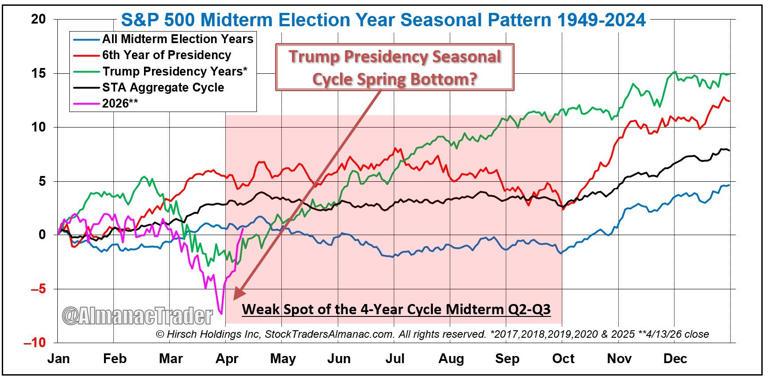
Veteran market strategist and editor-in-chief of Stock Trader’s Almanac, Jeffery Hirsch, recently pointed out that years during President Trump’s term often showed a very representative seasonal performance pattern in the US stock market. Combining this observation with the market performance in 2026, he noted that this pattern is reappearing and may provide important signals for future market trends.
Hirsch stated: "There is a particularly noteworthy rule: during years of President Trump’s administration, the S&P 500 Index usually forms a spring low point between late March and early April, followed by a substantial rally before the end of the year." #Insights2026#
This Wednesday, the S&P 500 Index reached a historic new high, not only fully recovering the previous losses caused by the war situation, but also achieving this rebound against the backdrop of peace talks yet to resume and oil prices remaining high, making its performance particularly noteworthy.
Reviewing this round of price movement, the end of March became the closing low for the S&P 500, and the subsequent two-week ceasefire agreement prompted a clear sentiment-driven rebound in the market.
Despite the strong recovery in the stock market, geopolitical risks have not truly subsided. With face-to-face negotiations failing to make substantive progress and the prospects for a permanent peace agreement still unclear, some on Wall Street warn that the market may still face greater volatility and pressure ahead.
However, Hirsch believes that the seasonal pattern of the Trump presidential cycle indicates this rebound is not just a fleeting episode, but may actually have a foundation for further continuation.
He wrote: "The market never waits for uncertainty to completely dissipate before bottoming out—on the contrary, it usually bottoms when uncertainty is at its peak. The S&P 500 Index has already erased all the declines brought by the Iran war. With market sentiment reset, positioning lighter, and volatility remaining high, the conditions for a short-term corrective rebound are now in place."
Hirsch further pointed out that the Middle East conflict may have released the market weakness that typically appears in the middle of midterm election years ahead of schedule, creating new opportunities for investors to position themselves.
He noted: "Geopolitical risks and the energy market remain important variables for the future, but the market’s ability to digest these shocks is clearly better than many had previously expected."
He added: "Current economic growth remains resilient, the job market is robust, and the Federal Reserve’s stance is relatively neutral. If the diplomatic process continues progressing toward easing tensions, then the overall allocation environment for US stocks before the end of the year will become increasingly positive."
Disclaimer: The content of this article solely reflects the author's opinion and does not represent the platform in any capacity. This article is not intended to serve as a reference for making investment decisions.
You may also like
The Kiwi defies hot US inflation as Fed pause bets weaken the USD
Apple says iPhone Duo demand is "unprecedented," pre-orders sold out within minutes, deliveries postponed until January next year
Within minutes of opening pre-orders for Apple's first foldable screen phone, iPhone Duo, the delivery period was extended to the end of January next year, affecting all colors and storage configurations. Analysts from Bloomberg Intelligence have raised their sales expectations, believing that sales may surpass the target of 14 million units and $28 billion. On Friday, Apple's stock price rose slightly by 0.43%.

Credit panic hits AI trading: CoreWeave bond yields remain high, Nasdaq posts biggest weekly drop since late June
Concerns over the debt risk of AI infrastructure companies continue to rise. Yields on some CoreWeave bonds briefly exceeded 15% on Thursday and remained elevated on Friday. CoreWeave's stock price plunged another 12% on Friday, and the Nasdaq Composite Index fell about 4.5% for the week. Analysts point out that as capital costs rise to unbearable levels, companies will have no choice but to reduce their capital expenditures.
Philadelphia Semiconductor Index Experiences Longest Losing Streak Since 2008; Jensen Huang Responds Calmly: Short-term Fluctuations Won't Change AI's Long-term Growth Prospects
Despite recent sell-offs in AI-related stocks, Nvidia CEO Jensen Huang remains confident in the long-term prospects of the AI industry.
Crypto prices
More


