
A 876% Surge in One Day! $419 Million Loss Over 5 Years and All US Stores Closed—Why Has the Former "Silicon Valley Miracle Shoe" Suddenly Made a Comeback?

Once favored by Wall Street traders, Silicon Valley tech professionals, and even former U.S. President Obama, footwear brand Allbirds is now undergoing an intense and thorough transformation. Amid worsening core business, store closures, and a plunging stock price, the company has announced a shift to AI computing infrastructure, planning to re-enter the capital markets as NewBird AI.
Stimulated by the news, Allbirds' stock soared by 876% on Wednesday (April 15th, 10:00 UTC+8), reaching $24.31, while its previous closing price on Tuesday was just $2.49. The market reaction was extremely intense.
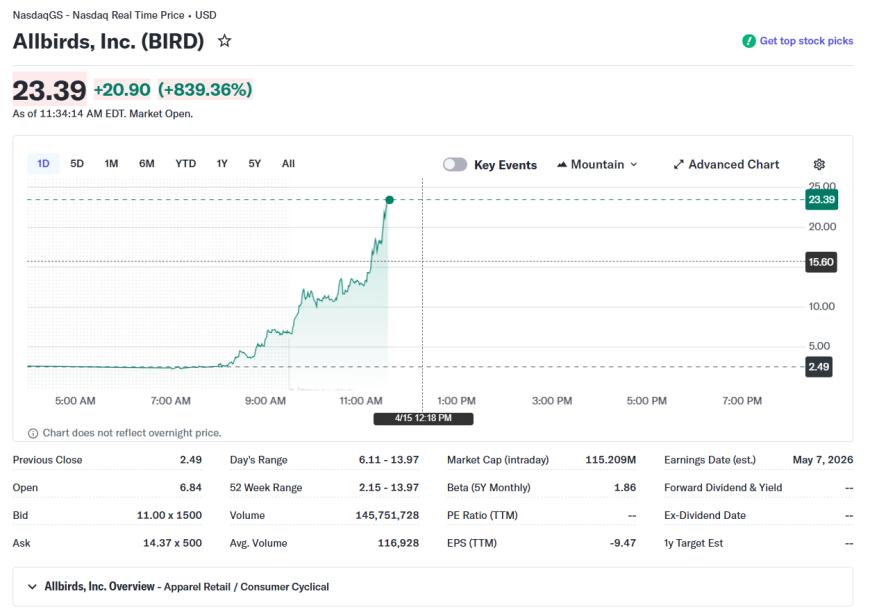
On its investor relations page, the company released a statement announcing a financing agreement of up to $50 million, expected to be completed in Q2 2026. These funds will primarily be used to acquire high-performance, low-latency AI computing hardware, accelerating the company's shift toward AI computing power infrastructure.
The company indicated that it will first seek to acquire high-performance, low-latency AI computing devices and provide services through a long-term leasing model, targeting demands not consistently met by the spot market and hyperscale cloud providers. According to its plan, the new company aims to become a “fully integrated GPU-as-a-Service (GPUaaS) and AI-native cloud solutions provider.”
Core business continues to deteriorate, Allbirds forced into a strategic pivot
This seemingly dramatic transformation is actually a passive response to Allbirds' prolonged struggles in its footwear business.
The financial and operational pressures on Allbirds’ footwear business have deteriorated in recent years. In Q3 2025, company revenue dropped 23% year-over-year. Despite accumulating about $1.2 billion in sales over the past five years, total losses reached $419 million.
Meanwhile, since its peak in 2021, the company’s stock price has plummeted approximately 95%, even sparking concerns over its continued listing status on Nasdaq.
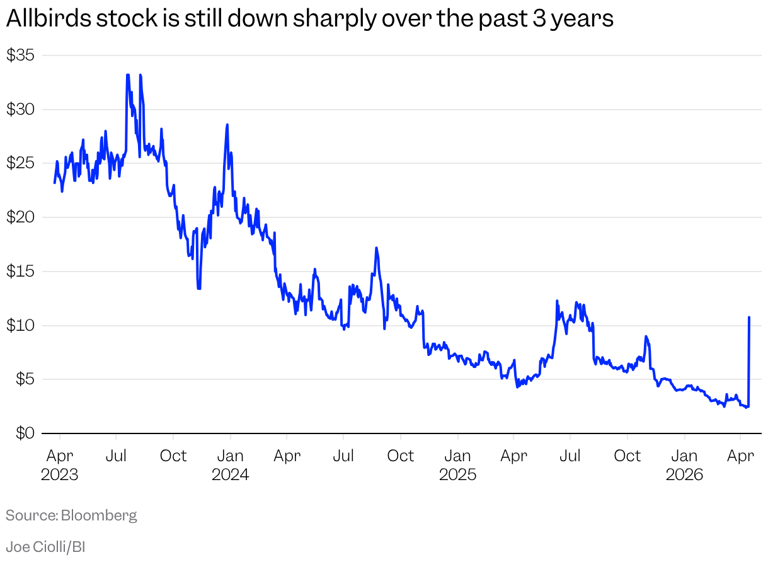
The market generally believes that Allbirds expanded too quickly into apparel and broader categories beyond its core wool sneaker product line, diluting its original brand positioning and consumer recognition. The brand’s image, initially focused on “comfort, environmental protection, and sustainability,” became increasingly blurred during rapid expansion.
To address operational pressures, Allbirds closed all its full-price retail stores in the U.S. at the start of 2026, retaining only two for operation, signaling a clear shift to e-commerce. The company also completed the full closure of U.S. full-price stores in February this year.
Selling footwear assets, Allbirds brand will remain
Before fully transitioning to AI, Allbirds began divesting its original footwear assets.
Last month, the company announced an agreement with American Exchange Group to sell its intellectual property and other related assets for $39 million. American Exchange Group is a brand management company specializing in accessories, owning multiple consumer brands.
According to the announcement, American Exchange Group will continue to sell Allbirds branded products, meaning that the “Allbirds” consumer brand itself will not completely disappear, but the original listed company is shifting to an entirely new business direction.
In other words, the Allbirds brand will continue to exist in the consumer goods market, while the listed company is attempting to use the AI infrastructure narrative to achieve a “redefinition” in the capital markets.
From “eco-friendly miracle shoe” to “AI concept stock”
Allbirds was founded in 2015 by former professional footballer Tim Brown and renewable resources expert Joey Zwillinger. Their aim was to create a new footwear category focusing on natural materials instead of relying on plastic and petroleum petrochemicals.
In 2016, the company launched its first product, the Wool Runner, made from Merino wool, achieving rapid success. Thanks to its comfort and eco-friendly concept, the shoe was particularly popular among Silicon Valley "tech bros" and helped the brand quickly gain recognition.
Subsequently, Allbirds initiated a large-scale store expansion and went public in 2021. During its IPO that year, it raised about $348 million at $15 per share, reaching a valuation of over $4 billion and becoming a new consumer favorite on Wall Street.
However, after going public, the company’s business quickly slowed down. With shifting consumer trends, increased competition, and rising customer acquisition costs, Allbirds' original growth trajectory collapsed. Between 2022 and 2025, revenue fell sharply from $298 million to $152 million, a cumulative decline of nearly 50%.
At the same time, management changes reflected increased internal restructuring pressure. The departure of co-CEO Joey Zwillinger, among others, indicated the company’s struggle to shake off the post-IPO rapid expansion fallout and search for a new strategic direction.
The AI computing power track is hot, but transformation is challenging
Allbirds has now become the latest company seeking to reshape its capital market narrative by leveraging the AI boom.
Since OpenAI launched ChatGPT in 2022, Wall Street’s pursuit of the AI concept has continued to intensify, with AI infrastructure emerging as one of the most imaginative directions. Although this field requires massive investment, complex technology, and high entry barriers, the potential rewards upon success can be massive.
For example, thanks to its market dominance in GPUs, Nvidia's valuation has neared $5 trillion, making it one of the world’s most valuable companies. This has prompted more struggling companies to try breaking into the AI track to re-attract investors.
The capital markets offer plenty of similar cases. From the internet bubble era to the blockchain and cryptocurrency booms, many underperforming companies have pivoted to the “hottest sector” to reignite market interest.
Therefore, Allbirds’ transformation from a shoe company to an AI computing power infrastructure company has sent its stock price skyrocketing, but the market will undoubtedly continue to watch: is this truly a strategic overhaul, or just another valuation reset driven by a hot concept.
Disclaimer: The content of this article solely reflects the author's opinion and does not represent the platform in any capacity. This article is not intended to serve as a reference for making investment decisions.
You may also like
Has the return on Amazon's massive AI capital expenditure been underestimated by the market?
Amazon is trading at 29 times expected earnings, lower than Walmart’s 37 times, even though its revenue growth rate is three times that of Walmart. This inversion reflects deep market concerns over whether AI capital expenditures will deliver as anticipated. AWS CEO Matt Garman revealed that AWS’s annual revenue has reached $160–170 billion, with a growth rate of 37%. Enterprise cloud migration, AI-native startups, and intelligent agent workflows are simultaneously driving three growth curves.
TSMC’s $2 Billion Silicon Interposer Order Given to GlobalFoundries, Key CoWoS Components to be Produced in the U.S. for the First Time
This move marks the official extension of a key link in the AI packaging supply chain to the United States. Analysis indicates that the five-year long-term contract reflects TSMC's strong long-term outlook for silicon interposer demand. Meanwhile, Taiwanese companies UMC and PSMC are actively expanding capacity to compete for orders, but this major order has been secured by GlobalFoundries, meaning that American production capacity will become a new factor in the silicon interposer market landscape over the next five years.

Gasoline Prices Rise in Tandem with Election Poll Trends! Goldman Sachs: With 26 Days Left Until the Midterm Election, Probability of a Democratic Sweep Rises to 65%
Goldman Sachs states that the probability of a Democratic sweep has risen to 65%, but polls in red states have historically overestimated their advantage; the rise and fall of oil prices is the decisive variable.

Crypto prices
More


