
Thailand proposes tighter scrutiny of funders behind crypto firms

Thailand’s securities regulator is seeking to curb money laundering and technology-related crimes by tightening funding rules for cryptocurrency companies.
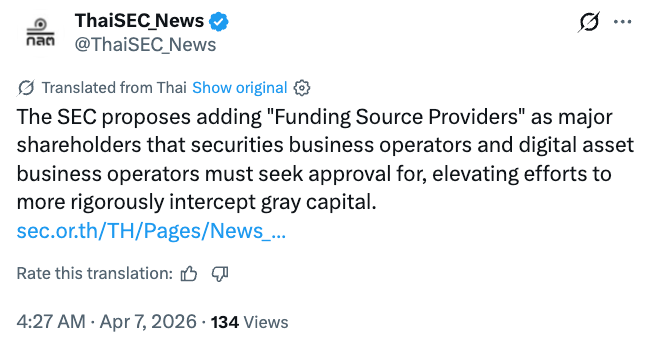
The Securities and Exchange Commission of Thailand (Thai SEC) on Monday proposed expanding approval requirements for crypto businesses to include financiers behind major shareholders.
Under the proposal, any person providing backing or financial support to major shareholders would itself be treated as a shareholder requiring regulatory approval from the regulator.
The move aims to tighten oversight of hidden capital flows and ensure that business operators are funded from legitimate sources, rather than from financing linked to unlawful activities, which may pose legal, credibility and reputational risks, the agency said.
The move reflects an emerging regulatory trend in Asian countries, with similar initiatives under consideration in South Korea, where regulators are weighing proposals to cap crypto exchange shareholder stakes at 20%.
Indirect backing through share acquisitions would fall under proposed rules
The proposed funding requirements cover a wide range of financial contributors, including not only those who provide funding or financial support to direct shareholders, but also those who do so indirectly through share acquisitions.
The rules apply to acquisitions of shares in business operators, as well as in legal entities that are shareholders of those operators.
 Source:
Thai SEC
“The provision of significant funding shall include guarantors, contractual arrangements, or investments in any instruments that result in the financial supporter having the status of, or acting in substance as, a funding provider to such major shareholders,” the SEC said.
If a major shareholder is a government-related entity, such as a ministry, department, public organization or other agency, the agency will only review ownership at the entity level. “These entities are already subject to government supervision and oversight,” the regulator said.
The proposed measures are open for public consultation until April 22.
Thai authorities have been ramping up efforts to combat financial crimes recently. In January, local authorities launched a “gray money” campaign to tighten oversight across both physical and digital markets as part of an effort to close money-laundering loopholes.
Following efforts by the Thai SEC and the Thai Digital Asset Operators Trade Association, local crypto platforms reportedly froze 10,000 accounts as part of an anti-money laundering crackdown.
Disclaimer: The content of this article solely reflects the author's opinion and does not represent the platform in any capacity. This article is not intended to serve as a reference for making investment decisions.
You may also like
 VIPIndiscriminate Selling Strikes, Igniting the Market's Black Friday
1. Global markets were caught in a liquidity squeeze and indiscriminate selling this week. Apart from natural gas, which surged 16.04%, and the US Dollar Index (DXY), which edged up 0.39%, major global equity indices, precious metals, industrial metals, and cryptocurrencies all fell sharply. Silver and the Nasdaq 100 led the decline, plunging 16.24% and 10.43%, respectively. 2. Minutes from the Federal Reserve's Federal Open Market Committee (FOMC) meeting warned that AI infrastructure is pushing up near-term inflation and adding to market concentration risk. The warning triggered a wave of profit-taking in tech heavyweights. The Nasdaq Composite fell 5.28% on Friday, erasing its gains for the year, and NVIDIA declined for a seventh straight week. At the same time, AI giant Anthropic raised $81.3 billion in the largest IPO on record globally. This massive draw on capital, combined with selling pressure in the secondary market, quickly spread the cooling in risk appetite to high-beta crypto assets. 3. Fed officials dissented in favor of a 25-basis-point rate hike, and Governor Waller went further, warning that an outsized 50-basis-point hike may be needed in December to curb inflation. Tightening expectations drove DXY to a 19-month high of 103.97 and tipped markets into a dash-for-cash liquidity squeeze. Spot gold plunged to a 14-month low, and US equities, commodities, and cryptocurrencies fell in tandem as institutions systematically cut their cross-asset risk exposure. 4. Caught between the tech rout and a strong dollar, Bitcoin briefly fell below $60,000, and market-wide liquidations jumped to $1.33 billion in 24 hours. Institutional flows saw a watershed reversal. BlackRock's IBIT posted a net outflow of $541 million on Thursday, its largest single-day outflow since launch, and cumulative net outflows from US spot Bitcoin ETFs have neared $3.5 billion so far in November. Looking ahead, the market is set to search for a bottom in both sentiment and valuations in the near term. 5. Assets in focus: BTC, ANT, and NVDA

5 Best VPNs Worth Using for Crypto
Ripple ETF Investors Hold On, But XRP Buyers Go Missing
--KKR in Talks to Buy EdgeCore at Valuation of Up to $10 Billion, Bloomberg Reports

Crypto prices
More


