
Private Credit Crisis Spreads, CLO Market Becomes the Next Risk Trigger Point

The turmoil in the private credit market has spread from BDCs (Business Development Companies) to the broader credit ecosystem. Although JPMorgan CEO Jamie Dimon believes it does not yet pose a systemic risk, the latest reports from Barclays and UBS reveal an overlooked blind spot: the deep entanglement between private credit and the collateralized loan obligation (CLO) market.
As BDCs face massive redemptions, private credit valuations may be forced to shift from "model-based pricing" to "mark-to-market," and investors should be aware of the NAV impact caused by declines in underlying asset prices, especially software/SaaS loans.
Meanwhile, the spread on unsecured BDC bonds has already widened significantly, while pricing in the private credit CLO space has yet to fully reflect this reality. Barclays points out that BDCs are highly comparable to Single-A CLOs, and as default rates in software loans rise, the CLO market is highly likely to become the next flashpoint for risk.
UBS warns that rising private credit defaults will lead to a sharp reduction in leveraged loan and CLO issuance. Given the substantial investor overlap between public and private credit markets, liquidity pressures could quickly spill over to the wider public credit market.
Crisis Trigger: BDC Redemption Wave and the Crisis of Valuation Transparency
In the past two months, private credit-related assets have been subject to selling pressure.
Investors in two Blue Owl private credit funds (Technology Income Fund and Credit Income Corp) have filed redemption requests amounting to 41% and 22% respectively, leading several listed private credit/BDC securities to hit all-time lows.
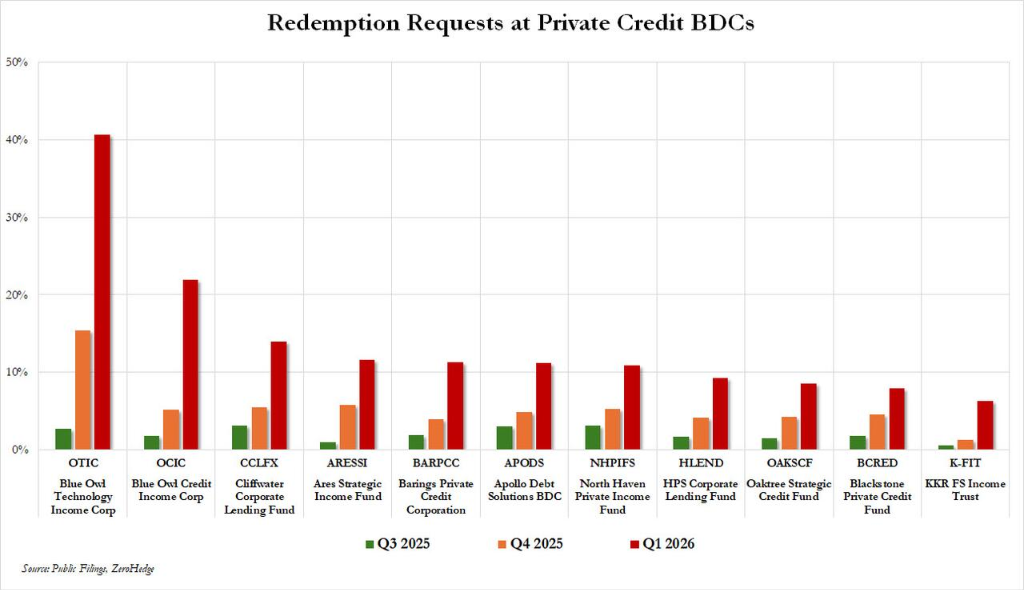
JPMorgan CEO Jamie Dimon has warned that "private credit broadly lacks transparency and rigorous loan marking," resulting in current actual losses exceeding what would be expected in a normal environment.
Dimon further warned that insurance regulators will eventually require stricter ratings or write-downs, and that retail investors are likely to resort to legal action once issues emerge.
Data from Pimco clearly demonstrates that publicly traded BDCs are now trading at a significant discount to their net asset value (NAV), with the valuation gap between the public and private markets continuing to widen.
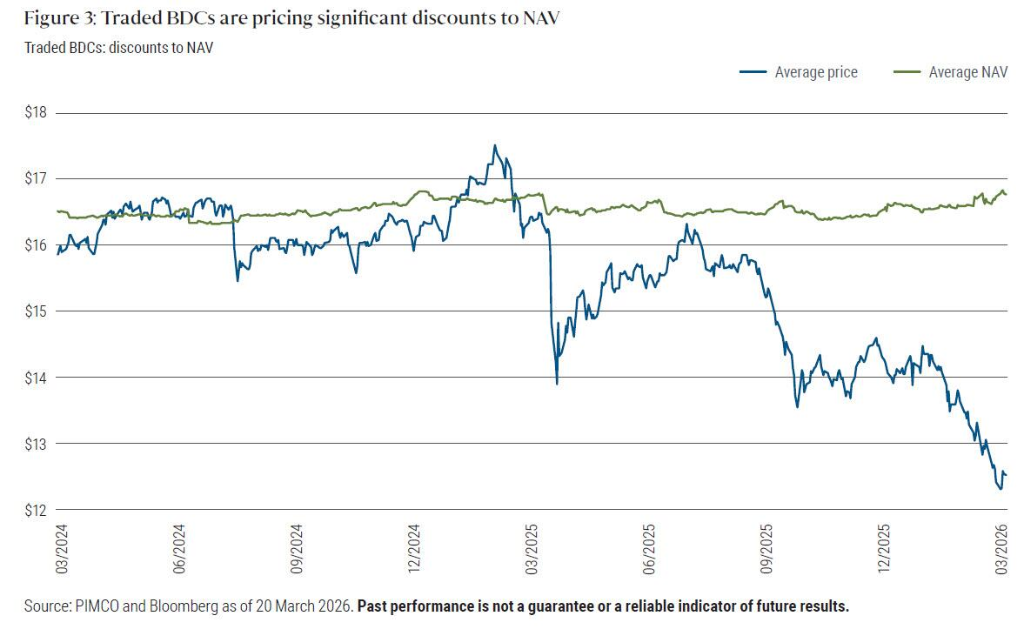
Even so, Dimon also stated that private credit "may not" pose a systemic risk due to its relatively limited size within the overall credit market—an assessment echoed by earlier reports from Goldman Sachs.
Barclays Warns: CLO Pricing Seriously Detached from Reality
However, Barclays’ research suggests that Dimon’s view may overlook the deep connections between private credit and derivative markets such as CLOs.
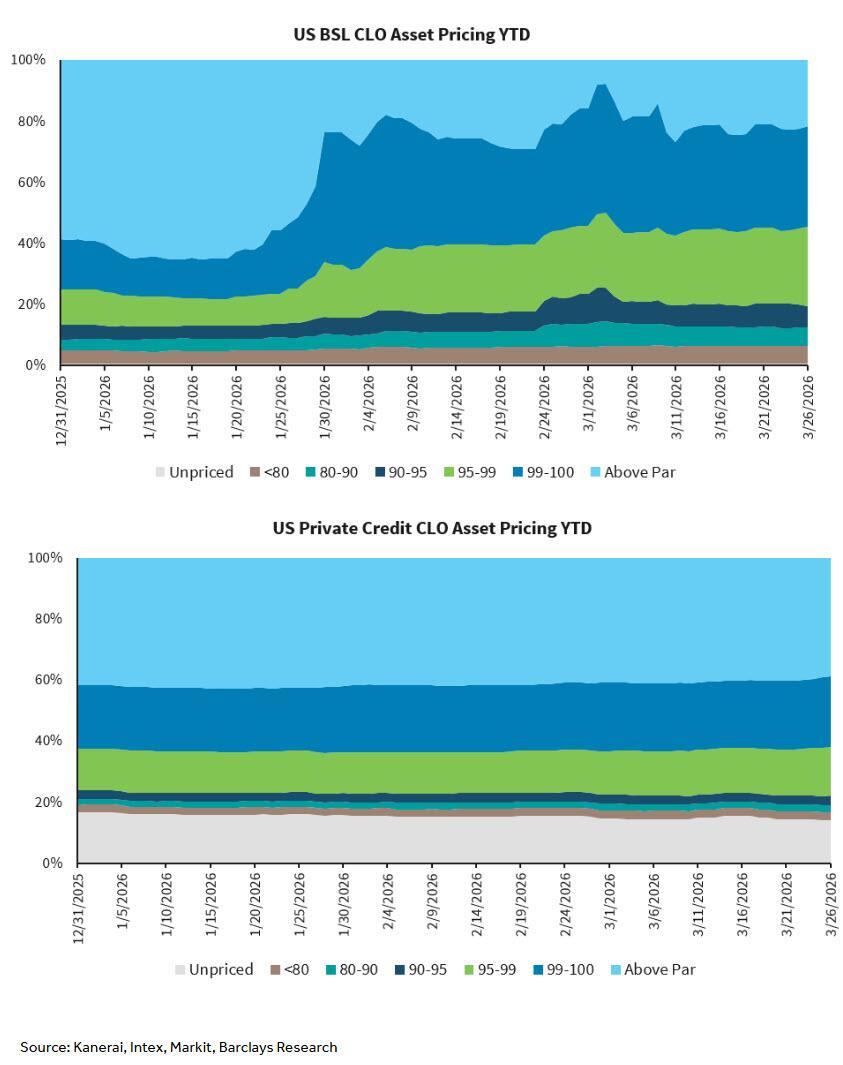
Credit analyst Gavin Zhu points out that, compared to the broad-based selloff in broadly syndicated loan (BSL) CLO assets, similar adjustments have not yet occurred for private credit CLOs.
So far this year, price movements for private credit CLOs have been minimal: the percentage of loans priced above par has only dropped from 42% to 39%, loans priced below 95 have only increased from 7% to 8%, and around 14% of loans remain unpriced.
By contrast, U.S. BSL loans priced above par have plummeted from 59% to 22%, while those below 95 increased from 13% to 19%. Barclays believes that the current pricing of BDCs is already seriously out of sync with the realities of the CLO market.
BDC Asset Coverage Test as Key Constraint, Single-A CLO as Best Benchmark
To quantify the relative value of unsecured BDC bonds, Barclays has developed a systematic comparative analysis framework.
Barclays points out that since the start of the year, spreads on unsecured BDC bonds have widened by 80 basis points (bp), now hovering around 260bp, sharply underperforming the investment grade (IG) index (which has only widened 15bp to 92bp). In search of an appropriate relative value reference, Barclays has turned to CLOs.
According to the 1940 Act, BDCs are subject to strict asset coverage tests, requiring at least 150% asset coverage of debt (i.e., a maximum leverage ratio of 2x).
In the event of a default, BDCs will be unable to issue new debt or pay dividends, and may even lose their regulated investment company (RIC) status and become cash taxpayers. The average/median regulatory asset coverage for investment-grade BDCs is currently 205%/191%.
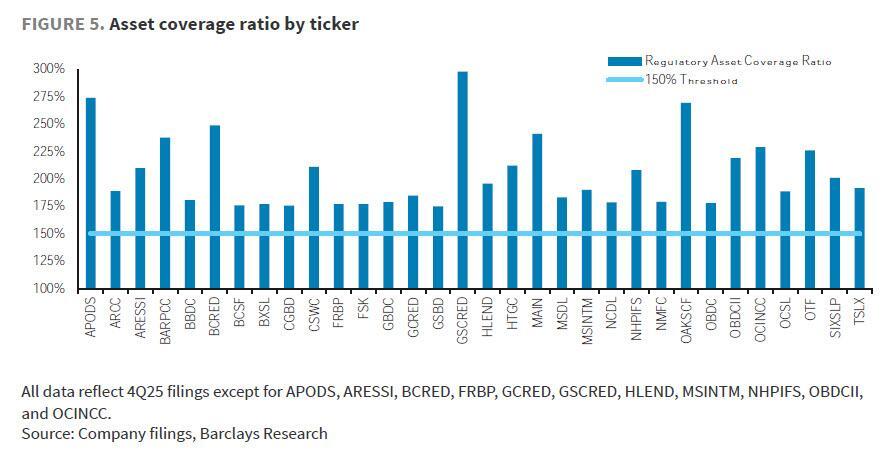
Barclays calculates that it would take an across-the-board 21% decline in median BDC asset values to hit the 150% red line. This attachment point most closely matches the Single-A tranche in standard BSL CLO structures. Thus, Single-A CLOs are the best benchmark for evaluating the relative value of unsecured BDC bonds.
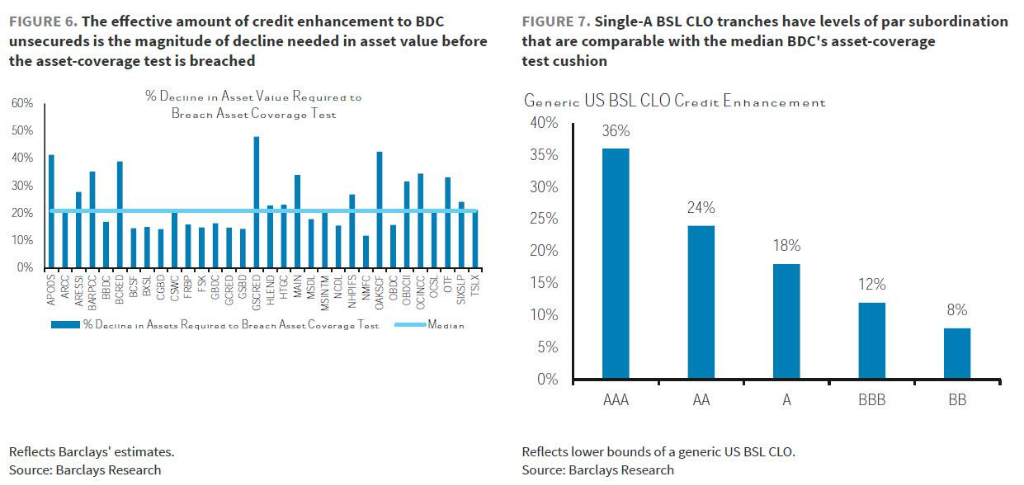
Quantifying the Impact of Software Loan Sell-Offs and Relative Value Calculations
Given the devaluation of software/SaaS assets triggered by AI disruption, Barclays has conducted quantitative analysis.
Direct software exposure in U.S. BSL CLOs is about 11-13%, with total exposure around 22%. In the current environment, assuming software loan prices fall by one point (with non-software loans falling 0.2 points), the spread on Single-A CLOs would widen by 4bp.
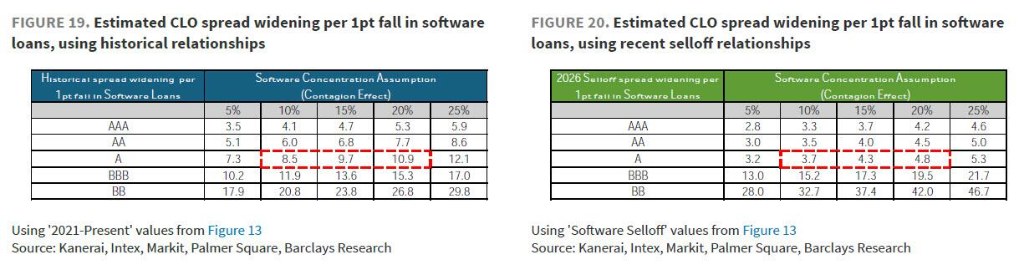
By comparison, BDCs have higher software exposure (around 20%). Barclays calculates that under identical shocks, spreads on unsecured BDC bonds should widen by 4.8bp (about 20% wider than for CLOs).
According to the research report and actual market movements: Recently, Single-A CLO spreads have widened about 20bp to 195bp; since January, unsecured BDC bonds have widened nearly 75bp on a Z-spread basis to 270bp.
Applying Barclays’ model, a 20bp widening in Single-A implies that BDCs should widen by 24bp. This indicates that unsecured BDC bonds have underperformed Single-A CLOs by about 50bp in substantive terms. As investors seek the next weak point in credit markets, attention will inevitably turn to the CLO market, which has so far not experienced severe disruption.
UBS: Contagion Pathways from Private Credit Crisis to CLOs and Public Markets
In their latest report, the UBS credit team systematically answers seven core client concerns, three of which relate directly to CLOs and risks in broader markets.
Question 1: What is the potential impact of rising private credit losses on structured finance markets?
UBS estimates that the volume of leveraged loans issued will shrink about 20% to $360 billion in 2026, with CLO issuance dropping from $208 billion for full-year 2025 to around $150 billion. In tail-risk scenarios, leveraged loan issuance may drop 50-75%, with CLO creation falling further to $100–110 billion.
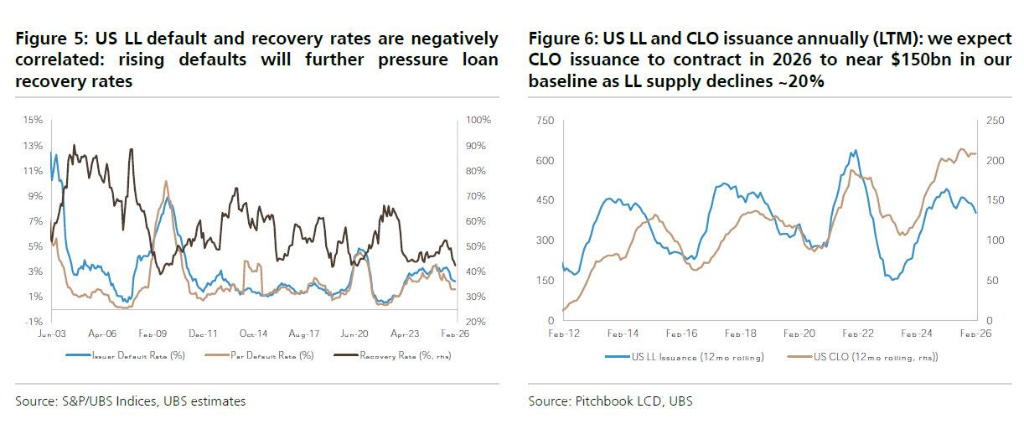
On credit quality, UBS analysis shows that around 11-12% of US and European leveraged loan portfolios are in high AI-disruption-risk industries with below-average ratings, of which about 8% face downgrade risk to CCC within two years. This will increase CCC concentration in CLO portfolios, which currently stands at 4.5-5.5%, approaching the 7.5% limit.
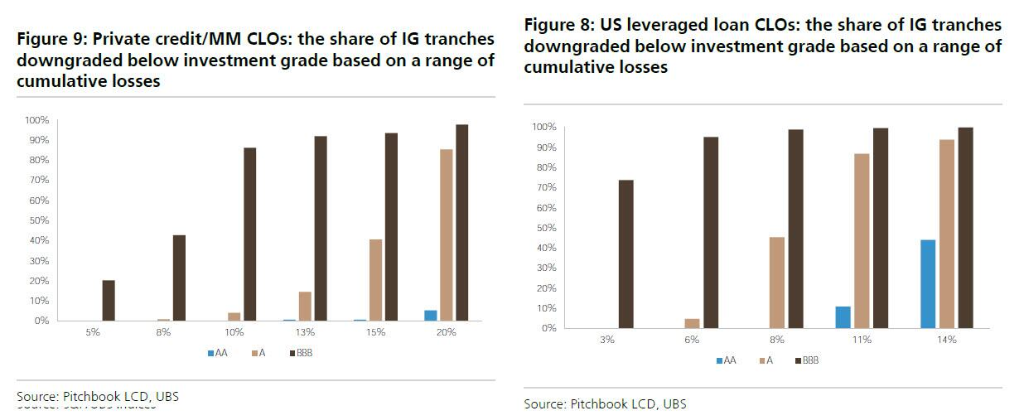
On ratings stability, S&P stress tests show that the average loss threshold for a downgrade from BBB is in the low-to-mid-single-digit range for leveraged loan CLOs, and in the higher single digits for middle-market CLOs. UBS’s baseline/tail scenario loss forecasts for 2026: 2.6%/6.75% for US leveraged loans, 7%/12.4% for private credit, implying substantial downgrade risk within the next year.
Question 2: What are the spillover channels from private credit to the public credit market?
UBS identifies four main transmission channels:
- Investor overlap: Insurance companies, foreign investors, and retail investors hold large positions in both private and public credit markets;
- BDC holdings of syndicated loans: BDC portfolios on average hold about 10% in syndicated leveraged loans, which could be dumped more aggressively under net redemption pressure;
- Valuation correlation: Private credit and global leveraged loan valuations are highly correlated. European portfolios have up to 50% overlap by debt-weighted metrics with US leveraged loan names;
- Issuance pattern correlation: US and European leveraged loan and high-yield bond issuance trends have historically been highly correlated.
Question 3: How might valuations evolve when private BDCs face redemption pressure?
BDCs account for one-third of private credit assets ($500 billion out of around $1.5 trillion in total), with two-thirds of BDCs structured as private, non-traded vehicles, bearing the bulk of redemption risk.
UBS believes that once redemption pressure starts impacting BDC liquidity, private credit valuations will shift from a "model-marked" framework to more traditional "mark-to-market" methods. Historically, B3/B- loans traded down to $90 during the 2022-23 Fed tightening cycle, briefly to $80 during COVID, the mid-$85s during the high-yield shale oil crisis, and the mid-$50s during the financial crisis.
UBS concludes that these historical datapoints provide a reference range for the likely evolution of private credit portfolio market pricing.
CLOs: The Next Domino in the Private Credit Crisis
Synthesizing the analysis from Barclays and UBS, the logic chain is now clear:
Layer One: AI disruption risk for software/SaaS companies continues to erode BDC asset quality, unsecured BDC bond spreads widen sharply, and redemption pressure soars;
Layer Two: There is a deep structural link between BDCs and CLOs, but current private credit CLO pricing reflects almost no stress, and this valuation gap must eventually close;
Layer Three: Once CLO pricing aligns with reality, it will trigger a chain reaction—downgrades to CCC, OC test pressure, falling CLO issuance—and propagate into public credit markets through overlapping investor bases and valuation correlations.
As Barclays points out, as investors look for the next weak point in credit markets, attention will inevitably turn to CLOs—a market that has so far been largely untouched by the collapse in BDCs.
UBS further warns that if AI’s disruptive impact on the software sector intensifies and broader economic weakness sets in, the private credit crisis will not only deteriorate but will also spread—using CLOs as the conduit—to the entire public credit market.
Disclaimer: The content of this article solely reflects the author's opinion and does not represent the platform in any capacity. This article is not intended to serve as a reference for making investment decisions.
You may also like
Rare "Three Firsts"! State Council's Major Moves to Stabilize the Market, How Do Institutions View It?
The State Council executive meeting has featured three "firsts": for the first time, the release time was advanced to trading hours; for the first time, the phrases "the capital market is crucial to the overall economic development" and "national team" were explicitly mentioned in the official statement. Analysts such as Tao Chuan from Guolian Minsheng and Wang Han from Industrial Securities believe that the market stabilization mechanism is evolving from short-term support to an institutionalized, diversified, and coordinated upgrade, with policy focus shifting to optimizing Huijin’s functions, introducing long-term funds into the market, and promoting dividends and share buybacks. Chen Guo from East Money regards this State Council meeting as an “important policy bottom.” CITIC Securities expects the market may see an oversold rebound in the short term. Going forward, key areas of attention will be Huijin’s actions and the implementation of fundamental policies.

U.S. Senate Democratic leader election to be voted on December 1, impacting AI regulation and tariff agenda
The election for the Democratic leader in the U.S. Senate will be held by secret ballot on December 1, and the winner must reach the threshold of 28 votes.

From Earning 20% Annually to Going Negative in a Single Month, Wall Street’s Favorite Arbitrage Trade “Fails”
After rising for six consecutive months, the Bloomberg FX Carry Index turned negative for the first time in November, falling by 0.9%. Cooling enthusiasm for AI has increased market volatility, and Brazil’s election led to an 8% single-day plunge in the real, nearly wiping out the carry trade's 18% annual return overnight. Industry giants such as Goldman Sachs and Citigroup have issued warnings: “The era of mindless long positions is over.” Although capital has not withdrawn, trading thresholds have surged, requiring defensive hedging and a shift toward selective strategies.

The global tobacco landscape is about to change! Marlboro's parent company Altria (MO.US) plans an all-cash takeover of Imperial Brands UK, targeting cigarette cash flow.
What Altria values is the overseas cigarette cash flow and the established distribution network. Since spinning off Philip Morris International in 2008, its cigarette business has been focused on the United States. Altria estimates that after adjusting for channel inventory changes, the U.S. cigarette industry’s sales volume declined by about 5% year-over-year in the third quarter. Acquiring Imperial Brands’ international business would allow Altria to instantly gain brands, retail channels, and operational scale in markets such as Europe, thereby reducing its dependence on the single U.S. market.

Crypto prices
More


