
Rushed quantum fix may backfire for Bitcoin, Samson Mow warns

Rushed quantum fixes for Bitcoin could introduce new risks, Samson Mow warned in response to calls from Coinbase executives for faster action.
Mow, a Bitcoin advocate and Jan3 founder, took to X on Saturday to address comments from Coinbase CEO Brian Armstrong and chief security officer Philip Martin, who urged the industry to begin preparing for quantum computing threats sooner rather than later.
He said that while post-quantum (PQ) cryptography could secure Bitcoin (BTC) against future quantum computers, rushing implementation may create new vulnerabilities such as compatibility issues and reduced network efficiency due to larger signature sizes.
“Simply put: make Bitcoin safe against quantum computers just to get pwned by normal computers,” Mow said, adding that a poorly timed transition could weaken Bitcoin against today’s threats before addressing future ones.
The exchange reflects a growing debate over how to future-proof Bitcoin, as new research from Google and Caltech reignited concerns about progress in quantum computing.
Why Mow is pushing back and how it ties to the block size wars
One of Mow’s biggest concerns about rushing a quantum fix for Bitcoin is the potential impact on performance, particularly block size, or the amount of transaction data that can fit into a single block.
“PQ signatures will likely be 10-125x larger than current ones, and massively reduce throughput,” Mow said, citing former Bitcoin developer Jonas Schnelli.
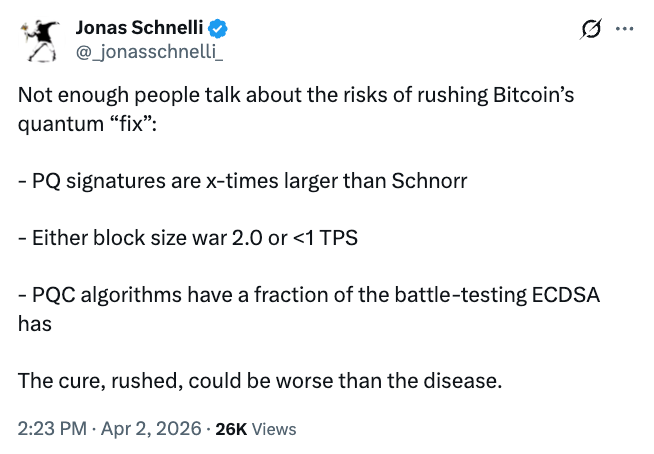 Source:
Jonas Schnelli
Source:
Jonas Schnelli
The signature issue could potentially pave the way for “Blocksize Wars 2.0,” Mow continued.
Bitcoin’s block size wars began around 2015 and peaked in 2017, when the community split over whether to increase the block size to handle more transactions.
Related: Circle unveils quantum-resistant roadmap for its layer-1 blockchain Arc
That dispute raised concerns about decentralization, network security and who controls Bitcoin’s future, ultimately leading to alternative scaling solutions rather than a simple increase in block size.
Despite arguing against rushing a transition to post-quantum cryptography for Bitcoin, Mow said work on potential solutions should continue.
“Given that quantum computers don’t actually exist and likely won’t exist for another 10-20 years, the worst possible course of action is to rush a fix,” he said. “That’s not to say work shouldn’t be done to prepare, and there is already much work being done.”
Magazine: Nobody knows if quantum secure cryptography will even work
Disclaimer: The content of this article solely reflects the author's opinion and does not represent the platform in any capacity. This article is not intended to serve as a reference for making investment decisions.
You may also like
The global bond market faces a "perfect storm"! 10-year US Treasury yield surpasses 5%, reaching a new high since 2007; Japanese and South Korean stock markets fall together; Brent crude price rises nearly 2% again
The surge in U.S. Treasury yields above 5% is a result of the combined pressures from soaring oil prices, expanding government debt, and the financing boom driven by AI. JPMorgan has warned that if yields rise to 5.25%, the stock market will experience "clear indigestion." The market is now focused on the Federal Reserve's decision this Wednesday, with the probability of a rate hike exceeding 90%. Analysts expect the 10-year yield could further climb towards 5.5%.
Indian Rupee declines further as US Treasury Yields extend rally
Where the Clarity Act stands ahead of Tuesday’s Senate vote
Dogecoin gains momentum as DOGE-1 moon mission and trading volume surge
Crypto prices
More


