
Societe Generale-FORGE launches EURCV stablecoin on Stellar

Societe Generale-FORGE, the crypto arm of French banking company Societe Generale, has deployed its euro-denominated stablecoin on the Stellar blockchain, completing a multichain expansion first announced in 2025.
The stablecoin, known as EUR CoinVertible (EURCV), is designed to comply with the European Union’s Markets in Crypto-Assets (MiCA) framework and represents a tokenized euro issued by the company for use in digital asset markets.
According to the company, the Stellar deployment is intended to broaden the stablecoin’s use across blockchain-based financial applications and tokenized asset services.
SG-FORGE said Stellar offers high transaction throughput, low network fees and built-in support for tokenized assets. The network also includes a decentralized exchange that allows users to trade digital assets directly onchain.
Societe Generale-FORGE first launched the EUR CoinVertible (EURCV) stablecoin on Ethereum in April 2023. The stablecoin is fully backed by reserves consisting of bank deposits and high-quality liquid assets on a one-to-one basis, and has a current market cap of around $452 million, according to DefiLlama data.
The development comes weeks after SG-FORGE deployed EUR CoinVertible on the XRP Ledger, then marking the token’s third blockchain network after Ethereum (ETH) and Solana (SOL).
In January, the stablecoin was used by global banking network SWIFT in a pilot that demonstrated the exchange and settlement of tokenized bonds using both fiat and digital currencies.
Related: Stablecoin payments startup Kast raises $80M at $600M valuation: Report
European stablecoin push
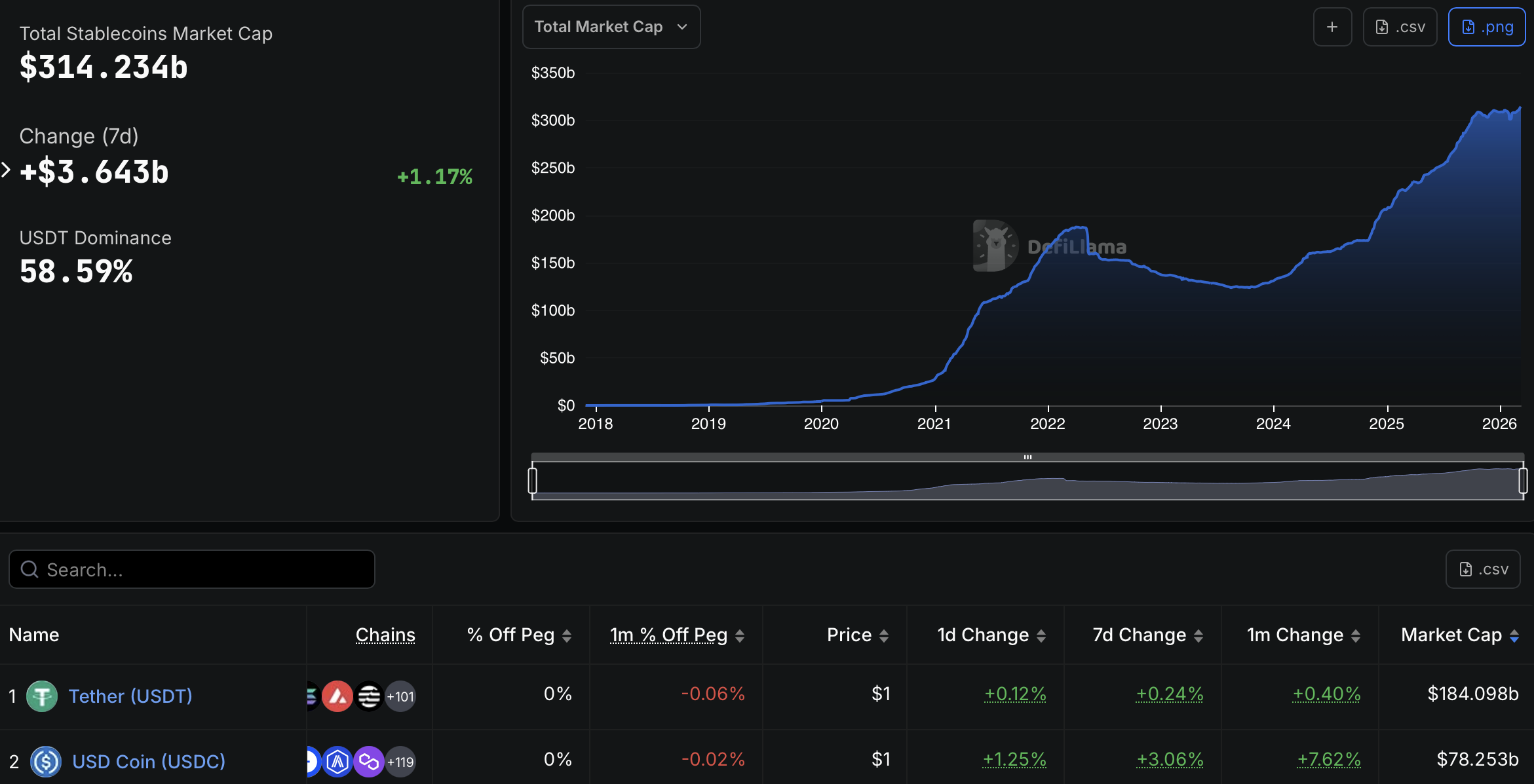
Despite growing interest in euro-denominated tokens, the stablecoin market remains dominated by US dollar-backed assets. Tether’s USDT (USDT) holds a market capitalization of about $185 billion, representing nearly 60% of the sector, while Circle’s USDC (USDC) accounts for roughly $78 billion.
Adoption of digital dollars accelerated in the US after the GENIUS Act passed in July 2025, providing regulatory clarity for stablecoin issuers. Total market capitalization has climbed from around $260 billion on July 20 to more than $314 billion today, per DefiLlama data.
Meanwhile, Europe has taken a more restrictive regulatory approach. The European Union’s MiCA framework introduced new rules for stablecoin issuers in June 2024, requiring companies operating in the European Economic Area to obtain an e-money license in at least one EU member state.
The regulation prompted several exchanges, including Coinbase, OKX, Bitstamp, Uphold and Binance, to remove or restrict support for stablecoins that had not secured authorization under the framework. Tether also decided it would discontinue its euro-pegged stablecoin EURT.
In November, European Central Bank officials warned that the growth of US dollar–backed stablecoins could weaken Europe’s monetary sovereignty by increasing reliance on dollar-denominated digital assets.
Magazine: The debate over Bitcoin’s four-year cycle is over: Benjamin Cowen
Disclaimer: The content of this article solely reflects the author's opinion and does not represent the platform in any capacity. This article is not intended to serve as a reference for making investment decisions.
You may also like
No more mandatory retention! Anthropic launches EFS system, allowing enterprises to take control of their own AI data
Anthropic has launched the public beta of its Enterprise Frontier Security (EFS) system, allowing corporate clients to store AI data on their own cloud platforms, with clients holding their encryption keys. Anthropic only performs automated security scans and cannot access the data itself. The system retains the 30-day data retention requirement, but control over storage is returned to enterprises, addressing strong customer backlash sparked by the mandatory retention policy implemented in June.

Report: Samsung's storage capacity is nearly sold out for the next three years, clients rush to secure long-term contracts until 2031
According to media reports, most of Samsung Electronics' memory manufacturing capacity for the period from 2027 to 2029 has already been secured through contracts. Some customers are even seeking to extend long-term supply agreements until 2031. Currently, leading memory manufacturers can only meet about 60% to 70% of client demand, and the supply shortage may intensify further in 2027.

Anthropic commits to about $900 billion in computing power expenditure; bond market expects its bonds to be junk-rated
Despite Anthropic raising over $100 billion in its public offering and reaching a market capitalization of $1.18 trillion, the company is widely expected by the debt market to be rated as BB-level "junk bonds" due to its lack of profitability and approximately $900 billion in massive computing power expenditure commitments. Amid pressure on tech giants in the debt market and chip companies planning to reduce loan guarantees, Anthropic will still need to rely on structured financing in the short term, facing about a three-year window to strive for an investment-grade rating.
JPMorgan Trading Desk Abandons Tactical Bullish Stance on S&P 500: Rebound May Occur, Bottom Not Yet Reached
J.P. Morgan's trading division has shifted from a tactical bullish stance to a cautious one, expecting stock market volatility in the coming weeks, but emphasizes that market fundamentals—from the economy to earnings—remain solid.

Crypto prices
More


