

Governments and investors are increasingly treating critical materials such as copper and uranium as strategic assets, helping drive what Sprott says could be the early stages of a new commodity bull market.
Commodity markets entered 2026 with renewed momentum as resource equities broke above long-term trading ranges after years of underrepresentation in global portfolios. According to a Sprott report released this week, the emerging cycle differs sharply from past booms, with structural forces such as deglobalization, fiscal expansion and rising geopolitical tensions reshaping demand for raw materials.
Rather than mirroring the China-driven construction boom of 2000–2014 or the inflation-led rally of the 1970s, the emerging cycle is being powered by investment in electricity systems, digital infrastructure and energy security.
Governments are increasingly prioritizing control over critical supply chains, pushing materials tied to electrification, defence and advanced infrastructure into strategic territory.
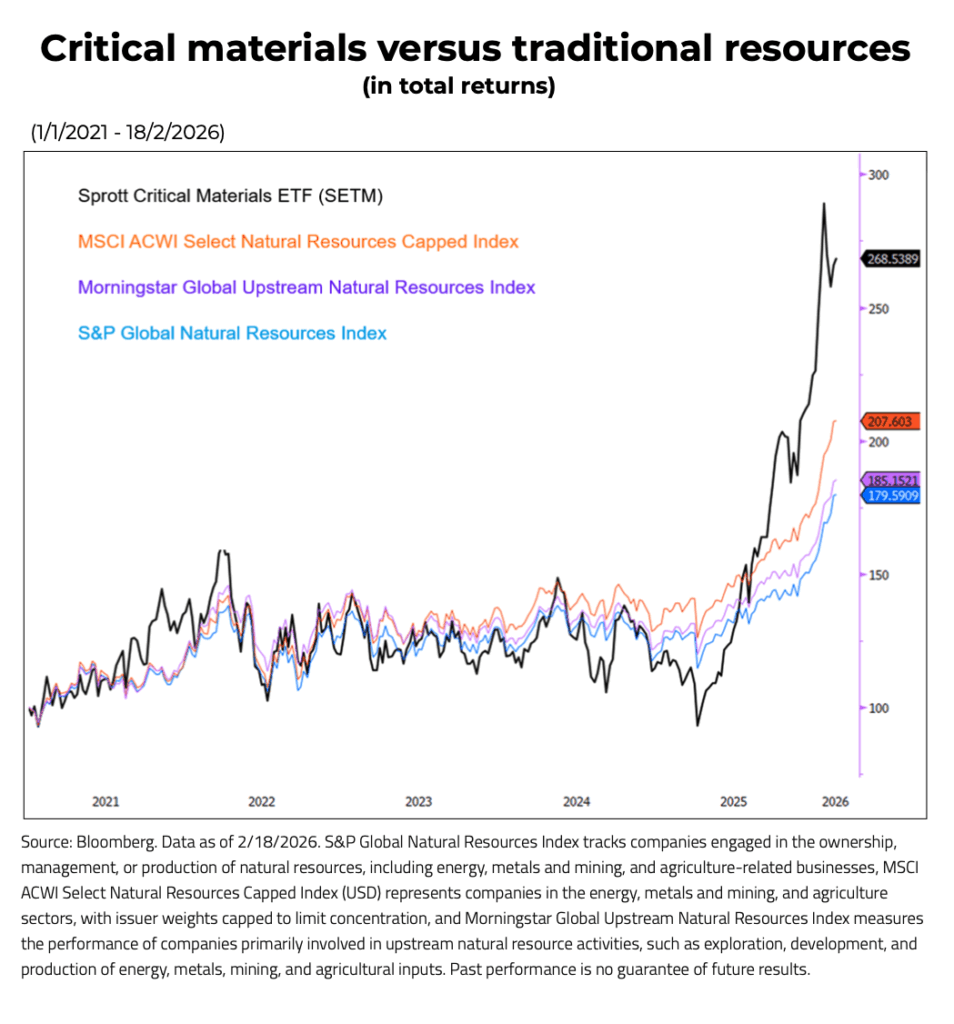
Within the broader resource sector, performance has begun to diverge sharply. Materials tied directly to electrification, power generation and energy security are outperforming traditional bulk commodities that dominated earlier cycles.
 Source: Sprott report.
The report highlights that the Sprott Critical Materials ETF (SETM) has significantly outperformed broader natural resource benchmarks since April 2025, underscoring growing investor focus on metals essential to modern infrastructure.
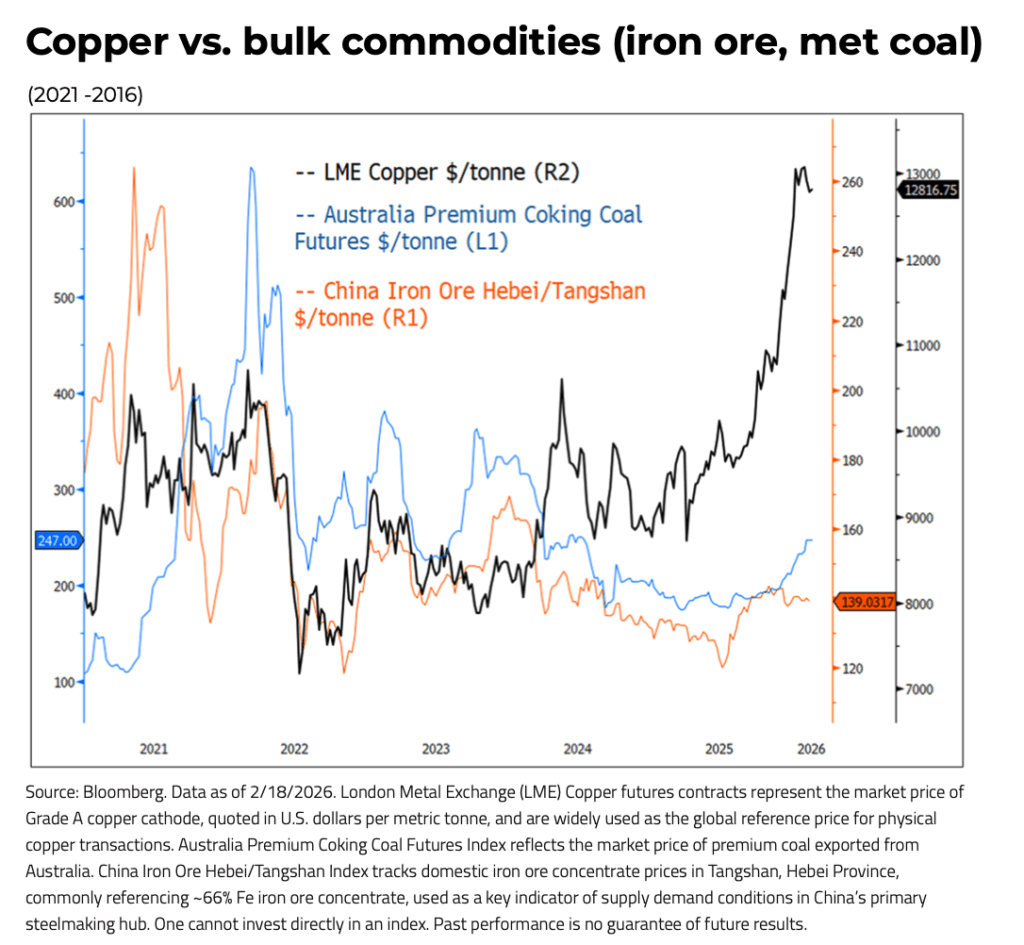
Copper sits at the centre of this shift., helping tighten its supply-demand balance relative to construction-focused bulk commodities. According to Sprott, copper-focused producers have increasingly outperformed large diversified miners whose earnings remain more closely tied to iron ore and other bulks.
Uranium over oil
Energy markets show a similar divergence. Oil markets still face ample supply and a long-term decline in consumption intensity relative to global GDP. Uranium, by contrast, is entering the cycle with constrained supply and strengthening demand as countries revisit nuclear power.
Sprott says the renewed interest in nuclear energy is driven primarily by energy security rather than environmental policy. Governments are extending reactor lifespans, planning new capacity and rebuilding long-term uranium contract coverage on the back of rising geopolitical tensions.
Beyond copper and uranium, the firm sees favourable fundamentals for other critical materials including lithium, rare earth elements and silver. Lithium and rare earths are essential for batteries and high-efficiency motors, while silver benefits from both industrial demand and its role as a monetary metal.
 Source: Sprott report.
The report argues that critical minerals are increasingly being valued not only by traditional supply-demand dynamics but also by their strategic importance to national security and technological infrastructure.
Despite the shift, many resource allocations still emphasize broad exposure to sectors that dominated earlier cycles, such as chemicals, forest products and agriculture. Sprott says this lag in recognition is typical in the early stages of commodity bull markets.
The firm expects investment in power generation, electricity grids, data centres and mineral supply chains to drive demand over a multi-year horizon. At the same time, long project lead times and a decade of underinvestment in new supply could keep markets tight.
Targeted exposure to critical minerals may therefore offer stronger returns than broad commodity allocations, Sprott says. The firm highlights investment vehicles such as the Sprott Critical Materials ETF (NASDAQ: SETM), which focuses on companies deriving at least 50% of revenue or assets from critical materials, and the actively managed Sprott Active Metals & Miners ETF (NYSE: METL).
While volatility remains likely, Sprott believes the structural forces reshaping the global economy could support sustained outperformance for select commodities and mining companies tied to electrification and energy security.


