
Bitcoin company Fold pays off $66M debt, frees up BTC collateral

Fold, a publicly traded Bitcoin financial services company, has eliminated $66.3 million in convertible debt, removing a potential source of share dilution and simplifying its balance sheet as it prepares to expand its product lineup.
In a recent disclosure, Fold said it retired two outstanding convertible notes, which are debt instruments that can be converted into equity at a later date. By paying them off, the company reduces the risk that new shares would be issued in the future, which may dilute existing shareholders.
Fold also said it released 521 Bitcoin (BTC) that had been pledged as collateral against the debt. With the notes retired, those Bitcoin holdings are no longer encumbered and can now be used for corporate purposes.
The company said the restructuring leaves it with fewer financing restrictions and greater operational flexibility. Fold plans to use that flexibility to support growth initiatives, including the rollout of a consumer-targeted Bitcoin rewards credit card that offers BTC instead of traditional points or cash-back rewards.
Founded in 2019, Fold went public on the Nasdaq in February 2025 through a SPAC merger with FTAC Emerald Acquisition, becoming one of the first Bitcoin-focused financial services companies to trade on a major US exchange.
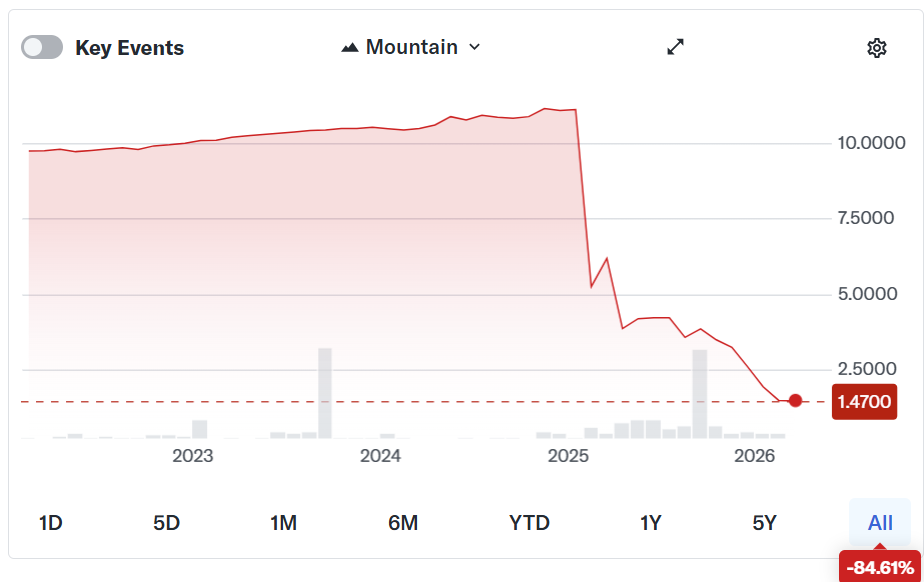 Fold (FLD) shares are down more than 84% since their public debut. Source:
Yahoo Finance
Fold (FLD) shares are down more than 84% since their public debut. Source:
Yahoo Finance
Related:
Crypto rewards cards compete for users
Fold built its brand as a Bitcoin rewards platform, offering a debit card that allows users to spend US dollars while earning Bitcoin cashback on everyday purchases. Over time, the company expanded its services to include savings features and merchant partnerships aimed at encouraging Bitcoin accumulation rather than direct crypto spending.
Competition is fierce in the crypto rewards space, with a number of other companies offering similar products.
The Coinbase Card, for example, allows users to spend cryptocurrency balances directly and earn crypto rewards on purchases. It is now part of Coinbase’s broader “super app” strategy announced last fall, which aims to integrate payments, trading and other financial services into a single platform.
Rival offering Nexo Card lets customers borrow against their crypto holdings to make purchases without selling their assets, while earning rewards. Bybit and Crypto.com offer Visa-branded cards that provide cashback in crypto tokens tied to their platforms.
 Source:
MetaMask
Source:
MetaMask
More recently, Mastercard and MetaMask launched a US crypto-linked card that allows users to spend digital assets at any merchant that accepts Mastercard, with crypto converted to fiat at the point of sale.
Related:
Disclaimer: The content of this article solely reflects the author's opinion and does not represent the platform in any capacity. This article is not intended to serve as a reference for making investment decisions.
You may also like
The U.S. 2026 fiscal year budget deficit is $1.99 trillion, up 12%, with interest expenses reaching a record high.
U.S. fiscal year 2026 expenditures are projected to grow by 6% to $7.4 trillion, while revenues are expected to increase by 3% to $5.4 trillion, resulting in a widening fiscal gap. Net interest spending will rise by $81.4 billion to $1.05 trillion, marking a new record high. The Trump tax cuts have caused corporate income tax revenue to decrease by more than $70 billion. Besant has identified tariff refunds as one of the key factors contributing to the expanding deficit. The IMF, European Central Bank, and CBO have all questioned the logic of “growth to solve deficits.”

Gold looks to housing, PMI and consumer sentiment data for direction next week

Inflation Shocks Wall Street as Selling Pressure Builds: 5 Altcoins to Try Before the Next Major Rally

Analytics Firm Says, “There’s a 90% Chance We’re at the Start of a Bull Market,” and Reveals Its Favorite Altcoins
Crypto prices
More


