
Bloomberg extends financial data to $25B tokenized markets via Kaiko

Bloomberg is collaborating with Kaiko, a Paris-based digital asset market data provider, to make Bloomberg’s licensed financial data accessible directly within blockchain environments rather than through traditional offchain databases.
The companies said Thursday that the initiative is designed to address the challenge of inconsistent data across tokenized markets.
In many tokenized asset ecosystems, companies may rely on different versions of pricing data, security identifiers or reference information, increasing the risk of discrepancies and operational inefficiencies.
By enabling a common, licensed data source to be embedded onchain, the collaboration aims to ensure that market participants reference the same dataset, potentially reducing reconciliation disputes and improving data integrity.
The first use case focuses on tokenized US Treasurys and repo markets operating on the Canton Network, a permissioned blockchain network designed for institutional financial applications. Kaiko launched that data on-ramp service in August.
The integration targets banks, asset managers and other regulated financial institutions experimenting with blockchain-based versions of traditional financial instruments, rather than retail crypto traders.
Questions around data reliability and market size in tokenized real-world assets (RWAs) have surfaced before.
In May, Cointelegraph interviewed Chris Yin, co-founder of RWA platform Plume, who said that the tokenized asset market may be significantly smaller than figures cited by some industry aggregators. At the time, Yin said the sector’s actual size was likely closer to half of what major data sources were reporting.
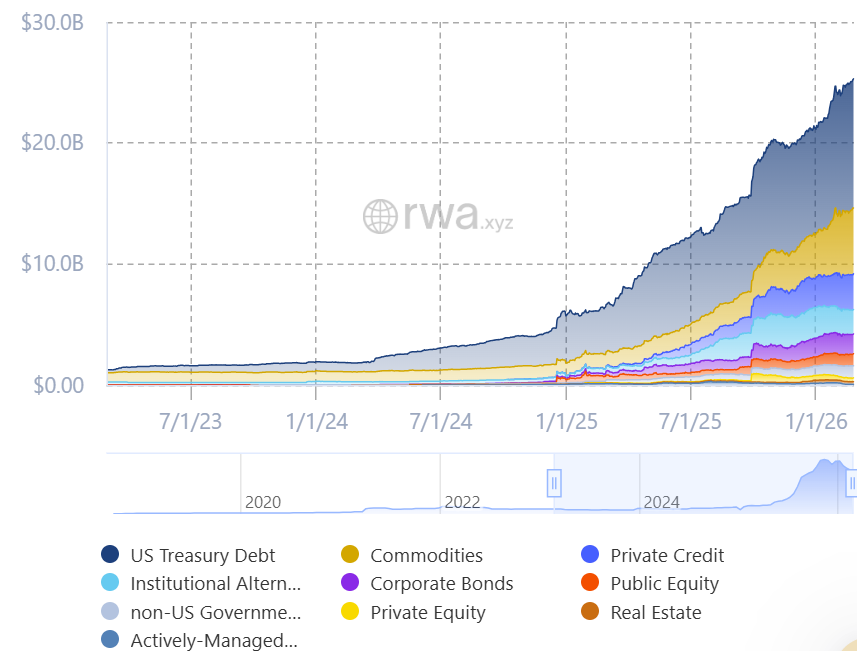 According to at least one estimate, the current size of the tokenized RWA market excluding stablecoins is about $25 billion. Source:
Related: Hong Kong to link new digital bond platform with regional tokenization hubs
Why data integrity matters for tokenized markets
Kaiko CEO Ambre Soubiran said institutional-grade data is essential for well-functioning financial markets, stating that the collaboration with Bloomberg “will extend the availability of market data used in traditional markets to now support the next generation of tokenized securities infrastructure.”
Kaiko expanded its footprint in the digital asset data sector with its 2024 acquisition of European crypto index provider Vinter, strengthening its presence in regulated benchmark and index services across Europe.
Reliable data has long been a priority in the digital asset industry, where market participants have relied not only on price feeds but also on onchain analytics and sentiment indicators to improve transparency.
In tokenized markets, particularly those linked to real-world assets like Treasurys, consistent pricing data and reference information help ensure that onchain assets accurately mirror the underlying financial instruments.
Related: Aster’s quiet relisting on DefiLlama leaves ‘big gaps’ in data: Exec
Disclaimer: The content of this article solely reflects the author's opinion and does not represent the platform in any capacity. This article is not intended to serve as a reference for making investment decisions.
You may also like
NEWMARK GROUP INC <NMRK.O>: KBW CUTS TARGET PRICE TO $16 FROM $17.50
NEWMARK GROUP INC : KBW CUTS TARGET PRICE TO $16 FROM $17.50
VALERO ENERGY CORP <VLO.N>: JEFFERIES CUTS TARGET PRICE TO $394 FROM $401
VALERO ENERGY CORP : JEFFERIES CUTS TARGET PRICE TO $394 FROM $401
Gold prices rise Rs 1,500/10g; silver up Rs 3,100/kg ahead of US economic data, softer yields. Buy, sell or hold?
The Shopify Stock Rally Isn't Done: Chart of the Week -- Barrons.com
By Doug Busch Shopify is no longer a pandemic-era growth story that simply failed to slow down. It is compounding at a pace few software platforms its size still manage. In the second quarter of 2026, sales on its platform rose 32%. That was the fifth straight quarter of growth exceeding 30%. Merchants are also using more of Shopify's own tools, from payments to Shop Pay, and new channels like AI shopping agents are starting to increase demand. The simple bull case is that the stock already commands a huge share of independent online commerce, and that position should become more valuable as more buying moves through its checkout. A rule of market mechanics is that the vast majority of an individual security's gain is driven by its underlying sector. Within technology, software has staged a robust recovery, joining semiconductors to power the broader sector higher. The iShares Expanded Tech-Software Sector ETF has maintained an upward trajectory since its mid-April lows, though the advance from $74 to $112 has been choppy as bulls repeatedly stepped in to defend when necessary. Breadth across large-cap software has expanded significantly, with 24 constituents surging over 20% over the past three months. During that same three-month window, Shopify generated outstanding relative strength, advancing 36%, more than doubling the IGV's 17% gain over the same period. Expect the stock's outperformance to persist as software momentum broadens. Let's examine the daily and monthly charts to outline the technical drivers behind this thesis. Looking at the daily chart, the ratio chart against the IGV shows persistent outperformance extending back to mid-May. The stock is riding an eight-session winning streak, during which price action cleared a double-bottom-with-handle pivot at $151.39. Within this broader base, the stock recorded a bullish golden cross in late August and successfully filled its Sept. 10 price gap, tracing back to its Aug. 4 session, the day before a powerful earnings reaction sent the stock surging 17% hi
Crypto prices
More


