
US lender Rate unveils mortgage program recognizing crypto holdings

US mortgage lender Rate has launched a nationwide program that allows qualified borrowers to use verified cryptocurrency holdings to help meet underwriting requirements without liquidating their assets, marking a formal step toward integrating digital assets into traditional home financing.
The product, called RateFi, operates within the lender’s existing non-qualified mortgage framework and permits borrowers to count verified crypto assets as qualifying reserves and, in some cases, as an income source.
Kate Amor, EVP and head of enterprise products at Rate, told Cointelegraph that for underwriting purposes, RateFi assesses digital asset holdings through a proprietary valuation framework that factors in market price, liquidity and asset-specific volatility. The approach enables certain crypto assets to count toward borrower qualification without being liquidated, while still applying traditional mortgage risk standards.
However, any digital assets used for a down payment or closing costs must still be converted to cash.
The rollout comes as more than 10% of Americans report holding digital assets, according to the company, yet most traditional mortgage programs do not recognize cryptocurrency as qualifying collateral unless it is first liquidated.
Liquidating or selling assets often triggers a taxable event or other tax implications, limiting borrowers to pledged-asset loan structures.
Amor said RateFi is designed to work with a curated set of established, high-liquidity large-cap cryptocurrencies and major US dollar-backed stablecoins, though she did not identify the specific assets supported.
Eligible crypto assets must be held with approved custodians or centralized exchanges, and borrowers are required to provide proof of ownership and asset seasoning, typically through monthly statements.
Amor told Cointelegraph that housing affordability pressures are a key factor driving interest in crypto-enabled home financing solutions. She said:
Younger generations are entering their peak homebuying years at a time when traditional paths to ownership are increasingly out of reach, yet they’re also the most active participants in the digital asset economy.
She added that the program “is about recognizing how wealth is actually built today and modernizing access to homeownership accordingly, vs. promoting crypto for its own sake. For many younger Americans, crypto is a foundational part of their financial planning.”
Rate said the program applies standard anti-money laundering (AML) and know-your-customer (KYC) verification and is available through its existing digital mortgage platform.
Related:
Crypto wealth meets US housing affordability crisis
Housing affordability remains a major economic challenge in the United States, particularly for younger Americans, and has drawn increased attention from the Trump administration and lawmakers in recent months.
Absent any legislation that would open up crypto-backed mortgage lending to the broader US market, policymakers have begun exploring how digital assets could be incorporated into housing finance frameworks.
In June 2025, Federal Housing Finance Agency Director William J. Pulte instructed government-sponsored mortgage buyers Fannie Mae and Freddie Mac to draft proposals on treating cryptocurrency as a reserve asset in single-family mortgage risk assessments.
In July, Senator Cynthia Lummis introduced the 21st Century Mortgage Act to codify that directive into law.
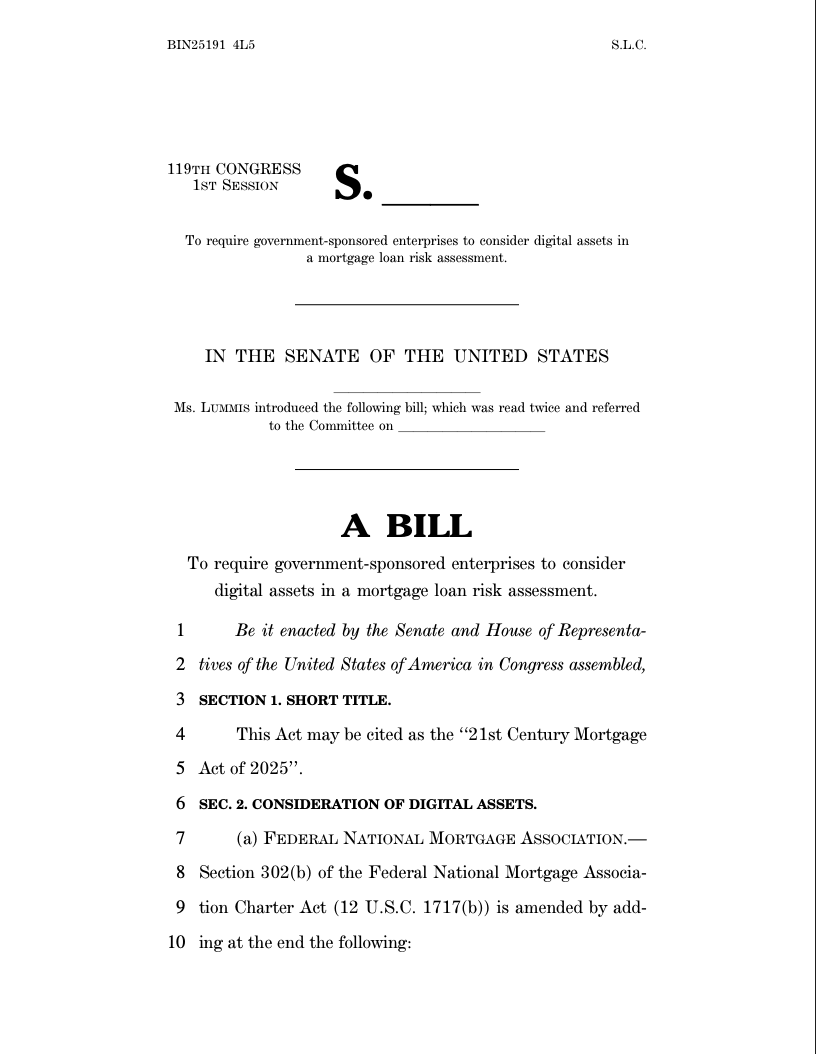 The 21st Century Mortgage Act. Source:
Senator Cynthia Lummis
The 21st Century Mortgage Act. Source:
Senator Cynthia Lummis
A niche market for crypto-backed real estate financing already exists. Lenders such as Nexo offer loans backed by more than 40 digital assets, while Ledn provides Bitcoin-backed mortgage products that allow borrowers to pledge Bitcoin (BTC) as collateral.
A January survey of 1,000 Americans published in the OKX Insights series found a pronounced generational divide in attitudes toward digital assets, with younger respondents far more likely to view crypto as credible and central to the future of finance.
Magazine:
Disclaimer: The content of this article solely reflects the author's opinion and does not represent the platform in any capacity. This article is not intended to serve as a reference for making investment decisions.
You may also like
SpaceX, Broadcom, and Oracle Issue Massive Bonds! The U.S. Bond Market Is “Overflowing,” “Concentration Is Increasing, Ultimately All Influenced by the AI Cycle”
The AI financing wave has generated over $150 billion in debt demand within a week, saturating the public debt market and forcing a massive shift toward private credit and SPVs. "Crowding-out effects" in the debt market have pushed the 10-year US Treasury yield back to 5.31%, while CCC-rated junk bond spreads are nearing the historic threshold of 1,000 basis points. Oracle's five-year default probability has been priced by the market at over 20%, and SpaceX's CDS has nearly doubled in four months. Goldman Sachs warns that AI borrowers are "prepared to pay any price," with consumers, small businesses, and even governments ultimately footing the bill.
SpaceX Acquires Low-Frequency Spectrum with Massive Investment, Enters Mobile Operator Market; US Telecom Stocks Plummet
SpaceX announced the acquisition of 800MHz low-band spectrum covering the entire U.S. and has been authorized by the FCC to deploy 15,000 direct-to-cell satellites, officially declaring its independent entry into the U.S. mobile carrier market. Following the news, AT&T, T-Mobile, and Verizon all fell by more than 6% after hours. With $93.5 billion in cash and 12 million Starlink subscribers, Elon Musk is using this "final piece of the puzzle" to reshape the competitive landscape of the entire telecommunications industry.
Firmus backed by Nvidia delays Australian listing, casting a shadow over data center IPO candidates
The Australian IPO of data center company Firmus Grid Ltd., supported by Nvidia (NVDA.US), is expected to be delayed, which is an ominous sign for other companies planning to go public.
Crypto prices
More


