
Deel taps MoonPay to roll out stablecoin salary payouts in UK, EU

Global payroll platform Deel will begin offering stablecoin salary payouts through a partnership with MoonPay, starting with workers in the UK and EU next month. The integration allows employees to receive wages directly in stablecoins to non-custodial crypto wallets, with a US rollout planned in a later phase.
Deel processes $22 billion in payroll annually worldwide, to more than 150 million workers, the company said in October. It will use MoonPay to handle stablecoin conversion and onchain wallet delivery, effectively adding crypto settlement rails to its existing payroll infrastructure, according to Tuesday’s announcement.
Under the arrangement, workers will be able to opt in to receive part or all of their salary in stablecoins, instead of local fiat currencies. MoonPay will manage the conversion and settlement process, while Deel continues to operate the payroll and compliance layer.
JP Richardson, co-founder and CEO of Exodus, said the partnership signals a broader shift toward everyday crypto use. “You don’t bring the world into crypto with whitepapers. You do it with paychecks,” Richardson wrote, arguing that stablecoin payroll will reduce cross-border payment delays and intermediary fees for workers globally.
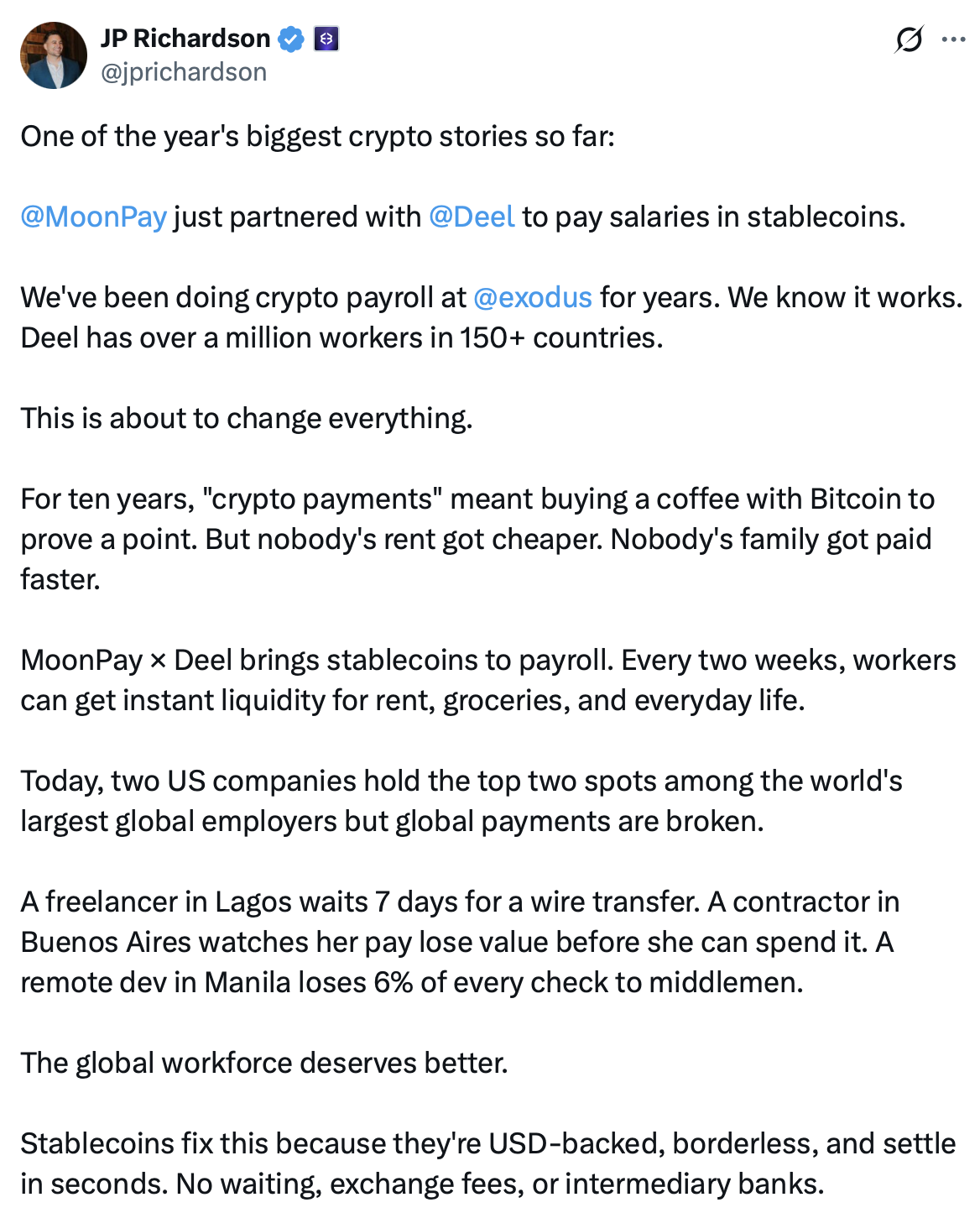 Source:
JP Richardson
Source:
JP Richardson
The partnership expands Deel’s existing crypto payout options and adds another enterprise distribution channel for MoonPay, which holds a New York BitLicense and money transmitter licenses across the US, as well as authorization under the EU’s MiCA framework.
The companies did not disclose which stablecoins will be supported or how many users are expected to opt in at launch. They also did not provide a specific time line for the US expansion or details on regulatory approvals tied to the second phase.
Related: European Parliament throws support behind digital euro
Stablecoin space is becoming increasingly crowded
While MoonPay and Deel’s rollout targets workers in the UK and EU, the partnership comes amid rapid expansion in the US dollar–pegged token market. Since the US Congress established a federal framework for payment stablecoins in July 2025 with the GENIUS Act, a growing number of companies have moved to launch regulated stablecoins in the US.
In March, World Liberty Financial, a DeFi platform linked to the Trump family, launched its USD1 stablecoin, and in January, Wyoming became the first US state to issue its own stablecoin, the Frontier Stable Token (FRNT).
The same month, Tether, issuer of the world’s largest stablecoin USDt (USDT), confirmed the launch of USAt, a US dollar–pegged token issued through Anchorage Digital Bank and positioned as a federally regulated payment stablecoin for use within the US.
Some traditional US banks are also preparing to enter the stablecoin market after the Federal Deposit Insurance Corp. proposed a framework outlining how subsidiaries of FDIC-supervised banks could apply to issue payment stablecoins in December.
Despite the wave of new entrants, the market remains heavily concentrated. According to DefiLlama data, Tether’s USDt accounts for about 60% of total stablecoin market capitalization, while Circle’s USDC (USDC) represents about 24%.
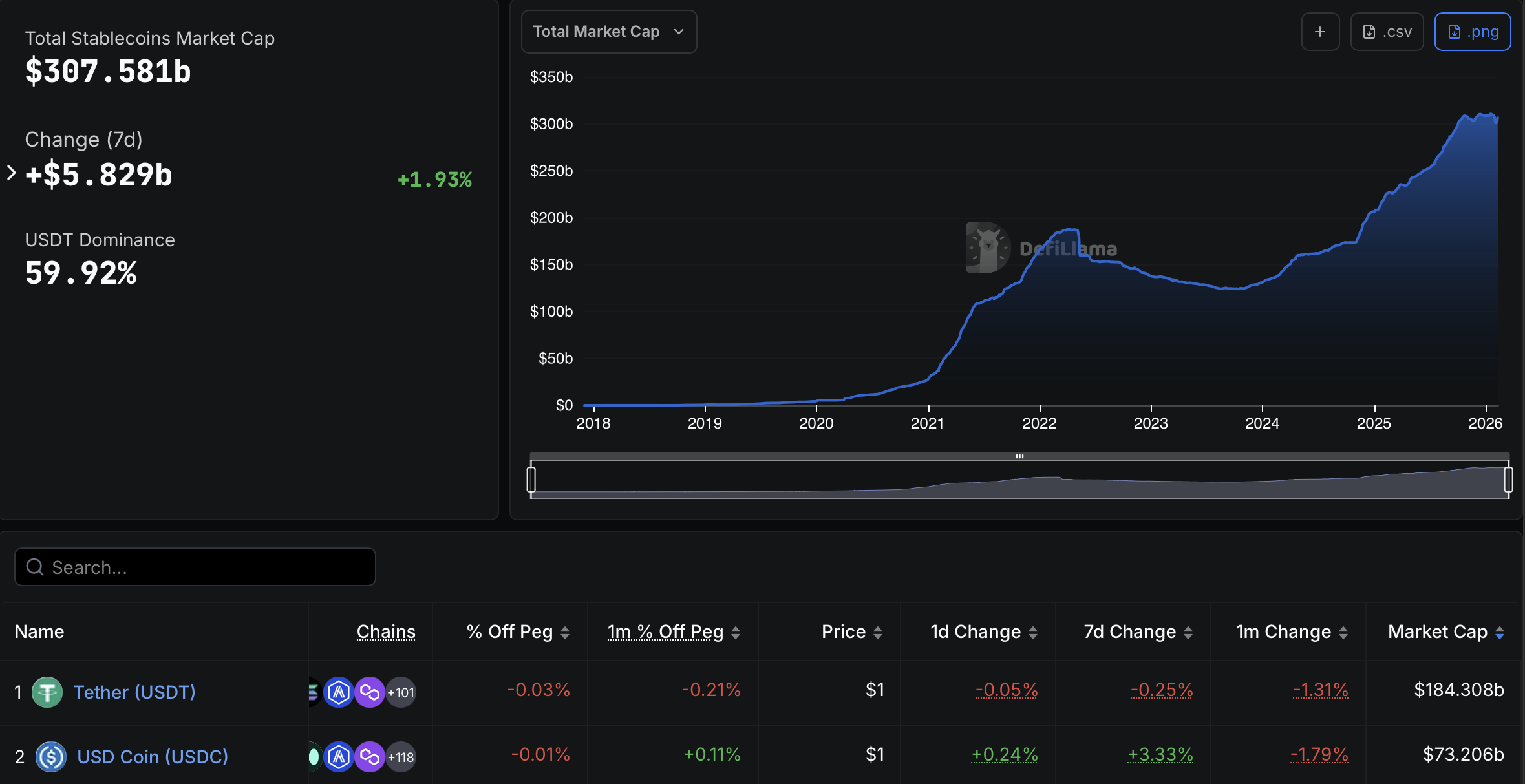 Stablecoin market cap. Source:
DefiLlama
Stablecoin market cap. Source:
DefiLlama
Magazine: Is China hoarding gold so yuan becomes global reserve instead of USD?
Disclaimer: The content of this article solely reflects the author's opinion and does not represent the platform in any capacity. This article is not intended to serve as a reference for making investment decisions.
You may also like
Agent "reshapes" the service industry! Muse reignites "panic" and financial stocks "take a hit"
On Tuesday, the US stock market's financial sector plunged about 2% in a single day. Institutions such as JPMorgan Chase, Wells Fargo, and Charles Schwab saw their largest declines in months. Insurer Allstate and travel booking platform Booking Holdings were also affected. Analysts pointed out that AI agents can automatically perform price comparisons and bill management, directly disrupting business models that rely on "consumer inertia."
OpenAI and Anthropic Launch "Low-Cost Models" on the Same Day, Kicking Off a "Price War"
Anthropic launched Claude Opus 5.5, with costs 40% lower than the previous generation; OpenAI released Sol and Luna, priced 50% lower than the previous series. The driving force behind these price reductions is the continued market share expansion of Chinese open-weight models. Additionally, Anthropic is using this opportunity to lay the groundwork for the largest tech IPO in history, while OpenAI aims to reverse its sluggish growth from earlier this year.
From "Shovel Sellers" to "Shovel Makers": How Innodata (INOD.US) Achieved a Transformation with the Tailwind of Meta AI
Overnight, U.S. stock Innodata surged 15% in a single day, directly triggered by a research report from Hunterbrook Capital. The report indicated that Meta's newly launched personal AI agent, Muse, is likely to achieve significant success, and Innodata is likely one of Meta's largest data service clients.
ECB Governing Council Member Nagel: If energy prices remain high, interest rates may need to be raised to a moderately restrictive level
Joachim Nagel, a member of the European Central Bank's Governing Council and President of the German Bundesbank, said that if energy prices remain high, the European Central Bank may have to raise interest rates to levels that restrain economic growth.
Crypto prices
More


