
India’s US Treasury Holdings Hit Five-Year Low, Another Major Player Joins the Global Central Bank “Gold Buying Alliance”

India's holdings of US Treasury bonds have dropped to a five-year low, as the country works to support its currency and diversify its foreign exchange reserves, joining a broader trend of major economies reducing exposure to the world’s largest bond market—the US Treasuries.
According to US government data released last week, India's holdings of long-term US Treasuries have fallen to $174 billion, a 26% decrease from the 2023 peak. Data from the Reserve Bank of India shows that US Treasuries now account for a third of India’s foreign exchange assets, compared to 40% a year ago.
With gold and other alternative assets taking a larger share in India’s reserves, this shift echoes moves by larger holders, rekindling questions about American exceptionalism and the role of its government bonds as reserve assets. Trump’s renewed trade threats over the Greenland issue have only deepened these concerns, raising the possibility that European governments might also start reducing their US Treasury holdings.
Win Thin, chief economist at Nassau 1982 Bank with nearly forty years of market experience, stated that this shift is largely a reflection of countries reducing dollar assets to minimize sanctions risk. “India still has room to cut its US Treasury positions.”
The Reserve Bank of India did not respond to requests for comment on its reduced holdings of US Treasuries. India’s Finance Minister Nirmala Sitharaman said in September last year that the central bank was making “very prudent decisions” to achieve reserve diversification.
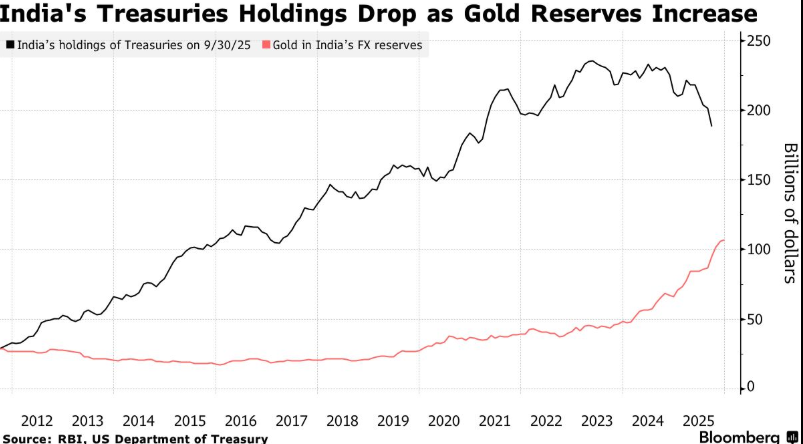 India increases gold holdings as it reduces US Treasuries
 For Mumbai (financial markets) and beyond, the lesson comes from the US freezing Russia’s foreign reserves following the outbreak of the Russia-Ukraine conflict in February 2022. Since then, India’s continuous purchases of Russian oil have become a point of contention with US President Trump, resulting in the US imposing hefty tariffs on the Asian nation.
“The speed of deterioration in US-India relations last year surprised many and prompted policymakers to reduce their vulnerabilities,” said Shilan Shah of Capital Economics, who was ranked by Bloomberg as the most accurate forecaster of the rupee exchange rate last quarter.
Part of the reasoning behind this move stems from the Reserve Bank of India’s efforts to defend the battered rupee. With US tariffs on Indian exports reaching as much as 50% (the highest in Asia), US-India trade agreements have been delayed and the rupee has fallen to record lows. By selling US Treasuries, the Reserve Bank of India can use the proceeds to buy rupees and support its value.
Within the investment community, Trump’s global trade tariffs and the weaponization of the dollar through sanctions have raised questions over whether US Treasuries remain the best choice. Recent US raids on Venezuela have further heightened these concerns.
As of November last year, the Reserve Bank of India was not a major holder of US Treasuries, with its holdings just a quarter of China’s nearly $683 billion and far below Japan’s $1.2 trillion. Moreover, the total amount of US Treasuries held by foreign entities remains near record highs. Nevertheless, India’s sell-off has intensified the debate over the role of US sovereign bonds in global portfolios.
Buying Gold
Central banks around the world now have to navigate an increasingly complex policy landscape, putting greater pressure on reserve allocation. While the dollar (and by extension US Treasuries) remains the world’s primary reserve asset, the search for alternatives is undoubtedly gaining traction.
The Reserve Bank of India’s selling comes as it continues to ramp up gold purchases. In October last year, Brazil slashed its long-term US Treasury holdings to the lowest level since at least 2011. Just this week, Poland’s central bank—the world’s largest disclosed gold buyer—approved a plan to purchase another 150 tons of gold.
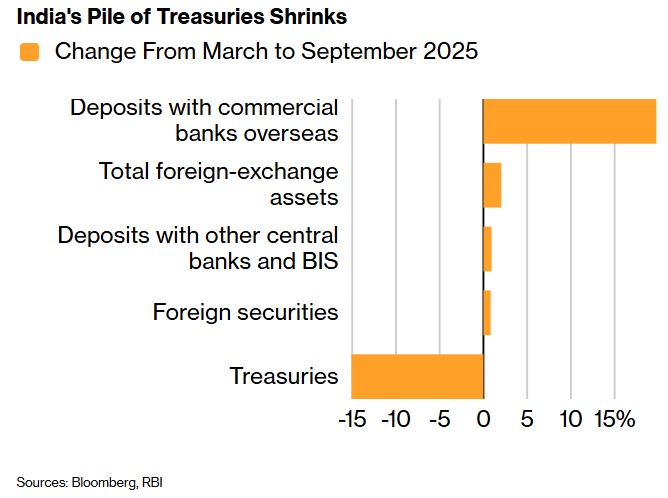 India’s US Treasury reserves shrink
 There are also reasons to believe that India’s pace of selling US Treasuries may slow, such as rupee stabilization reducing intervention needs, or if stalled trade agreements are finally reached, easing tensions.
“If a trade agreement is reached, the need to aggressively defend the currency may diminish,” said Krishna Bhimavarapu, Asia-Pacific economist at State Street Global Advisors.
However, more and more market observers say that the shift to other assets is underway. A survey by the think tank Official Monetary and Financial Institutions Forum (OMFIF) in November last year found that the vast majority of central banks still hold dollars, but nearly 60% plan to seek alternatives in the next year or two.
“The trend is now very clear,” said Michael Brown, Senior Research Strategist at London’s Pepperstone, referring to India’s sell-off of US Treasuries. A trade agreement “would only stabilize (India’s) holdings of US Treasuries, rather than trigger some kind of large-scale buying spree.”
Disclaimer: The content of this article solely reflects the author's opinion and does not represent the platform in any capacity. This article is not intended to serve as a reference for making investment decisions.
You may also like
SpaceX, Broadcom, and Oracle Issue Massive Bonds! The U.S. Bond Market Is “Overflowing,” “Concentration Is Increasing, Ultimately All Influenced by the AI Cycle”
The AI financing wave has generated over $150 billion in debt demand within a week, saturating the public debt market and forcing a massive shift toward private credit and SPVs. "Crowding-out effects" in the debt market have pushed the 10-year US Treasury yield back to 5.31%, while CCC-rated junk bond spreads are nearing the historic threshold of 1,000 basis points. Oracle's five-year default probability has been priced by the market at over 20%, and SpaceX's CDS has nearly doubled in four months. Goldman Sachs warns that AI borrowers are "prepared to pay any price," with consumers, small businesses, and even governments ultimately footing the bill.
SpaceX Acquires Low-Frequency Spectrum with Massive Investment, Enters Mobile Operator Market; US Telecom Stocks Plummet
SpaceX announced the acquisition of 800MHz low-band spectrum covering the entire U.S. and has been authorized by the FCC to deploy 15,000 direct-to-cell satellites, officially declaring its independent entry into the U.S. mobile carrier market. Following the news, AT&T, T-Mobile, and Verizon all fell by more than 6% after hours. With $93.5 billion in cash and 12 million Starlink subscribers, Elon Musk is using this "final piece of the puzzle" to reshape the competitive landscape of the entire telecommunications industry.
Firmus backed by Nvidia delays Australian listing, casting a shadow over data center IPO candidates
The Australian IPO of data center company Firmus Grid Ltd., supported by Nvidia (NVDA.US), is expected to be delayed, which is an ominous sign for other companies planning to go public.
Natural gas pipeline delays threaten the progress of AI data center projects! Oracle (ORCL.US) resorts to the "trucking gas" strategy to ensure power supply
Oracle (ORCL.US) is adopting a novel power supply strategy—transporting natural gas directly to server campuses by truck—to ensure that multiple data center projects progress as planned.
Crypto prices
More


