

The Search Engine That Isn’t Called a Search Engine
Something shifted in how people find products now, and most marketing teams are still catching up.
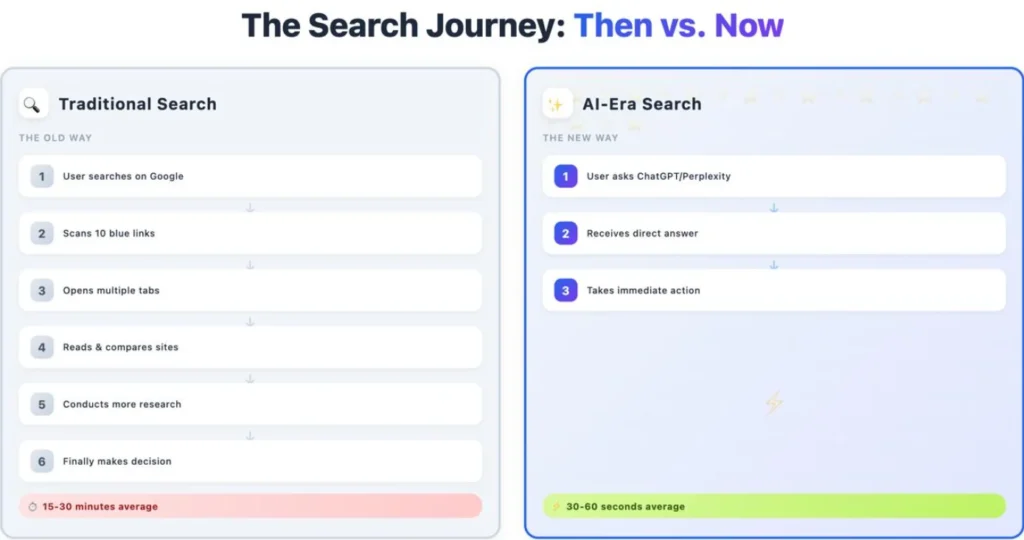
When a user asks ChatGPT “what’s the best anonymous crypto exchange,” they’re not conducting research — they’re making a purchase decision. When someone queries Perplexity about “how to swap ETH without KYC,” they’re one click away from conversion. These interactions look like conversations, but they function as search.
Obviously, the distinction matters now. Traditional SEO has spent two decades optimizing for Google’s algorithm. But a growing slice of high-intent queries now flows through AI assistants that pull answers from different sources, weight authority differently, and present results in fundamentally new ways.
For businesses operating in restricted advertising categories — cryptocurrency, CBD, gambling, certain financial services — this shift isn’t academic. It’s existential. When paid channels are limited or prohibited, organic visibility becomes the entire acquisition strategy.
One anonymous crypto exchange learned this firsthand. Facing declining organic traffic and unable to scale paid campaigns in a heavily regulated niche, the platform turned to ICODA, an agency specializing in AI-focused SEO for the crypto sector. What followed was a six-month experiment that produced results significant enough to warrant attention from marketers far outside the blockchain space.
The Problem: A Shrinking Organic Footprint in an Advertising Desert
Godex.io operates in a specific corner of the cryptocurrency market: no-KYC exchanges that allow users to swap tokens without identity verification. It’s a legitimate service with clear demand — privacy-conscious users, those in restrictive jurisdictions, and traders who simply prefer minimal friction.
But marketing such services presents obvious challenges. Google Ads restricts cryptocurrency advertising. Meta’s policies make paid social unreliable. Even programmatic display networks often decline crypto clients. The platform had relied on organic search, but traditional SEO efforts were producing diminishing returns. Google’s algorithm updates had impacted visibility, and the competitive landscape was intensifying.
The client needed an approach that could generate traffic without paid media — and ideally, one that would position them ahead of competitors rather than simply catching up.
ICODA proposed a strategy built around an emerging premise: AI-powered search platforms represent a distinct channel requiring distinct optimization. Rather than treating ChatGPT citations as a byproduct of good SEO, the agency approached AI visibility as a primary objective.
Building for Algorithms That Read, Not Just Crawl
The tactical framework the agency deployed combined traditional SEO fundamentals with specific adaptations for AI retrieval systems.
Intent-based keyword clustering. Queries were segmented by user intent: transactional terms indicating purchase readiness versus informational queries from users still in research mode. Content was mapped accordingly, with different page types, structures, and calls-to-action aligned to where users sat in their decision process.
PR as a search signal. Perhaps most critically, ICODA executed a sustained PR campaign targeting crypto and fintech publications. The goal wasn’t brand awareness in the traditional sense — it was generating editorial citations that AI systems would recognize as trust signals. When ChatGPT or Perplexity synthesizes information about a topic, they draw from sources they deem authoritative. Mentions in recognized publications effectively vote for a brand’s credibility in AI retrieval.
E-E-A-T alignment. Google’s Experience, Expertise, Authoritativeness, and Trustworthiness framework guided content creation. But the same principles apply — arguably more directly — to AI systems that must decide which sources to cite when answering user queries. Content demonstrated clear expertise, linked to verifiable information, and avoided the thin affiliate-style pages common in the crypto space.
Multi-platform optimization. Rather than optimizing solely for Google, the strategy accounted for Bing (which powers Copilot), the specific retrieval patterns of Perplexity, and the training data considerations relevant to ChatGPT. Each platform has different biases and source preferences; the campaign addressed these individually.
The Numbers: What Six Months Produced
Between June and November, the results accumulated across multiple platforms:
| Traffic Source | Growth | Significance |
| ChatGPT referrals | +688% | High-intent users who asked an AI assistant for recommendations and clicked through to the platform |
| Perplexity referrals | +268% | Valuable for consideration-stage queries as the platform gains traction among research-oriented users |
| Bing organic | +726% | Bing’s integration with Copilot means strong rankings contribute to AI visibility across Microsoft’s ecosystem |
According to Ahrefs’ AI visibility metrics, the platform achieved a top-two position among competitors in its niche. For a category where differentiation is difficult, this represents meaningful separation.
The citation data tells the fuller story. Across AI search platforms, the crypto exchange accumulated over 200 citations:
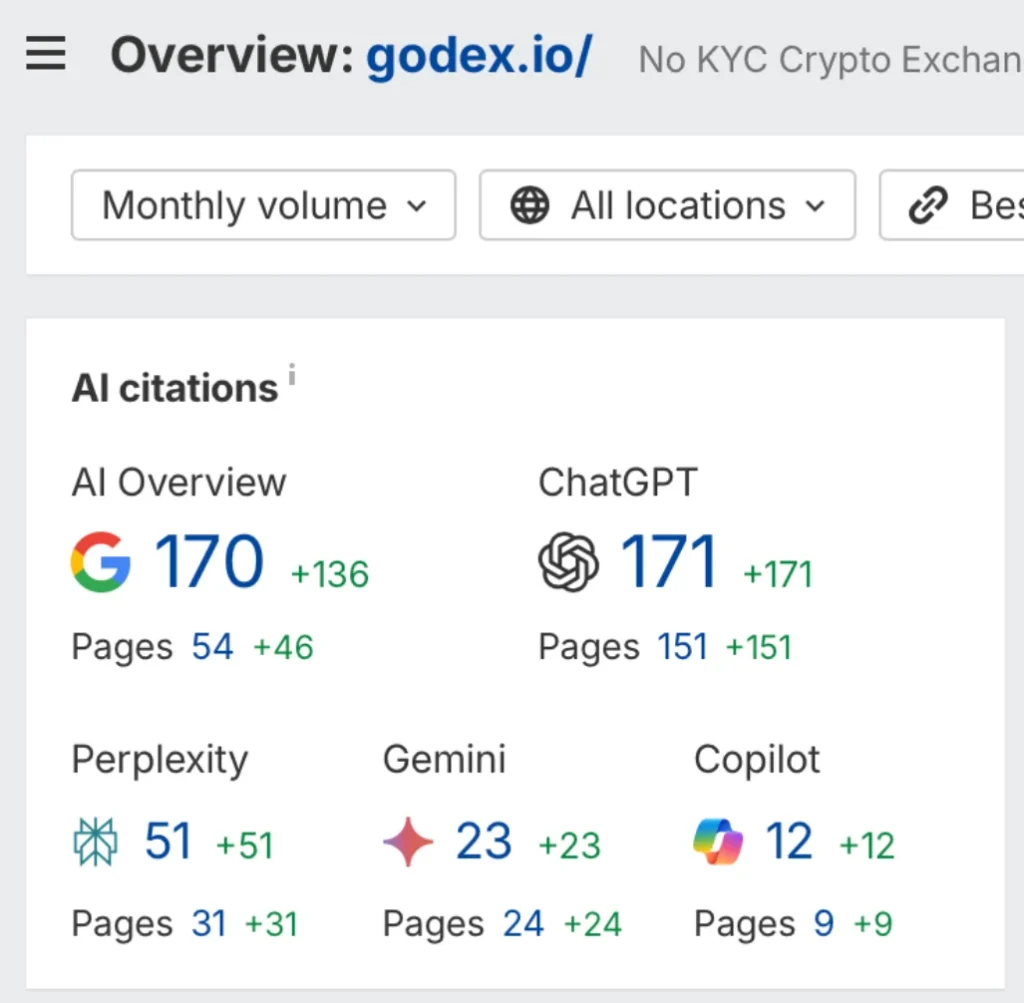
- Google AI Overview: 170 citations (an increase of 136)
- ChatGPT: 171 citations (all new)
- Perplexity: 51 citations (all new)
- Gemini: 23 citations (all new)
- Copilot: 12 citations (all new)
These citations function as earned placements. When a user asks about anonymous crypto exchanges and the AI mentions specific platforms, that’s effectively an unpaid recommendation from a source users increasingly trust.
Why AI Visibility Compounds Differently
Traditional SEO operates on familiar dynamics: rankings fluctuate, competitors optimize, algorithm updates reshuffle positions. The work is never finished, and advantages erode without continuous investment.
AI visibility may compound differently — at least for now.
When ICODA’s strategy generated citations in ChatGPT, those citations didn’t disappear the following month. AI systems update their knowledge bases, but not with the constant reshuffling of search engine results pages. A strong position in an AI’s training data or retrieval corpus persists longer than a volatile SERP ranking.
There’s also an awareness gap working in early adopters’ favor. Most companies aren’t optimizing for AI search yet. They’re monitoring it, perhaps, or waiting for clearer best practices. Meanwhile, the platforms that are actively pursuing AI citations are establishing positions in a less contested space.
This won’t last. As AI search takes more market share — and as the SEO industry develops more sophisticated AI optimization practices — competition will intensify. The window for gaining ground against less-aware competitors is open now, but it’s unlikely to remain open indefinitely.
The Broader Implications for Digital Marketing
The Godex case carries relevance beyond cryptocurrency, and beyond companies locked out of paid advertising.
First, it demonstrates that AI search optimization is already producing measurable results. This isn’t speculative — traffic from AI referrals is trackable, growing, and converting. For marketing teams debating whether to allocate resources to AI SEO, the question is shifting from “does this work” to “how quickly can we implement it.”
Second, it reinforces that PR and content strategy serve SEO functions that traditional link-building cannot replicate. AI systems are sophisticated enough to distinguish between organic editorial mentions and manufactured citations. The publications that mention a brand, and the context of those mentions, contribute to how AI systems evaluate trustworthiness. Earned media has always had value; in the AI search era, that value is becoming directly attributable.
Third, the results highlight channel diversification as a hedge against platform dependence. A strategy optimized exclusively for Google is increasingly a strategy with a single point of failure. Bing’s relevance to Copilot, Perplexity’s growth among research users, and ChatGPT’s emergence as a decision-support tool all argue for treating AI search as a distinct channel portfolio rather than an afterthought.
The campaign validated an approach the agency had been developing across multiple crypto clients: integrating AI visibility into comprehensive SEO strategies rather than treating it as experimental.
Where This Leads
The search landscape is fragmenting, and the fragmentation favors those who adapt early.
A year from now, AI SEO will likely be standard practice — integrated into every serious digital marketing strategy, supported by mature tools and established playbooks. The advantage available today is the advantage of moving before the crowd.
For the anonymous crypto exchange at the center of this case, six months of focused effort produced a new acquisition channel generating hundreds of percent more traffic than before. For marketers watching from adjacent industries, the question isn’t whether AI search matters. It’s whether they’re building for it yet.






