
After mixed US CPI data, gold price retreats after reaching a record high

Fxstreet, January 14—— After the release of US inflation data, gold rose slightly as core CPI came in weaker than expected, keeping market expectations for a Fed rate cut alive. Strong safe-haven demand persists, supported by geopolitical tensions and uncertainty surrounding the Fed’s independence.
On Tuesday (January 13) during the US trading session, as traders reacted to the latest US inflation data, spot gold climbed to a historical high of $4,634.25/oz before narrowing its gains. Spot gold traded around $4,602.59/oz intraday, up 0.12%.
Data released by the US Bureau of Labor Statistics (BLS) showed that the overall Consumer Price Index (CPI) was broadly in line with expectations, while core inflation was below expectations, keeping the Fed inclined toward further monetary easing.
Precious metals continue to be supported by steady safe-haven demand as investors remain cautious amid geopolitical and economic uncertainty. The criminal investigation into Fed Chair Powell has left markets uneasy, reigniting concerns about central bank independence.
Meanwhile, new geopolitical developments hurt risk sentiment after President Trump threatened to impose a 25% tariff on countries conducting trade with Iran. Previously, the US had taken military action against President Maduro of Venezuela, and Trump once again commented on US strategic interests in Greenland.
The US Department of Justice issued a grand jury subpoena as part of a criminal investigation into Fed Chair Powell, related to his testimony in the Senate regarding the Fed’s $2.5 billion headquarters renovation project. Powell stated that the move was politically motivated and emphasized that the Fed would continue to set policy based on economic conditions rather than political pressure.
Concerns over Fed independence have intensified as President Trump is expected to announce a potential successor to Powell later this month, with Powell’s term as Fed Chair ending in May 2026. The market widely expects Trump to nominate a candidate more aligned with his policy views, adding to uncertainty over the future direction of US monetary policy.
On the monetary policy front, the market currently expects the Fed to cut rates about twice this year. However, last week’s US jobs report showed the labor market performing better than many feared, reducing expectations for aggressive rate cuts and reinforcing the view that the Fed might leave rates unchanged at the January meeting.
Market attention is also focused on the US Supreme Court, which will hold an opinion day on Wednesday to discuss the legality of Trump-era tariffs. Meanwhile, the Supreme Court is scheduled to hold a hearing on January 21 regarding Trump’s attempt to remove Fed Governor Lisa Cook.
Major investment banks are generally optimistic about the outlook for gold. Bank of America, JPMorgan, Goldman Sachs, Morgan Stanley, and UBS expect gold prices to remain in the $4,500 to $5,000/oz range through 2026, supported by expectations of Fed rate cuts, rising debt concerns, continued buying by global central banks and ETFs, and persistent geopolitical uncertainty.
Technical analysis: Despite being overbought, the strong trend continues
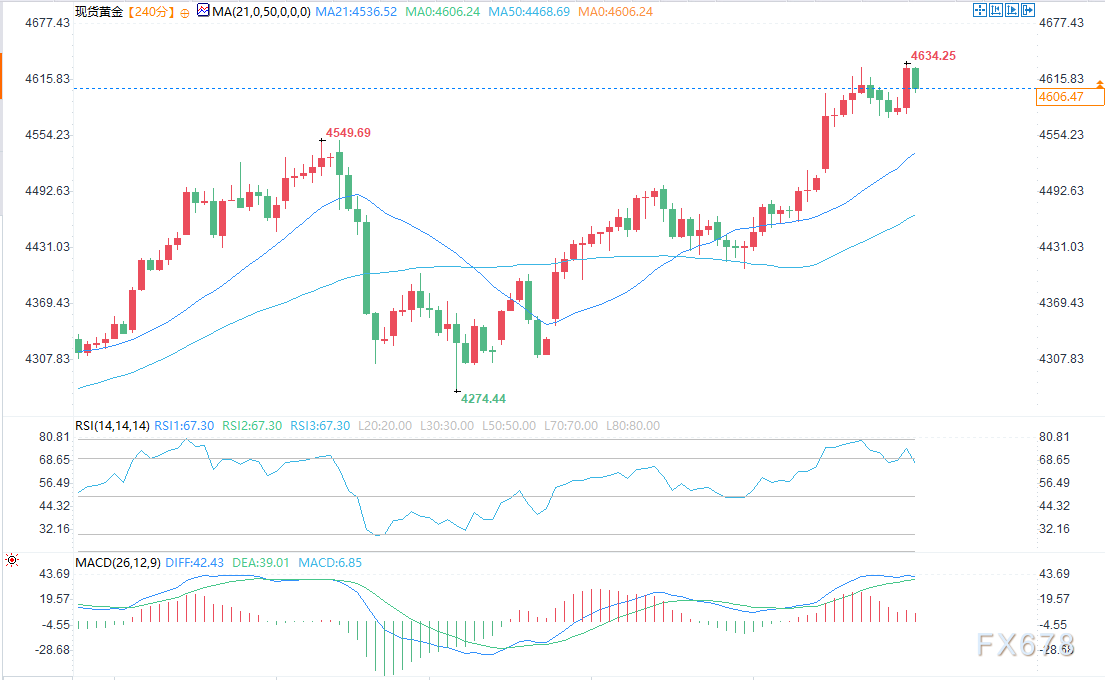
(Spot gold 4-hour chart Source: EasyFxstreet)
On the 4-hour chart, the 21-period simple moving average (SMA) has crossed above the 50-period SMA, with both sloping upwards, reinforcing the current uptrend.
Price action remains comfortably above key moving averages, with the 21-period SMA near $4,534.94 providing the first layer of dynamic support, followed by the 50-period SMA around $4,468.91.
Momentum indicators remain positive. The MACD stays above the signal line in positive territory, while the slightly widening histogram indicates strong bullish momentum.
Meanwhile, the RSI reads 67.3, having dropped from overbought status, suggesting the rally may pause or consolidate in the short term. However, any pullback may be viewed as a correction rather than a trend reversal, and the overall technical outlook remains bullish.
Disclaimer: The content of this article solely reflects the author's opinion and does not represent the platform in any capacity. This article is not intended to serve as a reference for making investment decisions.
You may also like
Societe Generale “Super Bear” Questions the AI Bull Market: Frenzy Reminiscent of the Eve of the 1997 Asian Financial Crisis, Productivity Slowdown Masked by Capital Expenditure
Societe Generale strategist Albert Edwards compares the current artificial intelligence (AI) investment boom to the economic bubble before the 1997 Asian financial crisis. He warns that large-scale capital expenditures may be masking stagnant productivity growth, raising doubts about whether the AI frenzy can meet investors’ high expectations.

1.7 Trillion Unlock V.S 1.7 Trillion Buyback: Goldman Sachs Bets on the Latter to Sustain the US Stock Market Bull Run
Goldman Sachs expects US companies to raise $600 billion in 2027, sets S&P target at 8,700 points, and states that buybacks and profits can withstand supply shocks.
Next target 8%? US mortgage rates soar to a three-year high as “higher for longer” trades sweep the real estate market
U.S. mortgage rates are experiencing a sharp upward surge. In just over a month, the average 30-year fixed mortgage rate has climbed by a full percentage point, reaching above 7.5%, the highest level in three years. As a result, homebuyer demand has plummeted, and existing home sales in September are expected to show a significant decline.
Bank of America Hartnett: Interest rate hikes become the biggest bullish factor, the logic of ending the bond bubble is spreading
Bank of America strategist Hartnett has made a counterintuitive assessment: the most favorable event for the stock market before the end of the year would be for the Federal Reserve to proactively raise interest rates in October—using a tightening move to curb the out-of-control long end. If the Fed proves its willingness to control inflation and term premium through an October rate hike, the market may actually stop worrying about the 10-year yield surging toward 6%, thereby easing pressure on stocks. Currently, while US stocks have not yet been brought down by interest rates, cracks are quietly spreading in South Korean brokers, French government bonds, and CCC-rated credit bonds.
Crypto prices
More


