
Polymarket Trader Makes $1 Million on Google Search Bets, Sparking Insider Trading Fears

A Polymarket trader has earned nearly $1 million by placing suspiciously accurate bets on Google’s 2025 Year in Search rankings, sparking heated debate about insider trading on prediction markets. The wallet address “0xafEe” (previously “AlphaRaccoon”) netted nearly $1 million by correctly predicting nearly every outcome in Google search trend markets. Why Community is Suspicious of
A Polymarket trader has earned nearly $1 million by placing suspiciously accurate bets on Google’s 2025 Year in Search rankings, sparking heated debate about insider trading on prediction markets.
The wallet address “0xafEe” (previously “AlphaRaccoon”) netted nearly $1 million by correctly predicting nearly every outcome in Google search trend markets.
Why Community is Suspicious of AlphaRaccoon
The trader bought “Yes” shares on d4vd, a 20-year-old singer given just a 0.2% chance of being the most searched person of 2025, turning a $10,647 wager into nearly $200,000. The real money came from betting “No” on favorites like Pope Leo XIV, Bianca Censori, and Donald Trump.
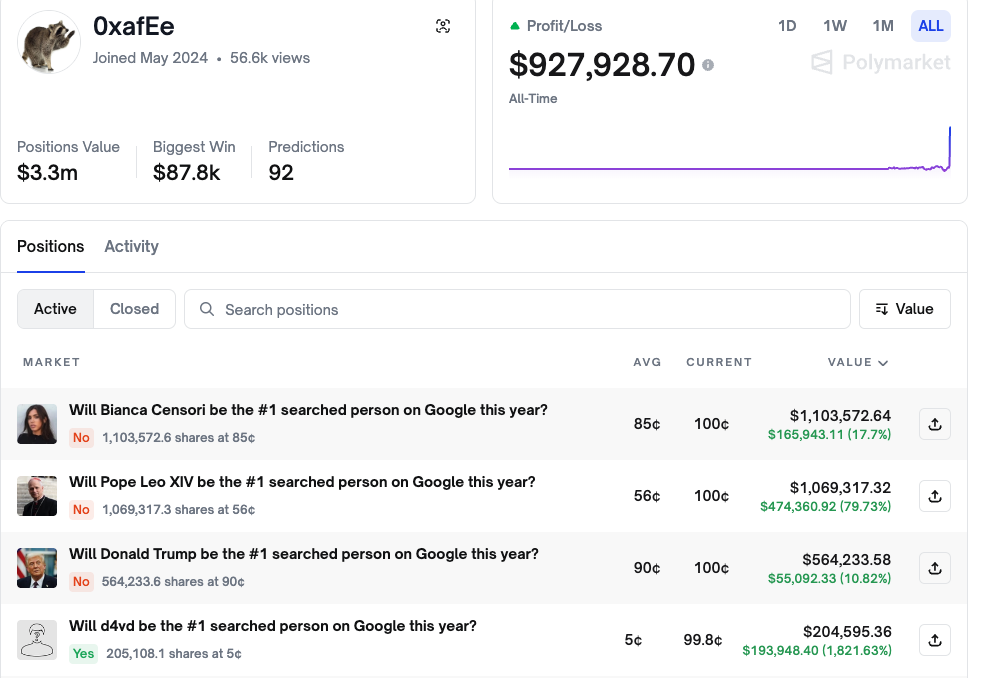
According to Meta engineer Jeong Haeju, who exposed the situation on X, the trader achieved a 22-for-23 success rate on Google search predictions. Public blockchain data shows the wallet deposited $3 million into Polymarket last Friday and immediately began placing large bets. The same account previously won over $150,000 by correctly predicting the exact Gemini 3.0 Flash release date.
“This isn’t a lucky streak. He previously made $150K+ predicting the early release of Gemini 3.0 before results were out. At this point it’s obvious: He’s a Google insider milking Polymarket for quick money,” Haeju said.
However, there’s no confirmation that the trader is actually a Google insider. The allegations remain community speculation based on the unusual winning streak.
Insider Trading: Feature or Bug?
The incident has divided the crypto community. Some argue that prediction markets are designed specifically for insider trading, creating financial incentives to share privileged information with the market.
“The reason for prediction markets to exist is insider trading. In stocks it’s prohibited, with predictions it’s endorsed. It’s designed to be like this,” X user WiiMee said
The controversy arises as Polymarket officially relaunched in the United States this week after receiving CFTC approval. The platform announced Wednesday that its iOS app is now rolling out to waitlisted users, starting with sports markets.
Polymarket processed over $3.7 billion in trading volume in November 2025. The platform received a massive boost when Intercontinental Exchange (ICE), parent company of the NYSE, invested up to $2 billion in October, valuing Polymarket at approximately $9 billion. Recent reports suggest the company is now seeking additional funding at a $12 billion valuation.
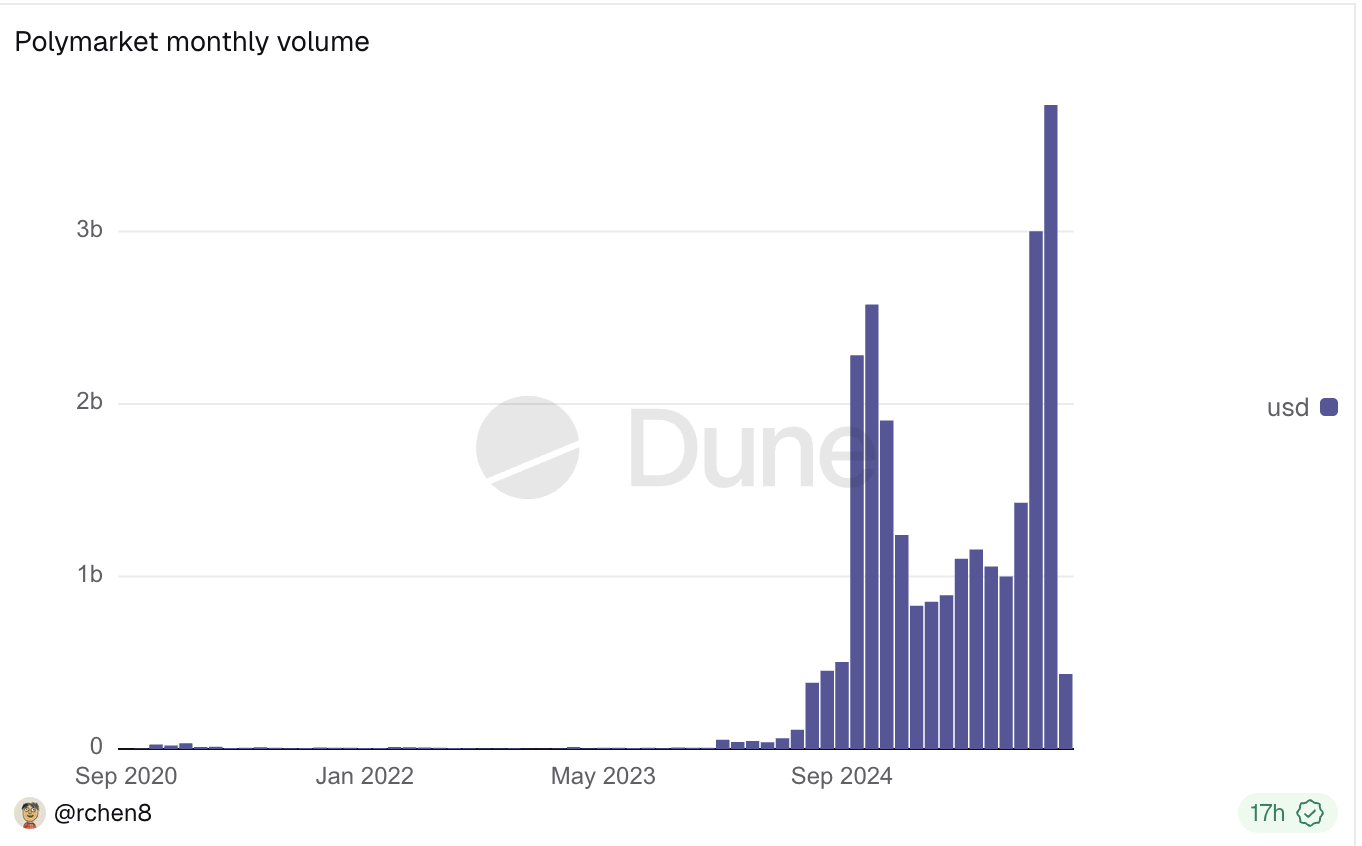 Polymarket Monthly Volume. Source:
Dune
Polymarket Monthly Volume. Source:
Dune
Chief Marketing Officer Matthew Modabber confirmed the platform will launch its native POLY token along with an airdrop for users, though not immediately.
“We could have launched a token whenever we wanted, but we want it to be with true utility, longevity, and to be around forever,” Modabber said.
The token launch is expected to occur in 2026, following the stabilization of the US platform.
For Polymarket, which faced scrutiny over alleged manipulation during the 2024 presidential election, how it handles insider information could define its regulatory future. The Google search markets saga serves as a test case for whether prediction markets are efficient information aggregators or insider profit machines.
Disclaimer: The content of this article solely reflects the author's opinion and does not represent the platform in any capacity. This article is not intended to serve as a reference for making investment decisions.
You may also like
VALERO ENERGY CORP <VLO.N>: JEFFERIES CUTS TARGET PRICE TO $394 FROM $401
VALERO ENERGY CORP : JEFFERIES CUTS TARGET PRICE TO $394 FROM $401
Gold prices rise Rs 1,500/10g; silver up Rs 3,100/kg ahead of US economic data, softer yields. Buy, sell or hold?
The Shopify Stock Rally Isn't Done: Chart of the Week -- Barrons.com
By Doug Busch Shopify is no longer a pandemic-era growth story that simply failed to slow down. It is compounding at a pace few software platforms its size still manage. In the second quarter of 2026, sales on its platform rose 32%. That was the fifth straight quarter of growth exceeding 30%. Merchants are also using more of Shopify's own tools, from payments to Shop Pay, and new channels like AI shopping agents are starting to increase demand. The simple bull case is that the stock already commands a huge share of independent online commerce, and that position should become more valuable as more buying moves through its checkout. A rule of market mechanics is that the vast majority of an individual security's gain is driven by its underlying sector. Within technology, software has staged a robust recovery, joining semiconductors to power the broader sector higher. The iShares Expanded Tech-Software Sector ETF has maintained an upward trajectory since its mid-April lows, though the advance from $74 to $112 has been choppy as bulls repeatedly stepped in to defend when necessary. Breadth across large-cap software has expanded significantly, with 24 constituents surging over 20% over the past three months. During that same three-month window, Shopify generated outstanding relative strength, advancing 36%, more than doubling the IGV's 17% gain over the same period. Expect the stock's outperformance to persist as software momentum broadens. Let's examine the daily and monthly charts to outline the technical drivers behind this thesis. Looking at the daily chart, the ratio chart against the IGV shows persistent outperformance extending back to mid-May. The stock is riding an eight-session winning streak, during which price action cleared a double-bottom-with-handle pivot at $151.39. Within this broader base, the stock recorded a bullish golden cross in late August and successfully filled its Sept. 10 price gap, tracing back to its Aug. 4 session, the day before a powerful earnings reaction sent the stock surging 17% hi
Crypto prices
More


