
Is This the Next Big Crypto Shift? Quantum Tokens Hit $9 Billion

The quantum-resistant crypto sector now exceeds $9 billion in market capitalization, seeing daily trading volumes above $1.5 billion. Investor focus on specialized blockchain projects has surged after Vitalik Buterin, Ethereum’s co-founder, warned about the threats posed by quantum computing that could compromise current cryptographic security. Market Data Reveals Growing Quantum-Resistant Sector Analysts expect quantum resistance
The quantum-resistant crypto sector now exceeds $9 billion in market capitalization, seeing daily trading volumes above $1.5 billion.
Investor focus on specialized blockchain projects has surged after Vitalik Buterin, Ethereum’s co-founder, warned about the threats posed by quantum computing that could compromise current cryptographic security.
Market Data Reveals Growing Quantum-Resistant Sector
Analysts expect quantum resistance to become a key theme by 2026, due to both technological urgency and investor sentiment.
Major projects, including Zcash, Starknet, Nervos Network, Quantum Resistant Ledger, and Abelian, are attracting attention from those seeking protection against future quantum vulnerabilities.
According to CoinGecko data, quantum-resistant tokens reached a market capitalization of $9.37 billion on November 25, 2025, despite a 10% drop over the previous 24 hours. The daily trading volume reached $1.58 billion, indicating strong activity and liquidity.
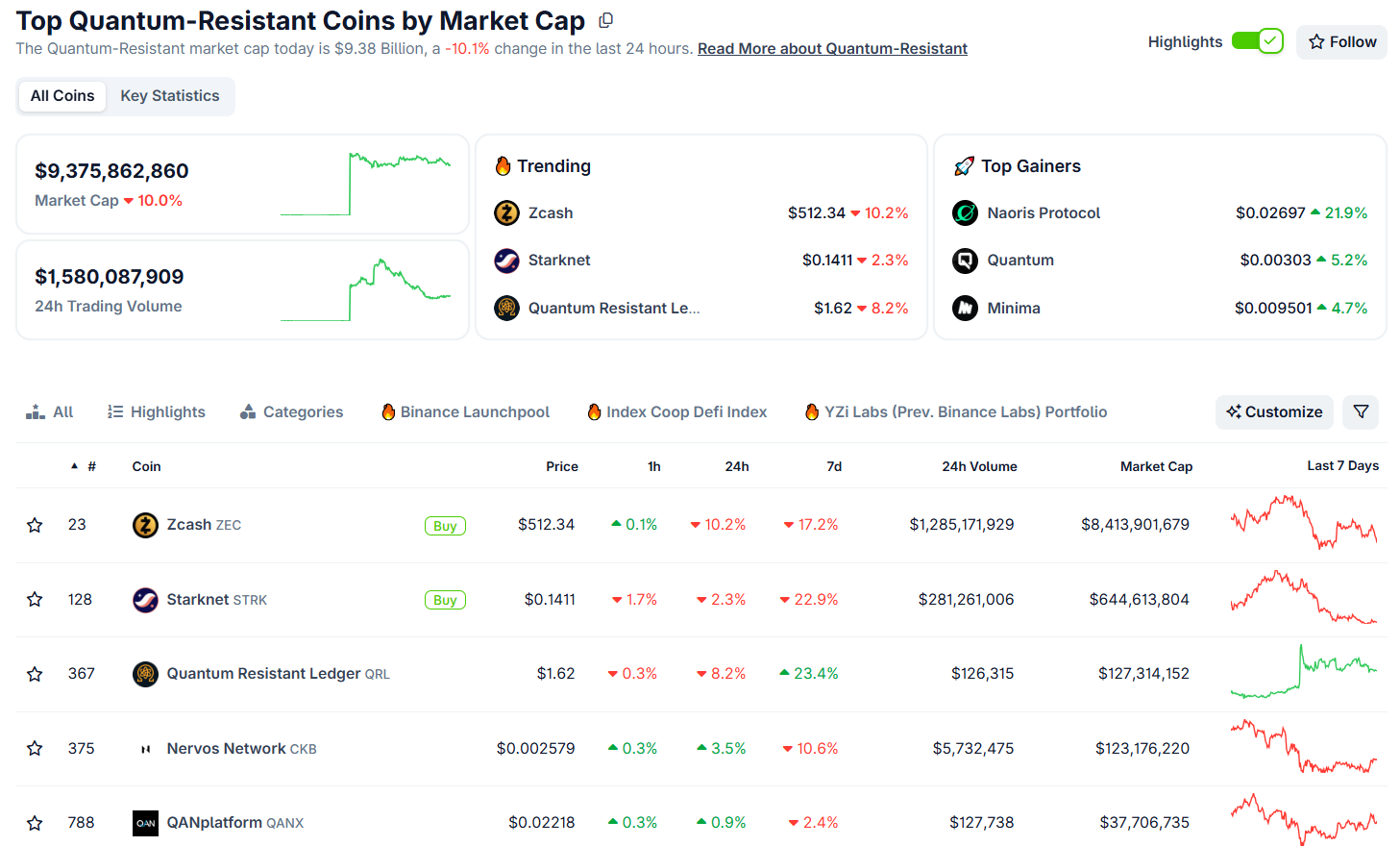 Quantum Resistant Tokens Market Cap. Source:
CoinGecko
These projects stand out with the use of post-quantum cryptographic techniques. Hash-based and lattice-based algorithms are at the heart of these architectures, offering resistance against quantum attacks.
In contrast to blockchains that use elliptic curve cryptography, quantum-resistant tokens employ alternative methods validated by institutions like the National Institute of Standards and Technology.
Zcash leads the sector, trading at $512.34 despite a 10.7% gain. Starknet and Quantum Resistant Ledger follow in the top three.
Technical progress has accompanied the sector’s growth. Zcash recently launched a shielded-balance verifier to enable portable proof of funds, bolstering quantum-resistant privacy.
Buterin’s Warning Catalyzes Industry Attention
Vitalik Buterin, co-founder of Ethereum, has repeatedly warned about the risks quantum computing poses to blockchain security.
He cited Metaculus, a prediction platform, estimating a 20% chance that quantum computers capable of breaking modern encryption might appear before 2030.
Speaking at the Devconnect conference in 2025, he cautioned that quantum breakthroughs could endanger blockchain cryptography as soon as 2028.
Buterin’s warnings highlight the vulnerabilities of elliptic curve cryptography, which support networks like Ethereum and Bitcoin.
His advocacy for quantum-resistant protocols has sparked research and redirected investments toward forward-looking projects.
The legitimacy of quantum resistance has been reinforced by government actions. In March 2025, NIST chose HQC (Hamming Quasi-Cyclic) as its fifth post-quantum encryption algorithm to back up ML-KEM.
NIST had earlier standardized ML-DSA (Dilithium) and SLH-DSA (sphincs+) as signature methods, giving blockchain developers trusted cryptographic options.
In April 2025, the Canadian Centre for Cyber Security backed NIST’s adoption process, showing growing global convergence on post-quantum cryptography.
This regulatory unity is speeding up the adoption of quantum-resistant methods across cryptocurrency infrastructure.
Technical Preparedness Sets Leading Projects Apart
Some blockchain projects have integrated quantum-resistant features proactively, rather than relying on future upgrades.
Zcash uses shielded pools for privacy, even if elliptic curve cryptography fails. Starknet’s proof systems, designed with quantum safety in mind, use hash-based cryptography to guard against quantum attacks.
- Nervos Network enables developers to add NIST-standardized quantum signatures without hard forks.
- Quantum Resistant Ledger has used hash-based signatures since launch, omitting vulnerable elliptic curves.
- Abelian, meanwhile, implemented lattice-based cryptography from its genesis.
Market observers note the importance of proactive implementation. One analyst pointed to Starknet’s second-place rank among quantum-resistant tokens.
The project’s quantum-safe design contrasts with protocols that could face disruptive migration down the line.
This technical edge extends beyond cryptographic tools. Projects with modular, quantum-resistant systems can update security as NIST standards evolve, providing long-term protection while maintaining network continuity.
Psychology and Practicality Shape the 2026 Narrative
Though technical groundwork exists, some question whether quantum resistance is more a market narrative than an urgent need.
The arrival of quantum computers is uncertain. While Buterin estimates a 20% chance before 2030, many expect critical advances after 2034.
This uncertainty allows narrative and psychology to influence valuations. Fear of quantum risk could fuel price volatility, as has happened with previous crypto trends linked to anticipated events. Price action can precede real-world adoption or implementation.
Still, the line between speculation and preparation is often blurred in crypto. Investors focused on potential threats can help fund and validate useful project advances.
Market participants are already citing quantum resistance as a likely “next big narrative in 2026,” naming QRL, QANX, XDC, QTC, MCM, and CKB among likely beneficiaries.
This dual dynamic, technical innovation, and powerful market narrative could benefit real quantum-resistant projects, but also brings scrutiny to valuations.
As 2026 nears, the sector’s future will depend on the interplay of quantum technology, regulatory standards, and shifting sentiment.
Disclaimer: The content of this article solely reflects the author's opinion and does not represent the platform in any capacity. This article is not intended to serve as a reference for making investment decisions.
You may also like
 VIPIndiscriminate Selling Strikes, Igniting the Market's Black Friday
1. Global markets were caught in a liquidity squeeze and indiscriminate selling this week. Apart from natural gas, which surged 16.04%, and the US Dollar Index (DXY), which edged up 0.39%, major global equity indices, precious metals, industrial metals, and cryptocurrencies all fell sharply. Silver and the Nasdaq 100 led the decline, plunging 16.24% and 10.43%, respectively. 2. Minutes from the Federal Reserve's Federal Open Market Committee (FOMC) meeting warned that AI infrastructure is pushing up near-term inflation and adding to market concentration risk. The warning triggered a wave of profit-taking in tech heavyweights. The Nasdaq Composite fell 5.28% on Friday, erasing its gains for the year, and NVIDIA declined for a seventh straight week. At the same time, AI giant Anthropic raised $81.3 billion in the largest IPO on record globally. This massive draw on capital, combined with selling pressure in the secondary market, quickly spread the cooling in risk appetite to high-beta crypto assets. 3. Fed officials dissented in favor of a 25-basis-point rate hike, and Governor Waller went further, warning that an outsized 50-basis-point hike may be needed in December to curb inflation. Tightening expectations drove DXY to a 19-month high of 103.97 and tipped markets into a dash-for-cash liquidity squeeze. Spot gold plunged to a 14-month low, and US equities, commodities, and cryptocurrencies fell in tandem as institutions systematically cut their cross-asset risk exposure. 4. Caught between the tech rout and a strong dollar, Bitcoin briefly fell below $60,000, and market-wide liquidations jumped to $1.33 billion in 24 hours. Institutional flows saw a watershed reversal. BlackRock's IBIT posted a net outflow of $541 million on Thursday, its largest single-day outflow since launch, and cumulative net outflows from US spot Bitcoin ETFs have neared $3.5 billion so far in November. Looking ahead, the market is set to search for a bottom in both sentiment and valuations in the near term. 5. Assets in focus: BTC, ANT, and NVDA

5 Best VPNs Worth Using for Crypto
Ripple ETF Investors Hold On, But XRP Buyers Go Missing
--KKR in Talks to Buy EdgeCore at Valuation of Up to $10 Billion, Bloomberg Reports

Crypto prices
More


