
This year's 30% gains have been completely wiped out, and Bitcoin has fallen into a bear market.

The reversal from the historical highs in October is mainly attributed to fading optimism over US pro-crypto policies, a shift in the macro market toward risk aversion, and the quiet withdrawal of institutional buyers such as ETF investors.
The reversal from October’s historical highs is mainly attributed to the fading optimism over US pro-crypto policies, a shift in the macro market toward risk aversion, and the quiet withdrawal of institutional buyers such as ETF participants.
Written by: Long Yue
Source: Wallstreetcn
As enthusiasm for the US government’s pro-crypto stance wanes and risk aversion intensifies in the market, bitcoin is facing a severe test, and the bear market across the entire crypto sector appears to be deepening.
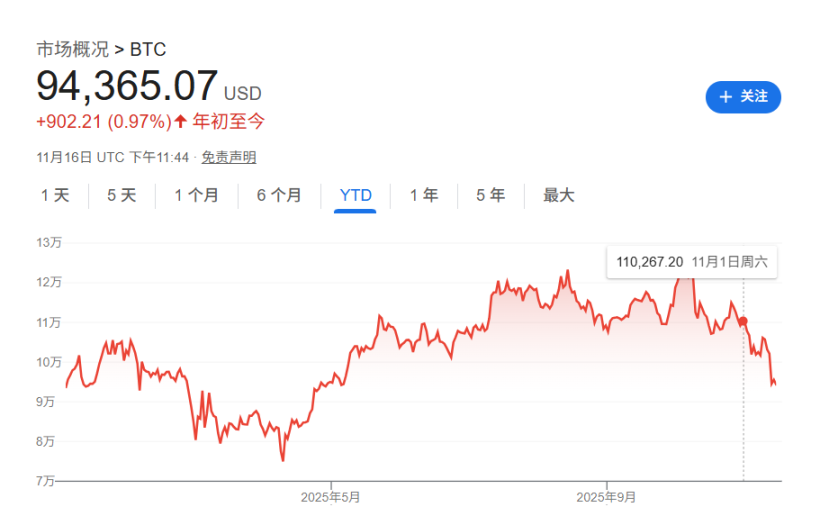
As the largest cryptocurrency by market capitalization, the bitcoin price fell below $93,714 on Sunday. This price level is already lower than its closing price at the end of 2024, meaning that the annual gain of more than 30% earlier this year has now been “completely erased.”
This round of sharp decline occurred just over a month after the asset hit an all-time high. On October 6, the bitcoin price soared to a record high of $126,251, but four days later, following unexpected remarks on tariffs by US President Trump that triggered global market turmoil, bitcoin began its downward trajectory.
The weakening of institutional participation is one of the core driving forces behind this downturn. According to Bloomberg data, since the beginning of this year, bitcoin exchange-traded funds (ETFs) have attracted over $25 billion in capital inflows, pushing their total assets under management to around $169 billion. These steady capital flows had helped reshape bitcoin as a diversification tool for investment portfolios.
However, as large buyers—including ETF allocators and corporate treasury departments—quietly exit, the narrative of bitcoin as a “hedge asset” is becoming “fragile again.” A typical example is Michael Saylor’s Strategy Inc., whose stock price is now close to the value of its bitcoin holdings, indicating that investors are no longer willing to pay a premium for its highly leveraged bitcoin strategy.
Macro Headwinds and Leverage Unwinding
The shift in the macroeconomic environment is another key factor. Matthew Hougan, Chief Investment Officer at Bitwise Asset Management, pointed out that “the overall market is in risk-off mode,” and “crypto is the canary in the coal mine, reacting first.”
The recent pullback in tech stocks has also led to a decline in overall market risk appetite. Jake Kennis, Senior Research Analyst at Nansen, said this sell-off is “a confluence of long-term holders taking profits, institutional capital outflows, macro uncertainty, and the liquidation of leveraged longs.” He added that after a prolonged period of consolidation, the market has temporarily chosen a downward direction.
Altcoins Suffer Even Greater Losses
The prevailing pessimism in the market is intensifying the sell-off. Matthew Hougan stated, “Retail sentiment in crypto is quite negative,” with many choosing to exit early to avoid another 50% major pullback. This pessimism is even more pronounced in the market for smaller, more volatile tokens—namely, “altcoins.”
According to reports, a MarketVector index tracking the bottom 50 of the top 100 digital assets has fallen by about 60% this year. Chris Newhouse, Research Director at Ergonia, a company focused on decentralized finance, also observed that the market is generally “skeptical about capital deployment and lacks natural bullish catalysts.”
Disclaimer: The content of this article solely reflects the author's opinion and does not represent the platform in any capacity. This article is not intended to serve as a reference for making investment decisions.
You may also like
SpaceX Acquires Low-Frequency Spectrum with Massive Investment, Enters Mobile Operator Market; US Telecom Stocks Plummet
SpaceX announced the acquisition of 800MHz low-band spectrum covering the entire U.S. and has been authorized by the FCC to deploy 15,000 direct-to-cell satellites, officially declaring its independent entry into the U.S. mobile carrier market. Following the news, AT&T, T-Mobile, and Verizon all fell by more than 6% after hours. With $93.5 billion in cash and 12 million Starlink subscribers, Elon Musk is using this "final piece of the puzzle" to reshape the competitive landscape of the entire telecommunications industry.
Firmus backed by Nvidia delays Australian listing, casting a shadow over data center IPO candidates
The Australian IPO of data center company Firmus Grid Ltd., supported by Nvidia (NVDA.US), is expected to be delayed, which is an ominous sign for other companies planning to go public.
Natural gas pipeline delays threaten the progress of AI data center projects! Oracle (ORCL.US) resorts to the "trucking gas" strategy to ensure power supply
Oracle (ORCL.US) is adopting a novel power supply strategy—transporting natural gas directly to server campuses by truck—to ensure that multiple data center projects progress as planned.
U.S. budget deficit soars to nearly $2 trillion, exceeding 6% of GDP; high interest rates and tax cuts further worsen the deficit
The US budget deficit for fiscal year 2026 has risen to $1.993 trillion, a year-on-year increase of 12%, marking the highest level since 2021 and projected to account for over 6% of GDP. High interest rates have pushed net interest payments to over $1.1 trillion, accounting for more than half of the deficit increase; lower-than-expected tax and tariff revenues have further worsened the financial shortfall. With just weeks left before the midterm elections, neither party intends to implement substantial fiscal consolidation, and the deficit outlook is highly dependent on the election results.
Crypto prices
More


