
Michael Saylor and Robert Kiyosaki Give End-of-2025 Bitcoin Price Prediction

Bitcoin advocates Michael Saylor and Robert Kiyosaki made bold year-end forecasts, expecting prices to double despite recent volatility and MicroStrategy’s stock drop.
Bitcoin’s leading corporate and retail advocates — MicroStrategy’s Michael Saylor and ‘Rich Dad Poor Dad’ author Robert Kiyosaki — both predicted that the world’s largest cryptocurrency could double in price by the end of 2025.
Their forecasts come as Bitcoin trades around $111,000–$115,000, down from its all-time high of $126,000 earlier this month.
Michael Saylor’s $150,000 Forecast
On paper, Bitcoin is still recovering from the $19 billion shock liquidation across the crypto market on October 10. But industry leaders are still optimistic about new all-time highs by Christmas.
Speaking on CNBC, MicroStrategy’s Executive Chairman Michael Saylor said Bitcoin’s growth cycle remains intact despite short-term corrections.
“I think Bitcoin’s going to continue to grind up. The volatility is coming off of it as the industry becomes more structured,” Saylor said.
He projected that Bitcoin could reach $150,000 by the end of 2025, citing consensus among equity analysts following the company.
“Our expectation right now is about $150,000 by the end of this year,” he added. “I don’t know why it won’t grind up to a million dollars a coin over the next four to eight years. Of course, my long-term forecast is that it goes up about 30% a year for the next 20 years and we’re headed toward $20 million per Bitcoin.”
Saylor’s optimism coincides with MicroStrategy’s continued accumulation of Bitcoin. The company purchased 390 BTC in late October for about $43.4 million, raising its total holdings to 640,808 BTC.
However, MicroStrategy’s stock (MSTR) fell nearly 13% this month, sliding from $332 to $289, mirroring Bitcoin’s retreat from recent highs.
The decline highlights how closely MSTR’s valuation tracks the cryptocurrency market sentiment.
Kiyosaki’s $200,000 Outlook
Meanwhile, Robert Kiyosaki shared a similar bullish outlook on X (formerly Twitter). He revealed holding “millions in Bitcoin” and predicted prices could reach $200,000 by year-end.
Kiyosaki used his portfolio example to emphasize emotional intelligence in investing. “Losers are more afraid of losing than getting rich,” he wrote, arguing that fear of short-term losses blinds investors to long-term gains.
WHY LOSERS lose:I was showing a friend my coin base app, explaining that a few years ago it was pathetic. Today my app showed my friend I have millions in Bitcoin…. and I think Bitcoin will double in price this year…. Possibly a high of $200k.Although my coin base showed I…
— Robert Kiyosaki (@theRealKiyosaki) October 29, 2025
His message resonated with Bitcoin’s retail audience, especially during a volatile month that tested investor patience.
Kiyosaki’s framing of emotional control reflects a recurring theme in crypto cycles — resilience during drawdowns often precedes major rallies.
Market Context
Bitcoin’s price currently hovers near $111,000, with trading volumes and futures funding rates sharply lower than in early October.
Institutional inflows remain steady, but thinner liquidity and concentrated liquidations have increased short-term risk.
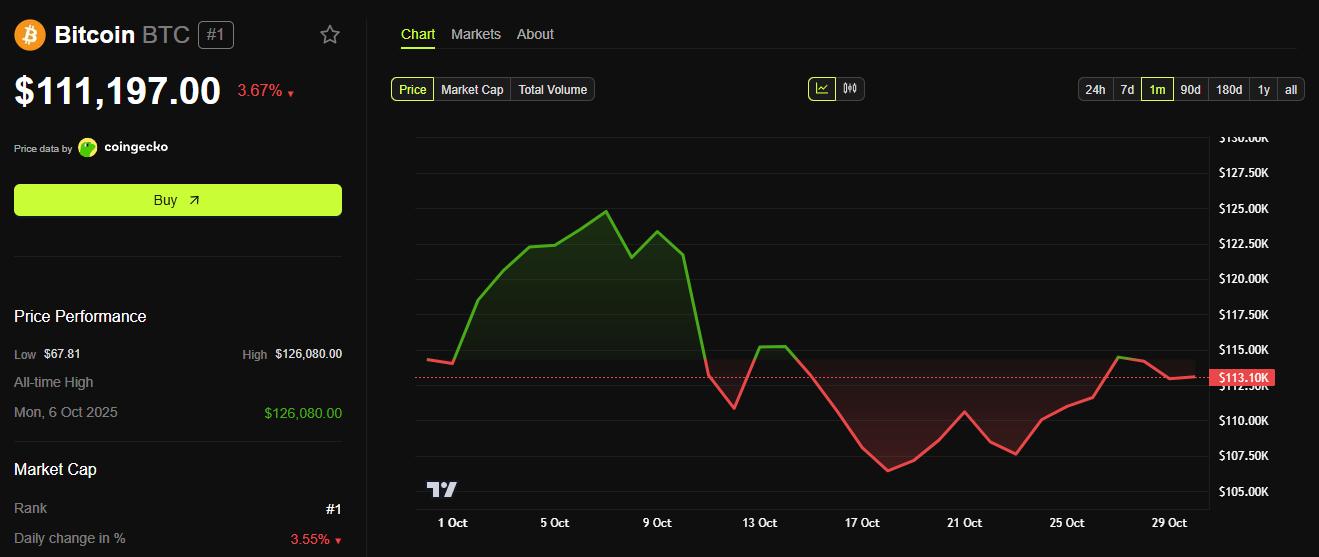 Bitcoin Price Chart In October. Source:
BeInCrypto
Analysts see the pullback as a mid-cycle correction rather than a trend reversal. On-chain activity continues to rise, and exchange balances are falling — signs of investor accumulation.
Saylor’s structured thesis and Kiyosaki’s behavioral framing point to the same conviction: Bitcoin’s long-term trajectory remains upward.
Both foresee significant gains through 2025, despite macro uncertainty and volatile trading conditions.
Disclaimer: The content of this article solely reflects the author's opinion and does not represent the platform in any capacity. This article is not intended to serve as a reference for making investment decisions.
You may also like
How much CPO demand will Nvidia Rubin Ultra generate? Bernstein: Optical value per Pod will increase fivefold
Bernstein believes that the co-packaged optics (CPO) and fiber demand driven by Nvidia's Rubin Ultra architecture will surge significantly, with the optical content per Pod rising from $1 million to $5.4 million. This will propel the size of Nvidia's optical ecosystem market to $46.8 billion by 2028 (a 91% annual increase). Although the industry faces supply bottlenecks with InP substrates, the outlook remains positive. The institution reiterates its “outperform” rating for Lumentum, Coherent, and Ciena.

UBS Q3 implements a two-way strategy with gold options, heavily invests in technology stocks, and builds positions in SK Hynix (SKHY.US)
UBS Group (UBS.US) has submitted its Q3 holdings report (13F) as of September 30, 2026.

SpaceX (SPCX.US) reportedly attempts “de-Nvidiaization” at the rack level: developing Kessel cabinets to bypass L6 compute boards, purchasing only chips
SemiAnalysis: SpaceX has developed its own Kessel cabinet, bypassing Nvidia's L6 cards to provide more options for manufacturing its own hardware.

$3.7 billion “data center power equipment prepayments” abandoned! What did "the most active buyer of gas turbines", SoftBank, see?
In the second quarter of fiscal year 2026, SoftBank reported a net loss of $7.1 billion, primarily due to a $3.7 billion impairment charge from a $9.5 billion advance payment for power generation equipment for US data centers—of which about $2.9 billion was non-refundable and effectively lost. The CFO admitted that SoftBank placed orders before the project plan was finalized, and is now conducting a comprehensive review of its procurement strategy. "The most aggressive purchaser of gas turbines has now written off the deposit in this way."
Crypto prices
More


