
Wisconsin Lawmakers Push Bill to Ease Crypto Rules

Contents
Toggle- Quick breakdown
- Key provisions of the bill
- Legislative path and challenges
Quick breakdown
- Wisconsin’s Assembly Bill 471 seeks to exempt crypto mining, staking, and blockchain development from money transmitter licencing.
- The bill also safeguards the right to use self-hosted wallets and accept digital assets for payments.
- It faces hurdles, with only 25% legislative progress and several stages left for approval.
Wisconsin legislators have introduced a new bill that could exempt individuals and businesses engaged in crypto activities from obtaining money transmitter licences. The proposal, Assembly Bill 471, aims to create clearer regulatory boundaries for digital asset use in the state.
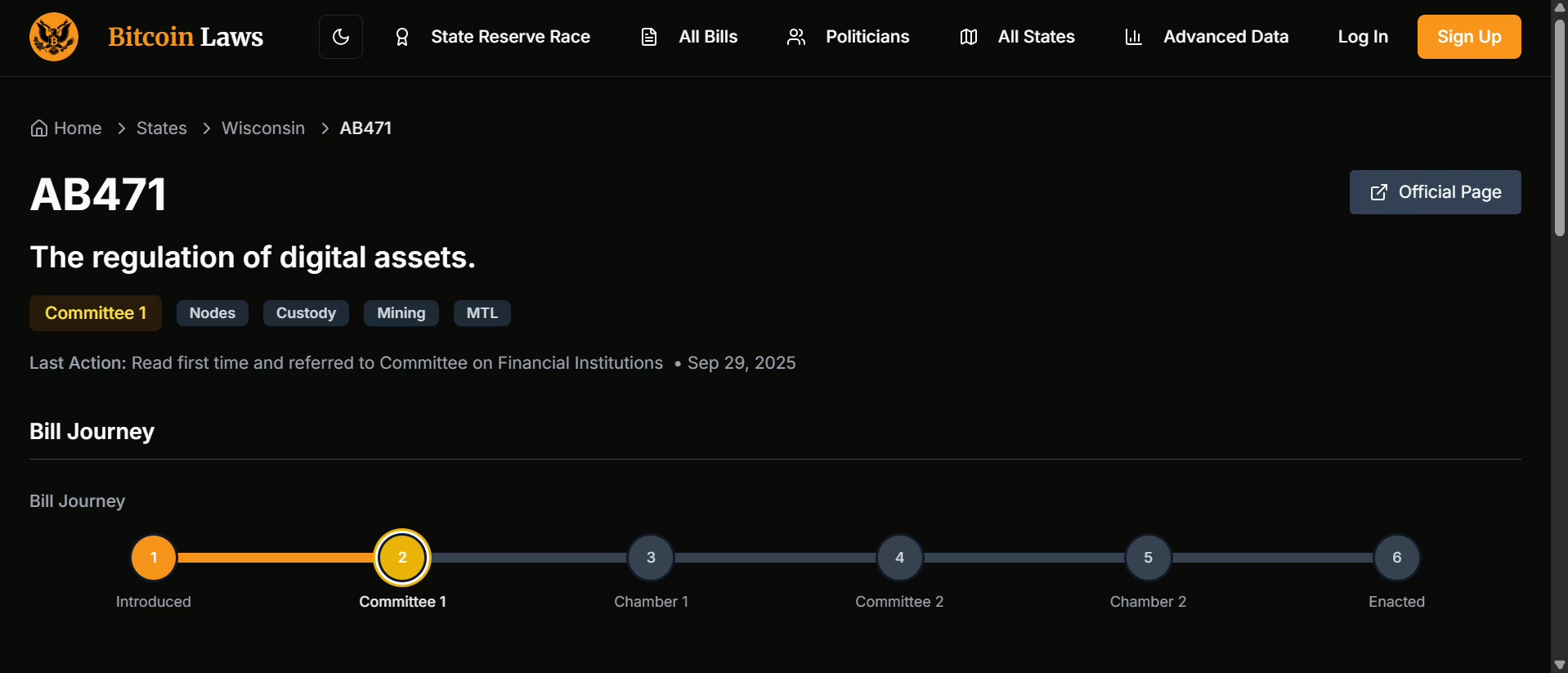 Progress of AB471 Bill. Source: Bitcoin Laws
Key provisions of the bill
According to the Wisconsin Legislative Reference Bureau, the measure would allow residents to engage in mining, staking, and blockchain software development without requiring a license from the Department of Financial Institutions (DFI).
The exemptions would also cover the exchange of digital assets, provided the transactions do not involve converting tokens into legal tender or bank deposits.
“Under the bill, neither a state agency nor a political subdivision may prohibit or restrict a person in accepting digital assets as a method of payment for legal goods and services or in taking custody of digital assets using a self-hosted wallet or hardware wallet,”
the document reads, adding that,
“The bill also specifies that a person in this state may 1) operate a node for the purpose of connecting to a blockchain protocol and participating in the blockchain protocol’s operations; 2) develop software on a blockchain protocol; 3) transfer digital assets to another person utilizing a blockchain protocol; and 4) participate in staking on a blockchain protocol.”
Legislative path and challenges
The bill has bipartisan interest but is currently sponsored by seven Republican Assembly members and two Republican senators. It has been referred to the Committee on Financial Institutions for review.
According to Legiscan data, the measure has reached just 25% progress and still needs to clear one chamber and two additional committees before it can be enacted into law.
Notably, the Wisconsin DFI launched a publicly accessible tracker to combat cryptocurrency and other investment scams. This initiative comes in response to nearly $3.55 million lost by Wisconsinites to financial grooming and cryptocurrency fraud between January 2022 and June 2024.
Disclaimer: The content of this article solely reflects the author's opinion and does not represent the platform in any capacity. This article is not intended to serve as a reference for making investment decisions.
You may also like
Rare "Three Firsts"! State Council's Major Moves to Stabilize the Market, How Do Institutions View It?
The State Council executive meeting has featured three "firsts": for the first time, the release time was advanced to trading hours; for the first time, the phrases "the capital market is crucial to the overall economic development" and "national team" were explicitly mentioned in the official statement. Analysts such as Tao Chuan from Guolian Minsheng and Wang Han from Industrial Securities believe that the market stabilization mechanism is evolving from short-term support to an institutionalized, diversified, and coordinated upgrade, with policy focus shifting to optimizing Huijin’s functions, introducing long-term funds into the market, and promoting dividends and share buybacks. Chen Guo from East Money regards this State Council meeting as an “important policy bottom.” CITIC Securities expects the market may see an oversold rebound in the short term. Going forward, key areas of attention will be Huijin’s actions and the implementation of fundamental policies.

U.S. Senate Democratic leader election to be voted on December 1, impacting AI regulation and tariff agenda
The election for the Democratic leader in the U.S. Senate will be held by secret ballot on December 1, and the winner must reach the threshold of 28 votes.

From Earning 20% Annually to Going Negative in a Single Month, Wall Street’s Favorite Arbitrage Trade “Fails”
After rising for six consecutive months, the Bloomberg FX Carry Index turned negative for the first time in November, falling by 0.9%. Cooling enthusiasm for AI has increased market volatility, and Brazil’s election led to an 8% single-day plunge in the real, nearly wiping out the carry trade's 18% annual return overnight. Industry giants such as Goldman Sachs and Citigroup have issued warnings: “The era of mindless long positions is over.” Although capital has not withdrawn, trading thresholds have surged, requiring defensive hedging and a shift toward selective strategies.

The global tobacco landscape is about to change! Marlboro's parent company Altria (MO.US) plans an all-cash takeover of Imperial Brands UK, targeting cigarette cash flow.
What Altria values is the overseas cigarette cash flow and the established distribution network. Since spinning off Philip Morris International in 2008, its cigarette business has been focused on the United States. Altria estimates that after adjusting for channel inventory changes, the U.S. cigarette industry’s sales volume declined by about 5% year-over-year in the third quarter. Acquiring Imperial Brands’ international business would allow Altria to instantly gain brands, retail channels, and operational scale in markets such as Europe, thereby reducing its dependence on the single U.S. market.

Crypto prices
More


