The Poland Crypto-Asset Market Act is a new Sejm‑approved bill that creates a KNF licensing regime for crypto-asset service providers (CASPs), adds fines up to 10 million PLN and up to two years’ prison, and sets a six‑month transitional window for compliance.
-
KNF licensing for all CASPs
-
Fines up to 10 million PLN and criminal penalties including up to two years’ imprisonment for violations.
-
Six‑month transitional period to secure licenses; failure may force cessation of operations.
Poland Crypto-Asset Market Act: Sejm approves CASP licensing, heavy fines and prison risk — read the key provisions, timeline and compliance steps for operators.
Poland Crypto-Asset Market Act awaits Senate review after Sejm approval, introducing a KNF licensing regime for CASPs and criminal penalties that have prompted strong industry and political backlash.
What is the Poland Crypto-Asset Market Act?
The Poland Crypto-Asset Market Act is draft legislation (bill 1424) approved by the Sejm that establishes licensing for crypto-asset service providers (CASPs), assigns oversight to the Komisja Nadzoru Finansowego (KNF), and aligns many requirements with the EU MiCA framework.
How does the bill change licensing and compliance for CASPs?
The bill requires all CASPs — exchanges, issuers and custody providers, domestic and foreign — to obtain a KNF license to operate in Poland. Applications must include corporate structure, capital adequacy, internal controls, risk management and Anti‑Money‑Laundering (AML) procedures.
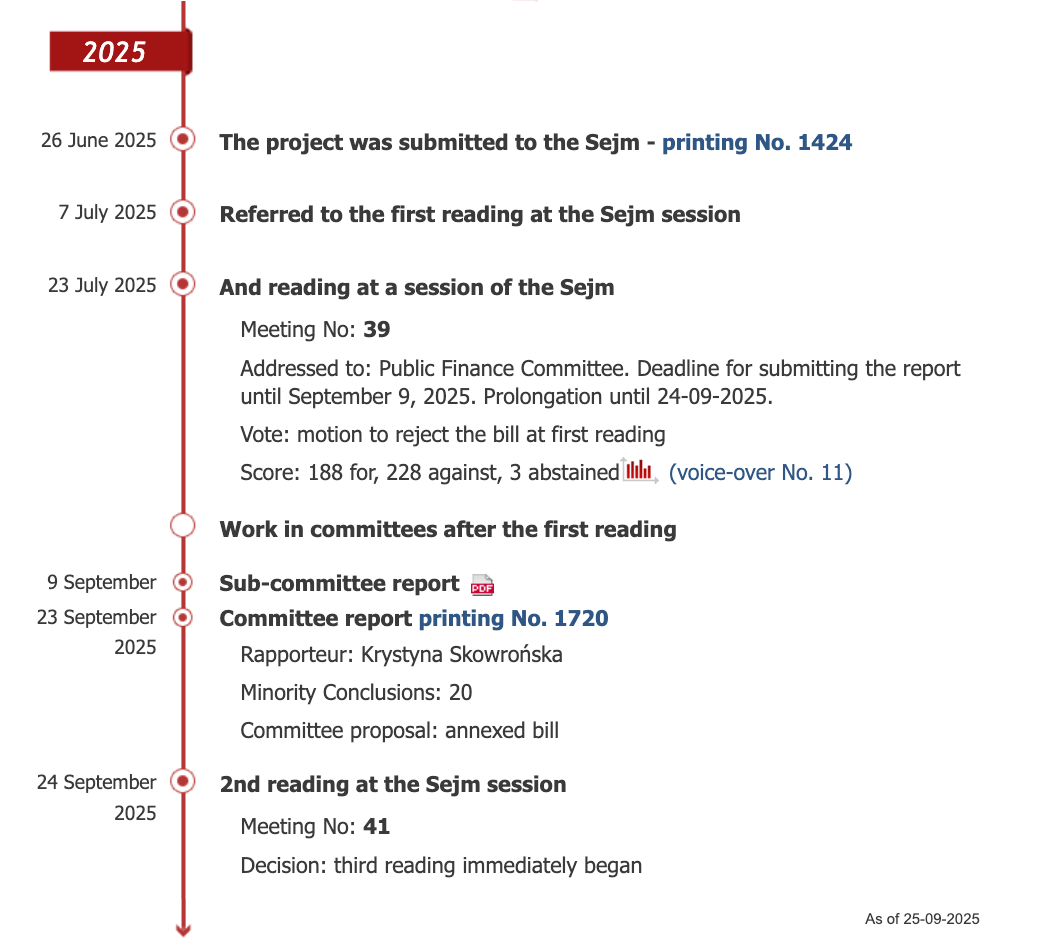 Timeline of Poland’s Crypto-Asset Market Act (bill 1424) as of Sept. 25, 2025 (translated by Google). Source: Sejm
If enacted, the law gives CASPs a six‑month transitional period to secure KNF authorization. Noncompliance during that window risks enforced shutdowns and legal sanctions.
Why are critics calling the bill restrictive?
The Sejm vote—230 in favor and 196 opposed—triggered protests from industry groups and some politicians who say the act imposes excessive burdens. The bill creates criminal liability for violations, including fines up to 10 million PLN (approx. $2.8 million) and prison terms of up to two years.
Who has publicly objected and why?
Opposition figures such as Janusz Kowalski criticized the measure as overly restrictive, calling it the EU’s strictest crypto law and warning it could harm Poland’s three million crypto holders. Tomasz Mentzen warned that slow KNF processing (anecdotally cited as ~30 months average) could undermine market activity and innovation.
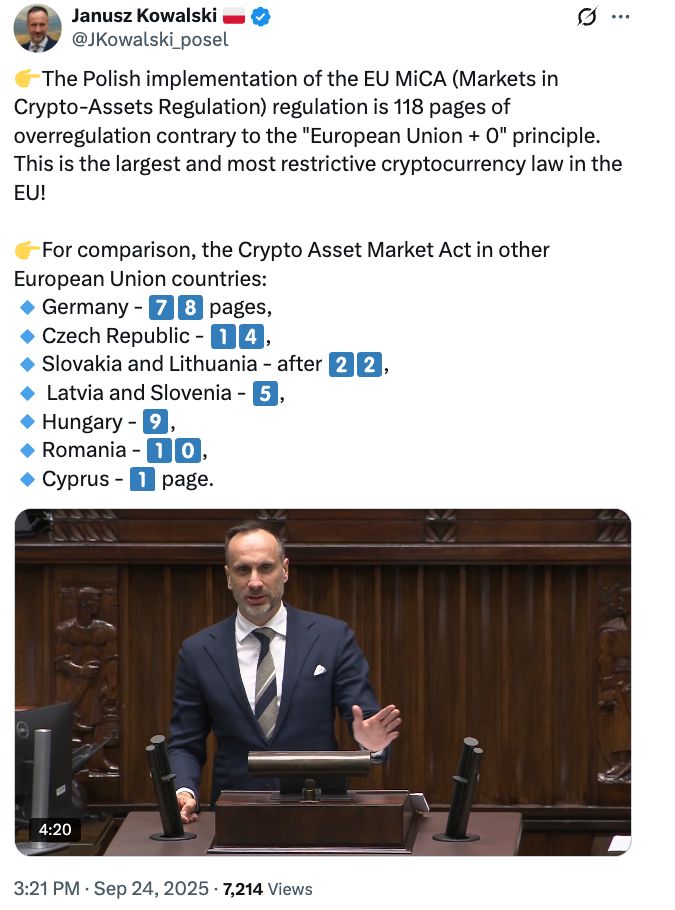 Source: Janusz Kowalski (X post translated by Grok)
Critics compare Poland’s proposed law to shorter national implementations elsewhere in the EU and argue the length and detail of the 118‑page draft will deter businesses.
When could the bill take effect and what is the timeline?
Following Sejm approval, the bill proceeds to the Senate for review and then to the President for signature. If signed, CASPs will face a six‑month compliance window. The current timeline shown above reflects the Sejm’s status as of Sept. 25, 2025.
What penalties and enforcement measures are included?
The measure includes civil and criminal penalties: fines up to 10 million PLN and prison terms up to two years for certain violations. Enforcement is centralized under the KNF, which will handle licensing and supervision.
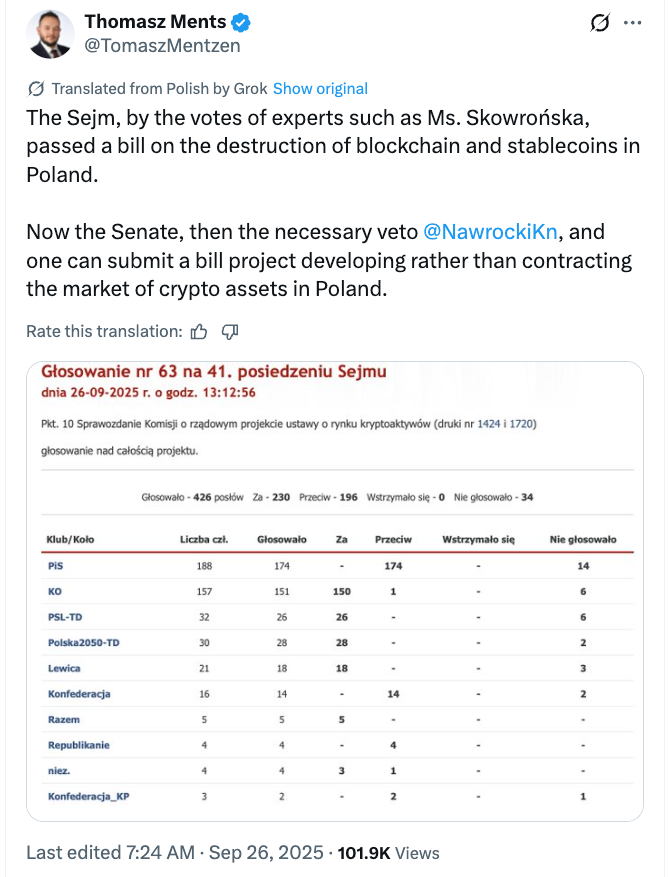 Source: Thomasz Mentzen (tweet translated by Grok)
How might political leaders influence the bill?
Political actors have signaled mixed positions. Sławomir Mentzen campaigned on crypto‑friendly policies, but Karol Nawrocki — the elected president who pledged to support innovation — may influence final outcomes via veto power or public pressure.
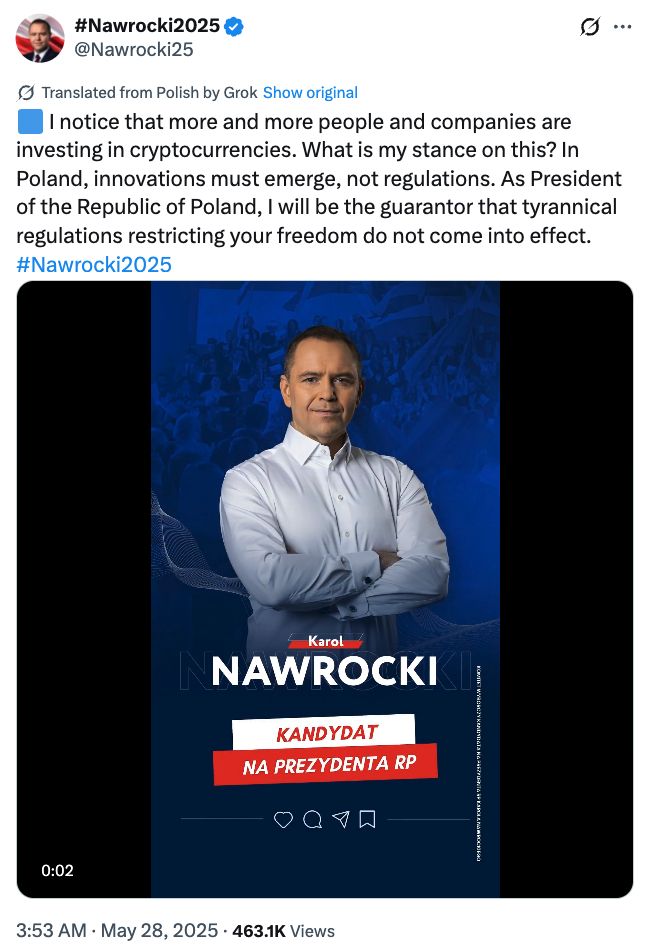 Source: Poland’s President Karol Nawrocki (tweet translated by Grok)
Frequently Asked Questions
How long do CASPs have to apply for a KNF license?
CASPs will have a six‑month transitional period after the law is signed to submit a full KNF license application; failing to apply may lead to forced cessation of operations.
Will foreign crypto exchanges be affected?
Yes. The bill covers both domestic and foreign CASPs operating in Poland and requires them to obtain KNF authorization to serve Polish users or to operate within Poland.
Does the bill align with EU MiCA?
Many provisions mirror MiCA’s aims on market integrity and consumer protection, but critics say Poland’s draft goes further by adding national criminal penalties and detailed authorisation requirements.
Key Takeaways
- Regulatory shift: Poland moves to a KNF licensing model for all CASPs, aligning with EU standards but adding national specifics.
- Severe penalties: The draft includes fines up to 10 million PLN and up to two years’ imprisonment for violations.
- Action for operators: CASPs should prepare comprehensive license files and monitor Senate and presidential review; six months of transition is anticipated.
Conclusion
The Poland Crypto-Asset Market Act redefines market access by mandating KNF licenses, stringent compliance evidence and new penalties. Market participants should prepare for rapid regulatory changes and prioritize license readiness during the six‑month transition. COINOTAG will monitor Senate and presidential actions and update this report as developments occur.