
Venture Capitalists Bet Big on Programmable Stablecoins as Market Hits $280B

Contents
Toggle- Quick Breakdown
- Investors Pump Nearly $100M Into M0 and Rain
- M0 Secures $40M to Build Custom Stablecoin Infrastructure
- Rain Raises $58M to Power Regulated Stablecoins for Banks
- Programmable Money Gains Global Momentum
Quick Breakdown
- M0 and Rain raised nearly $100M to expand programmable stablecoin infrastructure.
- M0 builds custom stablecoins, while Rain enables banks to issue regulated tokens and manage cross-border payrolls.
- Global pilots in Kazakhstan, India, and TradeOS highlight the growing real-world adoption of programmable money.
Investors Pump Nearly $100M Into M0 and Rain
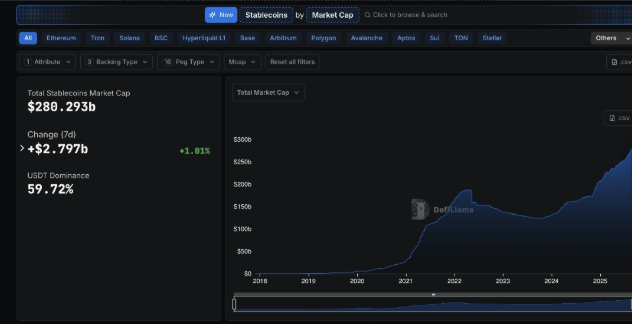
Venture capital firms are doubling down on the future of programmable stablecoins, with two major startups, Switzerland-based M0 and US-based Rain securing nearly $100 million in Series B funding this week. The funding surge comes as the global stablecoin market capitalization climbed to a record $280 billion, according to DefiLlama data.
 Source
:
DefiLlama
M0 Secures $40M to Build Custom Stablecoin Infrastructure
Founded in 2023, M0 raised $40 million in a round led by Polychain Capital and Ribbit Capital. The platform enables developers to issue application-specific stablecoins with rules directly embedded into their design. M0’s infrastructure has already been integrated into MetaMask and Playtron, with the latter launching a “Game Dollar” for in-device purchases on its handheld gaming system.
Rain Raises $58M to Power Regulated Stablecoins for Banks
Meanwhile, Rain closed a $58 million Series B, led by Sapphire Ventures with participation from Dragonfly, Galaxy Ventures, and Samsung Next. The company specializes in giving banks and enterprises the tools to issue regulated stablecoins and manage programmable money flows.
Rain’s technology is already powering real-time payrolls in over 100 jurisdictions through its partnership with Toku. The firm has also expanded across Solana, Tron, and Stellar, supporting programmable spending programs and card services.
Programmable Money Gains Global Momentum
The concept of programmable money digital currency embedded with rules on how, when, and where it can be spent is increasingly being tested worldwide. In Kazakhstan, the digital tenge has been piloted for milestone-based rail project funding and VAT refund automation.
The Monetary Authority of India expanded its digital rupee pilot in May to include programmability and offline capabilities. In April, Plaza Finance launched the first programmable derivative tokens on Base, introducing bondETH and levETH, a new class of on-chain financial instruments designed to offer innovative Ethereum investment strategies in the DeFi space.
With programmable money accelerating beyond payments into areas like infrastructure, taxation, and trade, investors appear convinced that M0 and Rain are building the rails for the next generation of finance.
Disclaimer: The content of this article solely reflects the author's opinion and does not represent the platform in any capacity. This article is not intended to serve as a reference for making investment decisions.
You may also like
Report: Samsung's storage capacity is nearly sold out for the next three years, clients rush to secure long-term contracts until 2031
According to media reports, most of Samsung Electronics' memory manufacturing capacity for the period from 2027 to 2029 has already been secured through contracts. Some customers are even seeking to extend long-term supply agreements until 2031. Currently, leading memory manufacturers can only meet about 60% to 70% of client demand, and the supply shortage may intensify further in 2027.

Anthropic commits to about $900 billion in computing power expenditure; bond market expects its bonds to be junk-rated
Despite Anthropic raising over $100 billion in its public offering and reaching a market capitalization of $1.18 trillion, the company is widely expected by the debt market to be rated as BB-level "junk bonds" due to its lack of profitability and approximately $900 billion in massive computing power expenditure commitments. Amid pressure on tech giants in the debt market and chip companies planning to reduce loan guarantees, Anthropic will still need to rely on structured financing in the short term, facing about a three-year window to strive for an investment-grade rating.
JPMorgan Trading Desk Abandons Tactical Bullish Stance on S&P 500: Rebound May Occur, Bottom Not Yet Reached
J.P. Morgan's trading division has shifted from a tactical bullish stance to a cautious one, expecting stock market volatility in the coming weeks, but emphasizes that market fundamentals—from the economy to earnings—remain solid.

AI sell-off brings a "fat pitch"? Hedge funds "give up" and clear positions, Morgan Stanley loudly calls to buy
Hedge funds have shifted to a net bearish stance on momentum stocks, abandoning bets for the first time since April 2025 that recently outperforming stocks will continue to rise.

Crypto prices
More


