
Bitcoiners Called It First: US Economic Data Proves Pompliano Right

Trust in the U.S. economic figures is wavering. In the shadow of institutional speeches, another voice is being heard, more biting, more direct: that of the Bitcoiners. Leading them is Anthony Pompliano, an essential figure in the crypto sphere, who denounces the growing disconnection between official data and lived reality.

The flaws of official statistics
The criticisms are not new. Pompliano insists: “The Bitcoiners were the first to see that the economic data was false“. He criticizes the underestimated inflation , the revised employment figures, and a GDP growth that he deems largely overstated. He relies on the very admission of U.S. Treasury Secretary Scott Bessent:
No, I do not trust the data.
Behind these words lies a wider concern. A 2024 study by the American Statistical Association already alerted:
Our public statistics are as vital as our roads. They are neglected until they break down.
Reduction of budgets, collapse of survey response rates, political interference: the statistical foundations are crumbling.
Bitcoin as a response to distrust
In light of this observation, Bitcoiners do not just criticize. They act. “They found a way to financially capture the rise, if they were right,” writes Pompliano. And the bet seems to be on the verge of being won. While traditional markets sway under the blows of Trump’s trade war, Bitcoin asserts itself as a safe haven.
On April 4, when the stock market stumbled, the price of bitcoin surged above $84,000. A rare counter-cyclical move, praised by analysts as a sign of increasing independence from stock exchanges.
For Pompliano, this resilience proves that Bitcoin is not just a speculative asset. It’s a critical tool, an alternative economic thermometer, disconnected from institutional channels.
“The dollar falls, and Bitcoin rises. It’s as simple as that“, recently asserted Jeff Parks of Bitwise.
Distorted data, muddled politics
The Federal Reserve, meanwhile, seems paralyzed. “Interest rates are too high, but the Fed is hiding behind official data“, exclaims Pompliano on LinkedIn . He reminds us that the Truflation index, which is more in line with real prices, shows an inflation rate of 1.7%, well below the 2.8% claimed by the government. Such a divergence has heavy consequences for households, businesses… and cryptocurrencies.
“If we cannot trust the figures, how can we make informed decisions?“, questions Pompliano. He is not the only one alarmed by this. The report “The Nation’s Data at Risk” highlights the danger of a gradual collapse of the public statistical system. These are the data that drive interest rates, social assistance, and markets.
Towards a new monetary standard? In this context, the idea that bitcoin could supplant the dollar is no longer just fiction. Some analysts mention a transition to a fragmented reserve system where “hard currencies” like gold… or Bitcoin, would gain legitimacy. This is perfectly summarized by Pompliano:
A public financial conversation has become an intellectual deadlock where people regurgitate opinions based on faulty data.
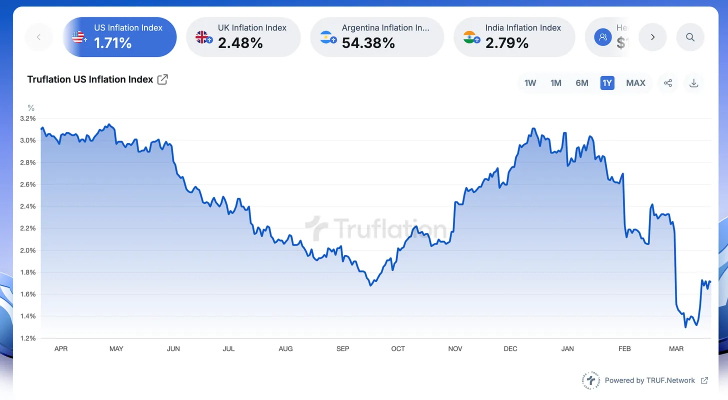 Truflation Index – Source: Anthony Pompliano (LinkedIn)
As the foundations of the official economic narrative falter, Bitcoiners stand as critical trailblazers. Their strategy? No longer to blindly trust the figures, but to rely on their experience, their network… and the blockchain. The future will tell if their reading of the world was correct. But one thing is certain: they now have the ear of a public in search of bearings.
Disclaimer: The content of this article solely reflects the author's opinion and does not represent the platform in any capacity. This article is not intended to serve as a reference for making investment decisions.
You may also like
From Earning 20% Annually to Going Negative in a Single Month, Wall Street’s Favorite Arbitrage Trade “Fails”
After rising for six consecutive months, the Bloomberg FX Carry Index turned negative for the first time in November, falling by 0.9%. Cooling enthusiasm for AI has increased market volatility, and Brazil’s election led to an 8% single-day plunge in the real, nearly wiping out the carry trade's 18% annual return overnight. Industry giants such as Goldman Sachs and Citigroup have issued warnings: “The era of mindless long positions is over.” Although capital has not withdrawn, trading thresholds have surged, requiring defensive hedging and a shift toward selective strategies.

The global tobacco landscape is about to change! Marlboro's parent company Altria (MO.US) plans an all-cash takeover of Imperial Brands UK, targeting cigarette cash flow.
What Altria values is the overseas cigarette cash flow and the established distribution network. Since spinning off Philip Morris International in 2008, its cigarette business has been focused on the United States. Altria estimates that after adjusting for channel inventory changes, the U.S. cigarette industry’s sales volume declined by about 5% year-over-year in the third quarter. Acquiring Imperial Brands’ international business would allow Altria to instantly gain brands, retail channels, and operational scale in markets such as Europe, thereby reducing its dependence on the single U.S. market.

AI agent commercialization accelerates + enterprise-level inference demand takes over! Strong demand supports growth fundamentals; Dell (DELL.US) rated up to $711 by analysts
Given that demand is expected to remain stable over the next few years, analysts have upgraded their rating for Dell to "Strong Buy," with a target price set at $711 per share.
Crypto prices
More


