
Bitcoin Today 17/03/2025: BTC Trades at $83K as Tokens Explode 300%

- Bitcoin rises to $83K today.
- MAVIA and EPIC tokens explode.
- BTC stress rate reaches alarming level.
With a daily increase of over 1%, the price of Bitcoin today 17/03/2025 is holding above the $83 zone while cryptocurrencies ETH, XRP, BNB and DOGE are registering increases between 2% and 3%. The highlight in the last 24 hours are the Heroes of Mavia (MAVIA) and Epic Cash (EPIC) tokens, which exploded an impressive 300%. Currently, Mavia is trading at $0,56 with an increase of over 291% while EPIC exploded 352.1% today and is being quoted at $1,53.
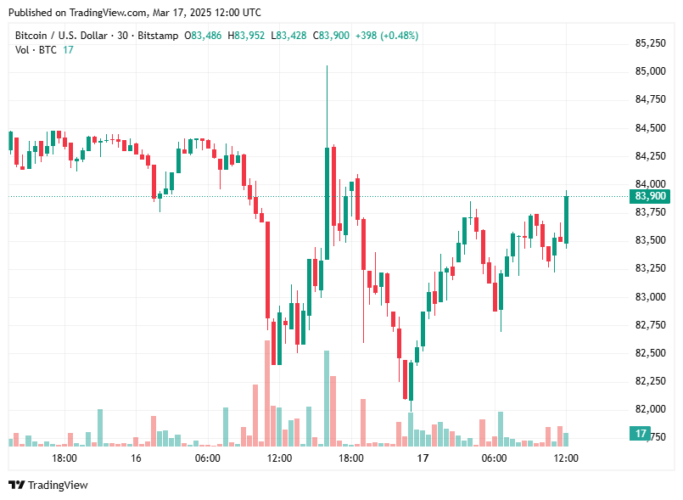
BTC, in turn, began an upward trajectory recently, breaking the $84 barrier again yesterday. However, the asset did not sustain its movement and retracted to $82, managing to recover to its current level.
At the time of publication, the price of Bitcoin was quoted at US$ 82.748,56 with an increase of 1.3% in the last 24 hours, equivalent to approximately R$ 479,794.90 BRL and € 76,677.00 EUR. In one week, BTC appreciated 1.3%.
 Source: TradingView
Following Bitcoin’s current development, major cryptocurrencies are witnessing significant recovery in the last 24 hours. Ethereum is trading at $1.911,83 with a 2.1% increase in its price. XRP is trading at $2,34 with a 1.9% increase. Cardano is priced at $0,7249 after registering a 2.7% increase. Solana is down 0.6% and is trading at $129,25. With a 3.5% increase, DOGE is trading at $0,1733. Leading gainers among major cryptocurrencies, BNB is up 6.3% to $631,38.
Bitcoin Stress Rate Reaches Alarming Level
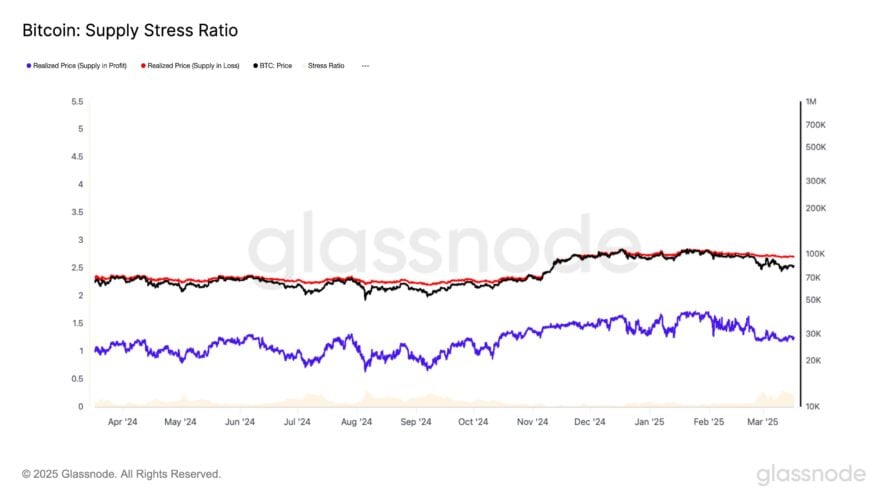
In a scenario that has been worrying investors and cryptocurrency enthusiasts, a new indicator is raising alarm bells for Bitcoin investors. The cryptocurrency’s “profitability stress ratio,” which measures the ratio of supply to loss in the market, reached 0,23, the highest value since last September, according to data shared by the Glassnode analysis platform. This level historically precedes periods of market turbulence, generating concerns about the near future of Bitcoin.
 Source: Glassnode
Glassnode’s analysis highlights that the rising stress ratio indicates increasing pressure in the market. In simple terms, more investors are selling their Bitcoins at a loss, which could trigger a spiral of selling and price decline.
“Historically, values above 0,2 have marked periods of heightened market stress. If the value continues to rise, it could signal increasing market pressure, potentially reinforcing a broader shift in sentiment,” he said.
Bitcoin has seen significant corrections in recent months, with its price seeing a 14.6% drop in the last 30 days alone.
Disclaimer: The content of this article solely reflects the author's opinion and does not represent the platform in any capacity. This article is not intended to serve as a reference for making investment decisions.
You may also like
AI investment enters the "Trough of Disillusionment", the next 18 months will be a life-or-death test!
Goldman Sachs believes that the AI investment cycle is currently in the "trough of disillusionment," but this is not the first time. The core contradiction lies in the fact that the business models of new cloud computing providers are highly dependent on end-user returns from AI spending, while currently "there are basically zero companies that can attribute profits to AI." Social Capital founder Palihapitiya has clearly defined an 18-month key window, during which the market will decide which AI business models are sustainable and which are not.

Anthropic's Core Concern: Revenue Can Be Withdrawn at Any Time, but Computing Power Costs Are Locked in for up to 20 Years
Zheshang Securities believes that Anthropic's revenue is mainly based on usage-based billing, with remaining performance obligations covering only about 5.1 months of annualized revenue, while compute power costs are already locked in with $895.4 billion in irrevocable commitments, some extending as far as 2045. Revenues can be reduced at any time, but costs are non-exitable, creating a highly asymmetric maturity gap between the two—this is the company's real core constraint.

Triple Pressure from the Federal Reserve, Treasury, and Congress; Goldman Sachs: Liquidity Crisis May Occur in 2027
Goldman Sachs warns that the reserve ratio of bank assets has dropped to around 11%, only slightly above the crisis trough of 2019. In the second half of 2027, a deadlock in debt ceiling negotiations will force the Treasury to rebuild the TGA, triggering a "perfect storm" of a sharp drop in reserves and a surge in T-bill supply; combined with stalled money market fund buying, this will create a huge liquidity black hole. The Federal Reserve could be forced into the awkward position of lowering interest rates and launching large-scale bond purchases to rescue the market.

Crypto prices
More


