No one understands NBIS better than me! US Stock 10x Stock
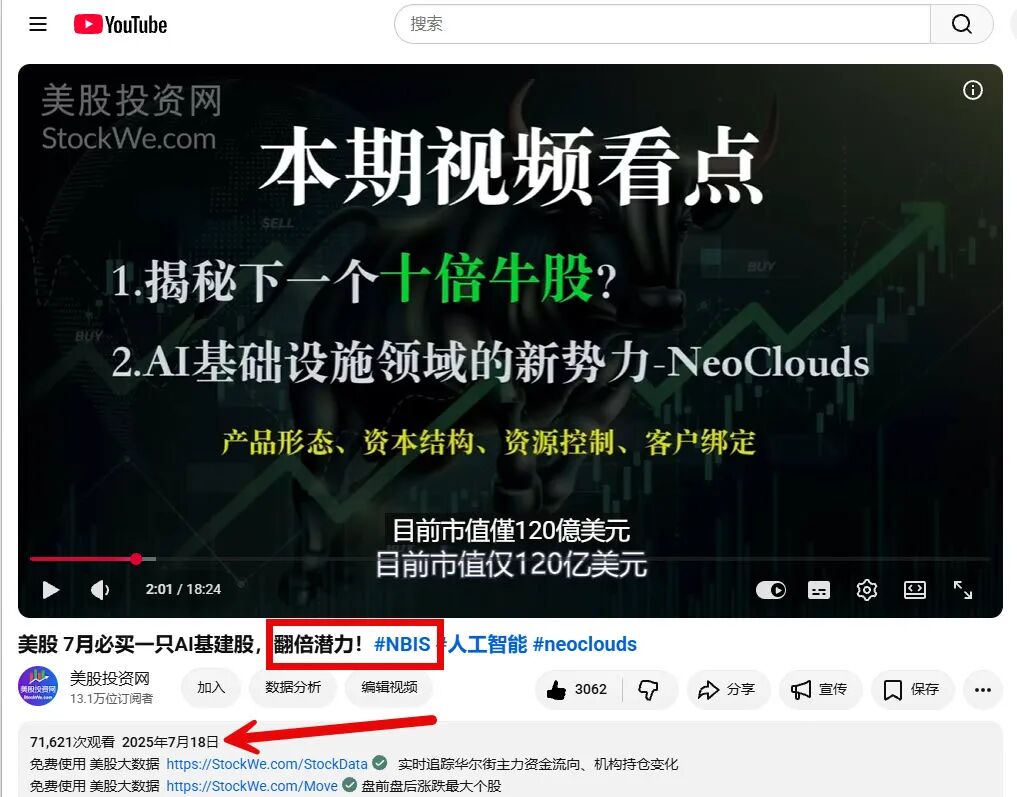
Since U.S. Stock Investment Network released an in-depth bullish research report on NBIS in July 2025 at $45, it has already risen by 600%. We continue to be optimistic on NBIS, our only major long-term holding!
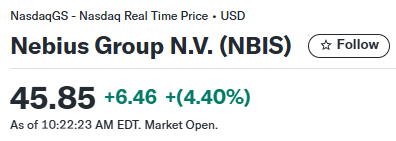
Before tomorrow’s pre-market earnings report, what should really be focused on in the August 12 NBIS earnings? Goldman Sachs clearly maintains a BUY rating with a 12-month target price of $286. With the share at $190 at the time of the report, this implies 50% upside.

1. Let's start with the conclusion: What is the real logic behind Goldman Sachs’ bullish view on NBIS?
In my opinion, the most important takeaway from this report can be summed up in one sentence:
The biggest issue confronting NBIS now is not “is there demand for AI capacity,” but “can they build out supply fast enough.”
This is a very significant shift.
Traditional cloud companies would worry about:
Customer demand → Any customers? → Will they pay? → What about gross margins?
Now, for NBIS, it’s more like:
Customer demand → Already very strong → All capacity sells out → Raise prices → Customers pay upfront → Company quickly builds more data centers
Goldman Sachs clearly points out that as of 1Q26, NBIS already indicated extremely strong demand for AI Infrastructure, and even after raising prices, all current capacity sold out. At the same time, AI infrastructure demand still exceeds supply.
This is a very favorable business climate for a Neocloud company.
Because:
Under-supplied + Price hikes + Long contracts + Prepayments
This means NBIS is shifting from a company that “sells GPU hours” to an AI infrastructure platform with strong pricing power and the ability to secure long-term contracts.
2. Major focus: NBIS revenue may continue to see significant upward revisions
One of the key things Goldman Sachs cares about:
With demand and pricing so strong, could 2026 revenue exceed the company’s previous guidance even further?
The previously disclosed 2026 revenue guidance: $3.0B–$3.4B
Yet, Visible Alpha Consensus already projects 2026 revenue at $3.36B
In other words, the market is already close to the high end of company guidance.
But here’s something worth noting.
Goldman isn’t simply saying NBIS’ revenue is growing fast.
Instead, they’ve noticed three changes:

First, prices are rising.
NBIS is already able to raise prices when supply falls short of demand.
Second, contract terms are getting longer.
Both new and existing customers are signing longer contracts.
Third, customers are starting to pay in advance.
To lock in future capacity, customers are willing to pay up front.
These three changes together are extremely important.
3. Why are “prepayments” especially important?
Many investors only focus on NBIS’ revenue.
But in fact, I think what needs more attention in the future is:
Contracted Capacity + Prepayments + Backlog + ARR
Because for AI computing companies, future value is not just about how much you sell today.
According to U.S. Stock Investment Network, what matters more is: how much future capacity has already been locked down by customers for the coming years.
Suppose a client:
Buys $100M in capacity this year;
Previously, contracts were annual.
Now, it’s a three-year contract.
So for NBIS:
Revenue visibility increases significantly.
If the client then:
Pays part of the fee in advance
NBIS can even use customer funds to help expand infrastructure.
This can create a very interesting loop:
Strong demand → Customers lock in capacity → Sign long-term contracts → Prepayments → NBIS builds data centers → More GPUs online → More revenue
This is also why Goldman emphasizes there is a clear improvement in contract quality for 2026.
4. But here is a huge question: Is $3.4B in revenue for 2026 enough?
This is what I think is the most cautionary aspect of this report for investors.
Goldman’s model is far above the company’s current 2026 guidance.
Goldman predicts:
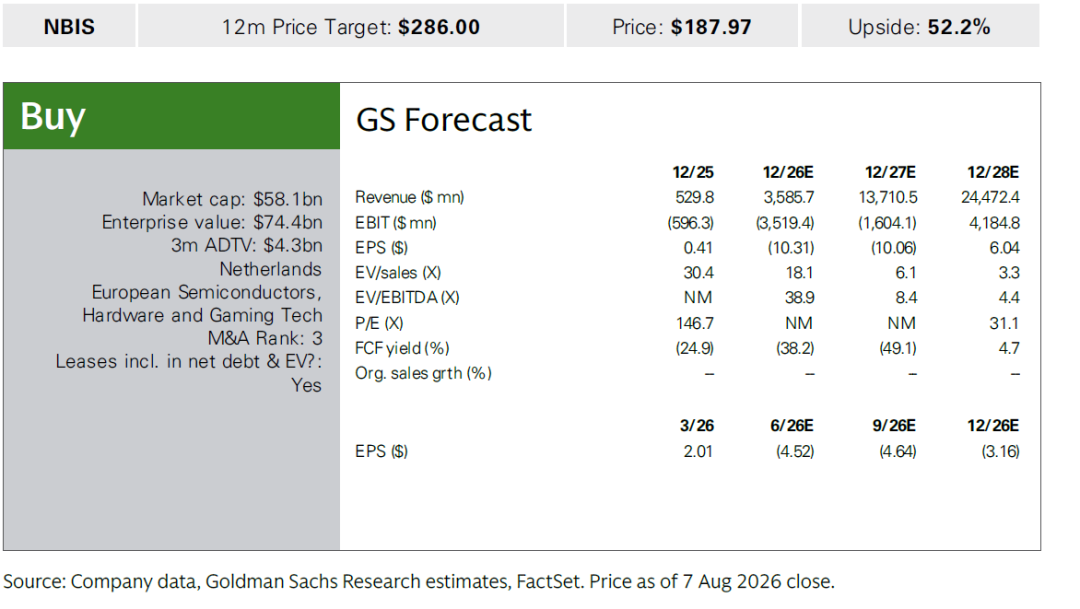
Year
Revenue
2025 $529.8M
2026E $3.586B
2027E $13.711B
2028E $24.472B
Note this number:
2027, $13.7B.
This means Goldman is in fact betting on extremely dramatic revenue growth for NBIS over the next two years.
From: 2025 $530M → 2026 $3.59B → 2027 $13.71B
This is no ordinary high-growth company.
This is the classic AI Infrastructure Hyper-growth thesis.
5. The most important figure: 2026 → 2027 revenue grows nearly 4x
Simple calculation:
$13.71B / $3.586B ≈ 3.82 times
That is, 2027 revenue is roughly 3.8 times that of 2026.
This shows Goldman’s real thesis isn’t:
“NBIS has a great earnings report this year.”
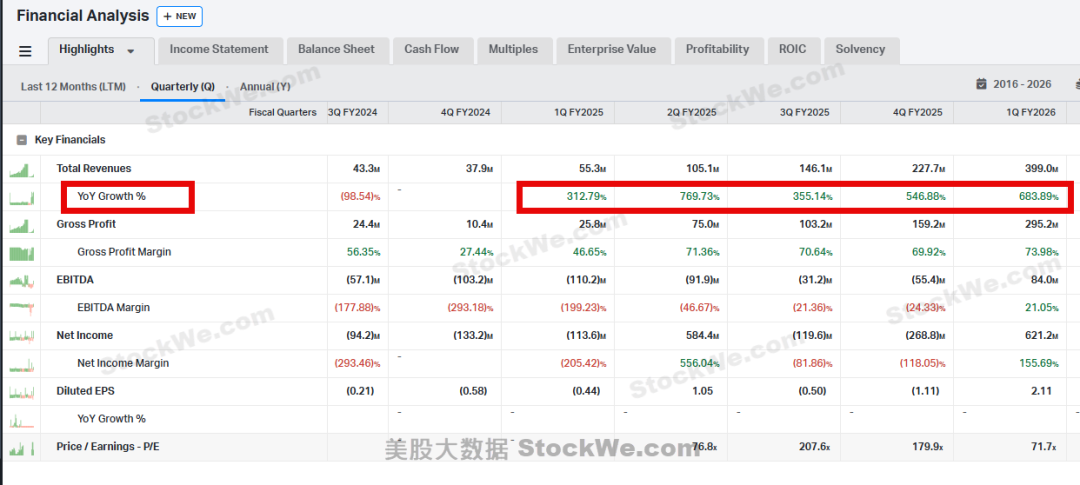
But rather: “NBIS is entering a phase of very rapid scaling.”
Therefore, if the August 12 earnings just tells the market:
“Our revenue will be a bit better this year.”
That might not be sufficient.
What can really drive NBIS’ re-rating is:
Whether 2027’s revenue, ARR, capacity, or contracted power keeps moving higher.
6. Second major question: Will Meta building its own cloud become NBIS’s biggest competitive threat?
This is a very important part of the report.
Goldman explicitly mentions:
Meta is developing its own cloud business.
Investors are concerned:
If Meta enters AI Cloud itself,
Does that mean:
Google, Microsoft, Amazon, Meta—will all eventually build their own AI infrastructure?
So:
Does a Neocloud like Nebius still have room to exist?
This is a very reasonable concern.
7. Why does Goldman believe NBIS still has a competitive edge?
This is a key highlight of the report.
Goldman believes NBIS is not just selling:
Bare-metal GPU capacity
In other words:
“I give you a stack of GPUs, you use them.”
NBIS wants to offer:
Full-stack AI Platform
That is, from:
GPU Compute
↓
Storage
↓
Orchestration
↓
AI infrastructure
↓
Engineering support
Everything integrated together.
This is the fundamental difference between NBIS and traditional GPU rental firms.
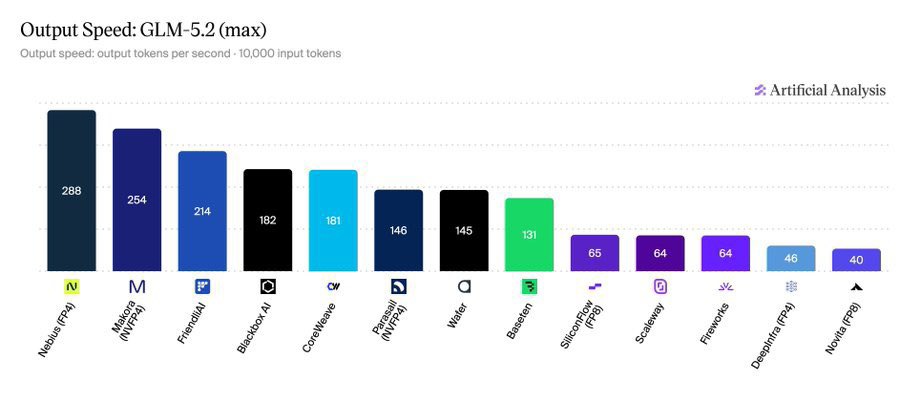
8. NBIS’s true moat may not be GPUs, but “software + service + compute power”
Goldman summarizes several advantages emphasized by NBIS at the Inflection event:
Faster response speed
More focused product
Integrated Compute + Storage + Orchestration
Clients can directly interact with engineering teams
More flexible contract structures
These things may not seem exciting.
But for AI companies, they are very important.
Because what AI clients really need isn’t:
“Give me 1,000 GPUs.”
But: “Allow me to train my model today.”
Therefore: GPU is just base infrastructure.
The true driver of customer stickiness may be:
GPU + Networking + Storage + Scheduler + Kubernetes + AI software + engineering support
This is also the business model most worth watching among Neoclouds.