
Ethereum climbs 3% on tokenization boom: Can bulls push ETH price past $1,800?

Ether (ETH) price gained 3% between Thursday and Friday, outperforming the broader crypto market. The move ties to growing tokenization, Robinhood Chain’s success, and ongoing corporate treasury purchases. However, ETH failed to break above $1,800 amid weak onchain and derivatives metrics. Is Ether price bound to retest $1,700?
Key takeaways:
- Ethereum leads RWA tokenization while Robinhood Chain drives fresh ETH inflows and ecosystem growth.
- Mixed signals persist as BitMine accumulates heavily, yet stagnant onchain metrics signal caution.
Robinhood Chain and tokenization growth boost ETH price
The successful launch of the layer-2 network Robinhood Chain has boosted Ether investors’ sentiment. The newly launched blockchain uses ETH as its native gas token and has netted $106 million in bridge deposits. The TradFi trading platform Robinhood offers tokenized stocks to customers in 120 countries, further strengthening the EVM-compatible ecosystem.
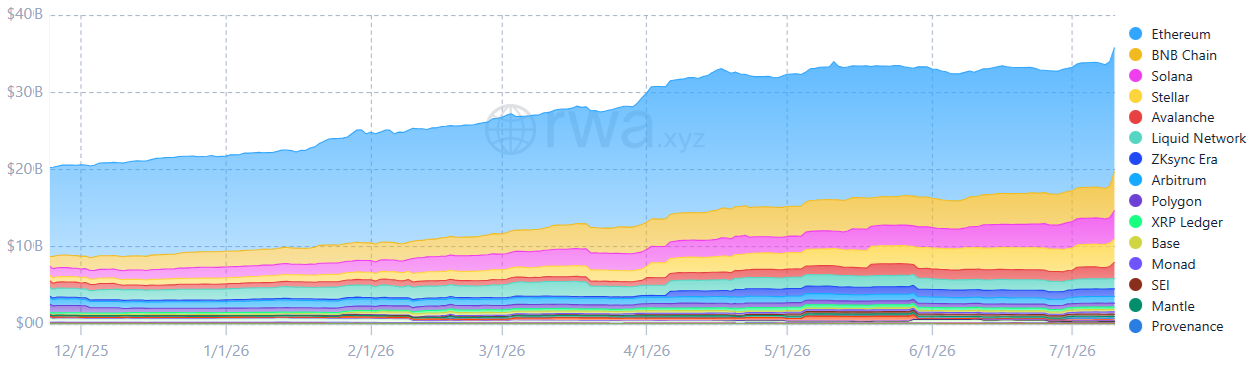
Distributed tokenized assets value per chain, USD. Source: rwa.xyz
Ethereum dominates the RWA (real-world assets) market with a 47% market share, according to Rwa.xyz data. Excluding stablecoins, notable highlights include SKY’s Tether Gold (XAUT), Ondo US Dollar Yield (USDY), and Franklin Templeton’s government bonds (iBENJI). Leaders among tokenized stocks include Strategy’s PP variable (STRCx) from xStocks and Circle Group (CRCLon) from Ondo.
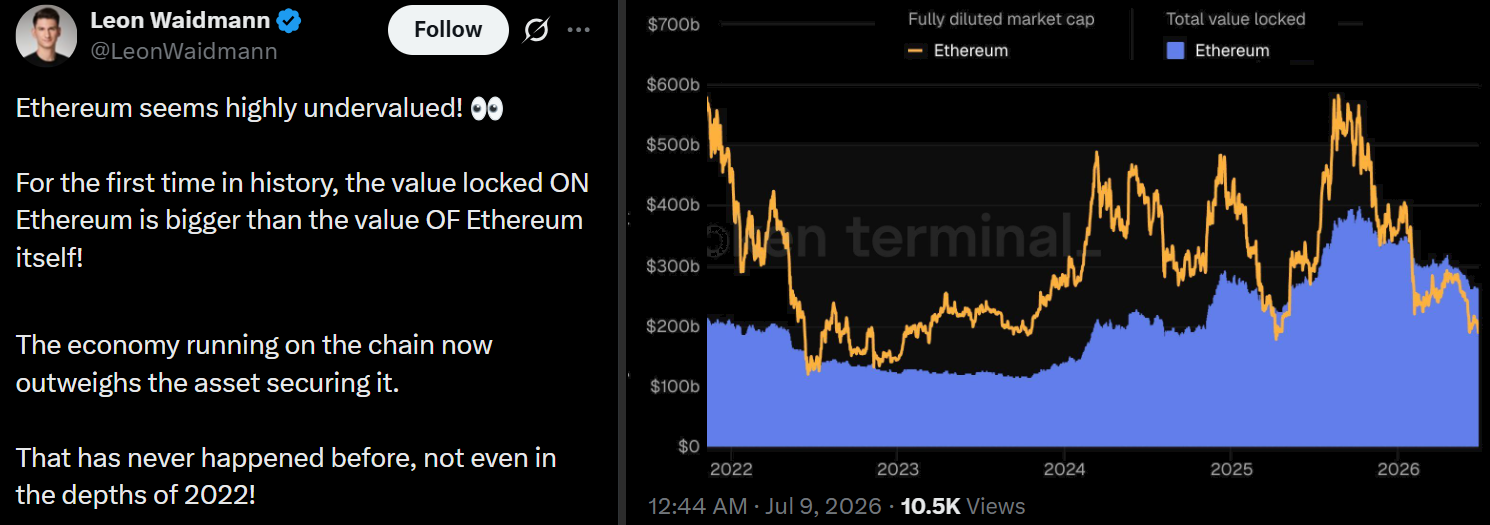
Source: X/LeonWaidmann
Leon Waidmann, head of Research at Lisk, noted that for the first time in history, the Total Value Locked (TVL) on Ethereum at $260 billion surpassed the market cap of Ether, currently at $210 billion. According to Waidmann, this distortion signals that “ETH is underpriced,” as the current relative valuation is lower than in the 2022 bear market.
Weak onchain and derivatives metrics limit Ether’s upside
Regardless of the growing adoption of Ethereum’s layer-2 solutions and the institutional inflows, onchain metrics point to overall stagnation. The 2026 bear market has hurt blockchain demand, while competing blockchains gained ground in specific sectors, including synthetic perpetual futures and automated yield vaults.

Ethereum weekly DApps revenue, USD (left) vs. active addresses (right). Source: DefiLlama
Decentralized applications (DApps) on Ethereum generated $11 million in weekly revenue, down from $20 million in the first quarter of 2026. Notable mentions include Sky at $3.1 million, Titan Builder with $2.4 million, and Chalink’s $1.1 million. Similarly, active addresses dropped to 3.2 million from 5.4 million in the first quarter, according to DefiLlama.
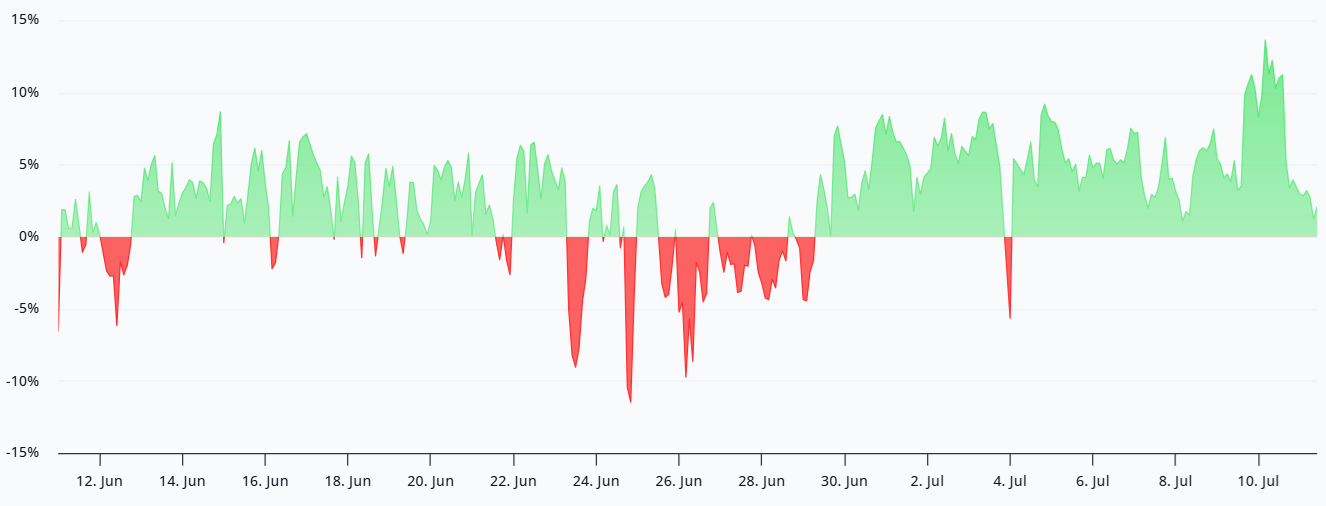
ETH perpetual futures annualized funding rate. Source: Laevitas
Meanwhile, ETH's perpetual futures annualized funding rate dropped to 3% on Saturday, below the 6% neutral threshold signaling weak demand for bullish positions. Current data contrasts with the peak 12% levels from Friday, suggesting that bulls lack confidence. However, institutional inflows likely explain the latest price gains.
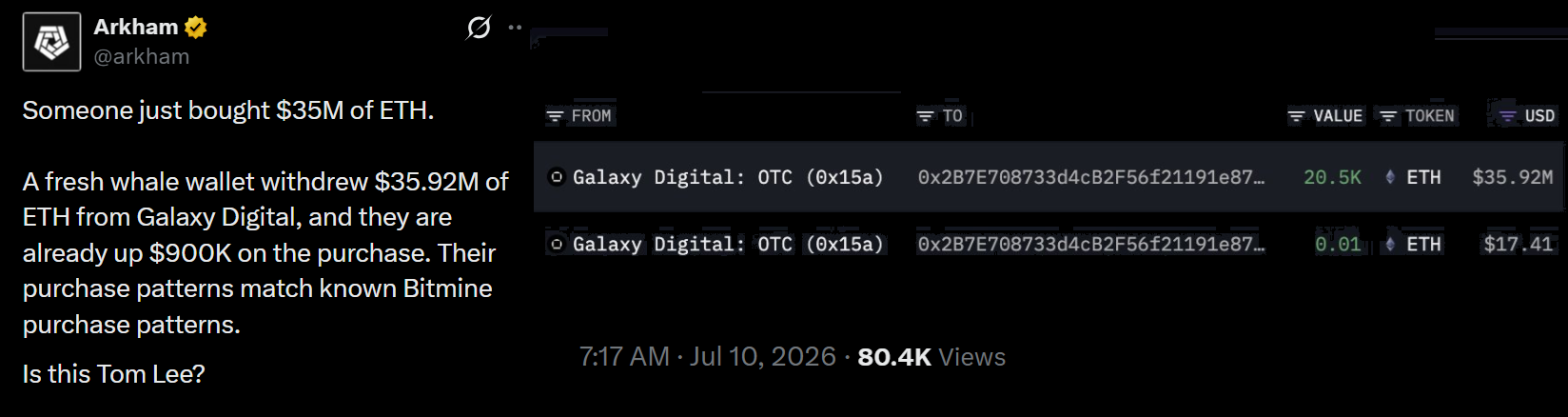
Source: X/Arkham
Arkham Intelligence flagged an ETH 20,500 withdrawal on Thursday worth $36 million from Galaxy Digital to a new wallet, a pattern that matches previous Tom Lee’s BitMine Immersion (BMNR US) purchases. BitMine added ETH 198,370 in the past 30 days alone, while the treasury company now holds $10.3 billion in reserves.
Ultimately, mixed signals from strong fundamentals and weak onchain metrics do not justify a retest of the $1,700 level, especially when considering BitMine's impressive accumulation pace.
Disclaimer: The content of this article solely reflects the author's opinion and does not represent the platform in any capacity. This article is not intended to serve as a reference for making investment decisions.
You may also like
Waymo, a subsidiary of Alphabet (GOOGL.US), expands into the European market: entering Spain and planning to launch services next year
Waymo, a subsidiary of Alphabet, will further expand into the European market, planning to launch its services in Madrid in 2027.

It is reported that Samsung and SK Hynix (SKHY.US) are seeking to upgrade their factories in China: aiming to win AI orders and prevent Yangtze Memory from taking market share.
According to four sources familiar with the matter, Samsung Electronics and SK Hynix are upgrading production lines at their factories in China.

PENGU Price Prediction: Can SoFi Adoption Push Pudgy Penguins Above $0.0085?

Meta Q3 Earnings Preview: Revenue May Exceed Expectations, 2027 Spending Is the Key Disagreement
The market generally holds an optimistic view on this quarter's revenue, but the real divergence lies in whether a balance can be achieved between capital expenditures in 2027 and AI monetization. Aside from spending concerns, analysts expect the earnings call to also focus on several key areas: user adoption rates for Muse and per-user token costs, enterprise-level AI opportunities, and large language model and infrastructure strategies. Bank of America warns that if management suggests capital expenditures or operating expenses may further increase in 2027, or if the timeline for AI monetization lags behind expectations, the company's stock price will inevitably come under pressure.

Crypto prices
More


