
Crypto VC Paradigm expands into AI, robotics with $1.5B fund: WSJ

Crypto investment firm Paradigm is seeking to raise $1.5 billion for a new fund that will invest in companies in AI, robotics and other frontier technologies, according to the Wall Street Journal.
Paradigm will continue to invest in crypto companies, according to sources familiar with the situation, but it will use its existing technical investment team to look at deals in frontier tech companies, they said.
San Francisco–based Paradigm has $12.7 billion in assets under management, according to the latest regulatory filings.
It launched its flagship $2.5 billion fund in November 2021, which was the largest crypto fund in history at the time. It publicly announced its third fund in 2024 — an $850 million venture fund focused on early-stage crypto projects.
According to the WSJ’s sources, the firm’s managers decided they didn’t want to be restricted in ways that could cause them to miss out on attractive deals.
There is also overlap between crypto and AI, such as agentic payments, or transactions made by autonomous AI agents, the person said.
Paradigm exploring AI as early as 2023
Paradigm acknowledged it had been “tinkering” with AI and its convergence with crypto as early as three years ago.
In 2023, Paradigm was seen removing Web3 and crypto-specific language from its website, prompting some speculators to suggest it was already pivoting from crypto to AI.
Matt Huang, the co-founder and managing partner of Paradigm, denied at the time that the website changes reflected a shift away from crypto, but acknowledged that the team had been exploring AI.
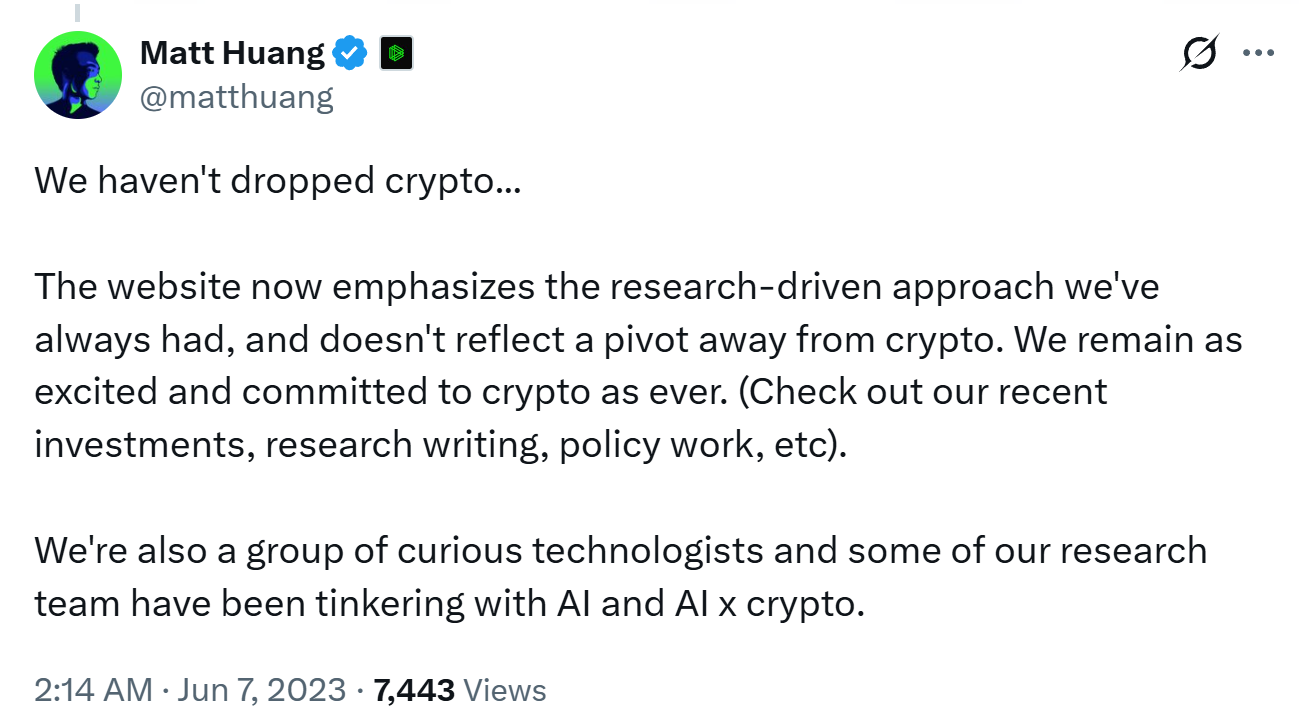 Source:
Matt Huang
In a lengthier tweet weeks later, Huang said that while “we’ve never been more excited about crypto and continue to invest across all stages,” the “developments in AI are too interesting to ignore.”
“It seems trendy to frame crypto vs AI as a zero-sum competition. But we don’t buy it. Both are interesting and will have plenty of overlap. We’re excited to continue exploring,” he said.
Earlier this month, Paradigm and OpenAI released EVMbench, a new benchmark evaluating how different AI models can detect and patch security vulnerabilities found in smart contracts.
AI made up more than half of all VC funding in 2025
In 2025, venture capital investments in AI firms amounted to $258.7 billion, accounting for 61% of all VC investment and doubling its share from 2022, according to OECD.
VC funding for generative AI firms made up 14% of all AI venture capital investments, with firms in the United States attracting the largest share of VC funding.
AI Eye: IronClaw rivals OpenClaw, Olas launches bots for Polymarket
Disclaimer: The content of this article solely reflects the author's opinion and does not represent the platform in any capacity. This article is not intended to serve as a reference for making investment decisions.
You may also like
WTI Oil plunges as US-Iran compromise proposal raises hopes of de-escalation
Why the Canadian Dollar's rebound isn't just about rate-hike bets
Korean stocks fall to historically "cheap" levels with no buyers, JPMorgan warns: Leverage-driven sell-off may continue
Excluding the influence of giants like Samsung and SK Hynix, the overall KOSPI is trading at just 8.4 times forward earnings, placing it in the 11th historical percentile. With stock buybacks by Samsung and SK Hynix having recently concluded, net sales by foreign investors, and weak demand from domestic institutions, Korean stocks are losing sources of buying exactly when the market most needs support. JPMorgan pointed out that although holdings of leveraged ETFs have faced large-scale sell-offs, they still remain high, and the possibility of another round of sell-offs cannot be ruled out.

CoreWeave bond plunge rings alarm bells, Fed may need to reassess rate hike pace
CoreWeave bond yields once surged to 15%, with junk-grade and investment-grade yields reaching their highest levels since 2025 and 2023, respectively. According to a Bloomberg column, as the 2028 high-yield debt maturity peak approaches, a disorderly widening of credit spreads could trigger a wave of defaults and rising unemployment. The Federal Reserve should stay put at its October meeting, maintaining the interest rate range at 3.75% to 4%, and prudently weigh its decision for December.

Crypto prices
More


