
Singapore’s MAS Unveils BLOOM Initiative to Advance Global Tokenized Finance

Quick Breakdown
- MAS launches BLOOM to enhance global digital asset settlement using tokenized bank liabilities and stablecoins.
- The initiative builds on Project Orchid’s successful trials exploring a digital Singapore dollar.
- Collaborations with Circle, DBS, Stripe, and others aim to advance cross-border payments and financial innovation.
MAS launches BLOOM to drive tokenized settlement innovation
The Monetary Authority of Singapore (MAS) is deepening its commitment to digital finance with the launch of BLOOM (Borderless, Liquid, Open, Online, Multi-currency) — a new initiative designed to scale tokenized settlement solutions and strengthen the global financial ecosystem.
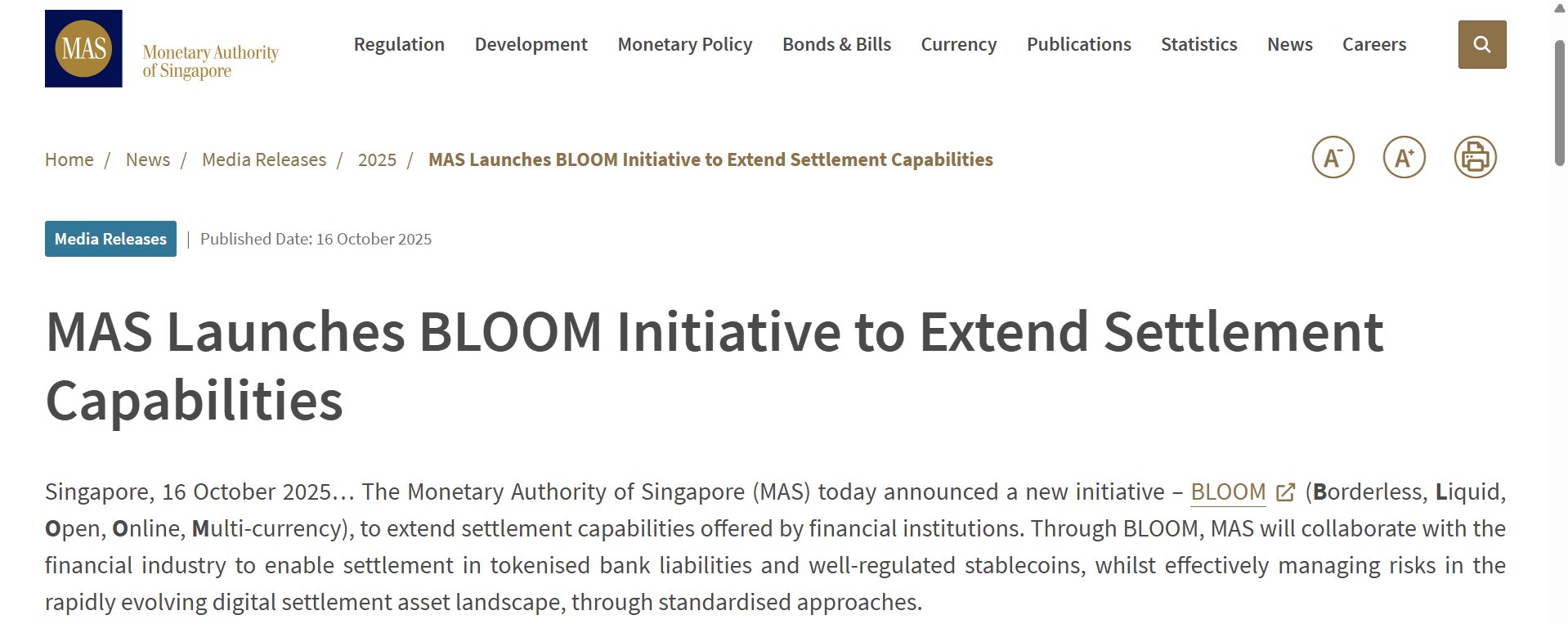 MAS launches BLOOM to enhance global digital asset settlement using tokenized bank liabilities and stablecoins. Source: MAS
Unveiled in an October 16 report, BLOOM aims to expand the use of tokenized bank liabilities and regulated stablecoins for cross-border and domestic payments while standardizing risk management frameworks in digital finance.
Building on Project Orchid’s success
BLOOM builds upon insights from Project Orchid, MAS’s 2021 exploration of a digital Singapore dollar. The initiative’s ten successful trials yielded critical data on real-world use cases, helping financial institutions develop market-ready digital asset solutions.
With BLOOM, MAS plans to bring these insights into practical deployment, enabling seamless integration of tokenized financial assets and stablecoins into both local and international payment systems.
Key focus areas of BLOOM
The BLOOM initiative targets several strategic areas to accelerate the adoption of digital assets , cross-border and domestic payments, multi-currency support and wholesale applications.
To achieve these goals, MAS has partnered with major industry players including Circle, DBS, OCBC, Partior, Stripe, and UOB. The collaboration will focus on reducing transaction costs, optimizing compliance checks, and simplifying settlement processes across global networks.
MAS Chief FinTech Officer Kenneth Gay noted that BLOOM complements ongoing initiatives like Project Guardian and Global Layer One, expanding the range of settlement options available to financial institutions and fostering long-term innovation.
Singapore’s steady march toward digital asset integration
This launch comes as MAS announced a one-year delay in implementing the Basel Committee’s crypto regulations, extending the timeline from 2026 to 2027. Despite the delay, Singapore continues to position itself as a frontrunner in digital finance, using BLOOM to lay the groundwork for a scalable and secure tokenized financial future.
Meanwhile, OKX introduced OKX Pay, Singapore’s first stablecoin-powered scan-to-pay service, marking a significant step in bringing crypto payments into everyday transactions.
Disclaimer: The content of this article solely reflects the author's opinion and does not represent the platform in any capacity. This article is not intended to serve as a reference for making investment decisions.
You may also like
WTI Oil plunges as US-Iran compromise proposal raises hopes of de-escalation
Why the Canadian Dollar's rebound isn't just about rate-hike bets
Korean stocks fall to historically "cheap" levels with no buyers, JPMorgan warns: Leverage-driven sell-off may continue
Excluding the influence of giants like Samsung and SK Hynix, the overall KOSPI is trading at just 8.4 times forward earnings, placing it in the 11th historical percentile. With stock buybacks by Samsung and SK Hynix having recently concluded, net sales by foreign investors, and weak demand from domestic institutions, Korean stocks are losing sources of buying exactly when the market most needs support. JPMorgan pointed out that although holdings of leveraged ETFs have faced large-scale sell-offs, they still remain high, and the possibility of another round of sell-offs cannot be ruled out.

CoreWeave bond plunge rings alarm bells, Fed may need to reassess rate hike pace
CoreWeave bond yields once surged to 15%, with junk-grade and investment-grade yields reaching their highest levels since 2025 and 2023, respectively. According to a Bloomberg column, as the 2028 high-yield debt maturity peak approaches, a disorderly widening of credit spreads could trigger a wave of defaults and rising unemployment. The Federal Reserve should stay put at its October meeting, maintaining the interest rate range at 3.75% to 4%, and prudently weigh its decision for December.

Crypto prices
More


