
Unlock cross-chain liquidity, Avail Nexus helps you seamlessly experience Monad applications

Monad is dedicated to achieving ultimate performance, while Avail Nexus focuses on unlimited scalability and seamless access.
The Monad mainnet has officially launched, with Avail serving as the foundational infrastructure powering the first batch of ecosystem applications. This allows users to seamlessly access liquidity without cross-chain bridging or worrying about gas fees.

How is this achieved?
● Avail Nexus eliminates all complex steps: no cross-chain switching, no unnecessary conversions, and no need to worry about gas.
● Applications built on Avail Nexus can directly access multi-chain liquidity (supporting 13+ chains) on Monad.
● For users: you can use assets from various chains directly within the Monad ecosystem, without manual cross-chain operations. Simply visit -
● For developers: achieve full-chain expansion with a one-time integration through the Nexus SDK.
Below are selected flagship applications within the Monad ecosystem, all powered by Avail Nexus:
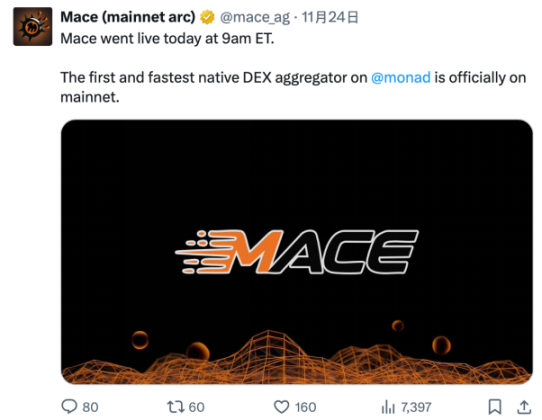
1. Mace
Monad decentralized exchange. Connect to Mace for easy swaps and yield farming.
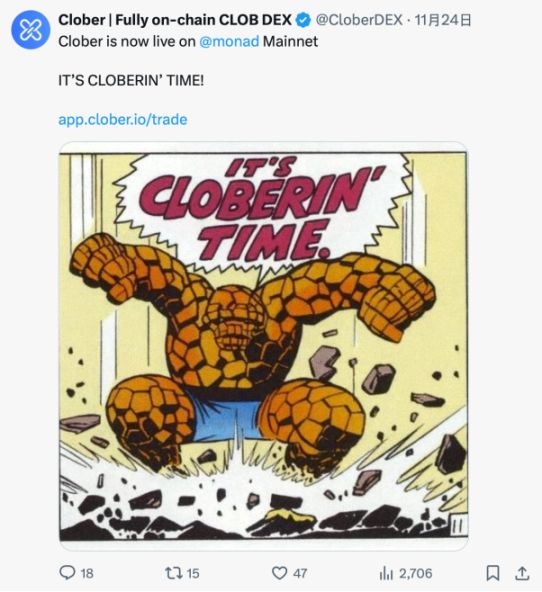
2. Clober
Monad on-chain order book infrastructure protocol. Provides CLOB-style trading and deep liquidity, ideal for traders seeking precise order execution on Monad.
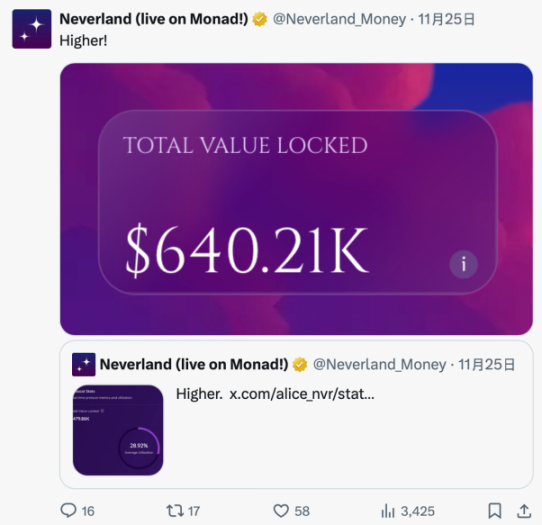
3. Neverland
Native Monad lending protocol, innovatively introducing a self-repaying loan model and returning 100% of protocol revenue to users. Additionally, its account name "neverland_money" is cleverly conceived and serves as a finishing touch.
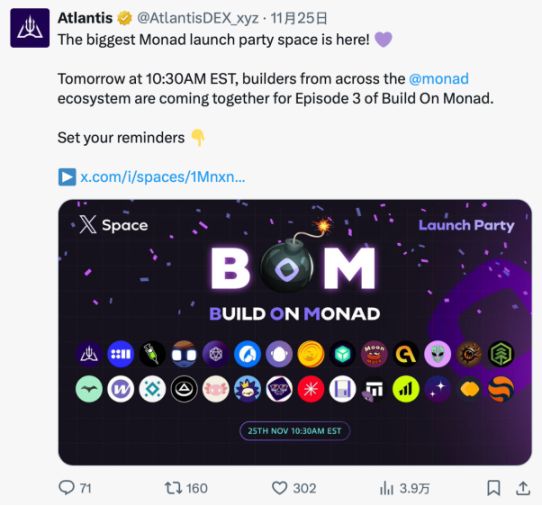
4. Atlantis
Modular V4 decentralized exchange and all-in-one DeFi hub. Powered by DeFAI, it enables swaps, yield generation, and project launches.
5. Rug Rumble
Only hardcore players can survive here! This is the ultimate battleground combining casino, gambling, and lottery elements.

6. Bean Exchange
Monad’s capital-efficient perpetual contract and DLMM spot trading platform. User operations require only three steps: connect → swap → done.

Avail✖️Monad
Monad is committed to ultimate performance, while Avail Nexus focuses on infinite scalability and seamless access.
The strong partnership between the two brings the following value:
● For users: a single interface aggregates liquidity across all chains;
● For applications: one integration provides instant access to funds across all chains;
● For developers: one integration deploys to all chains.
From now on, users can completely say goodbye to the hassle of "how to use funds across chains." This is the vision of a modular on-chain economy.
The Avail Nexus mainnet is about to launch, with more ecosystem developments to be revealed soon. Stay tuned!
If you need help scaling your Monad application and acquiring Web3-wide liquidity and users, feel free to DM us.
Disclaimer: The content of this article solely reflects the author's opinion and does not represent the platform in any capacity. This article is not intended to serve as a reference for making investment decisions.
You may also like

US Treasury "Extreme Short Sellers" Gather! With Oil Prices and Treasury Yields "Dual Pressure," Rate Hike Expectations Surge, Market Bets Real Money on a New Round of Tightening
According to some veteran Wall Street analysts, the most favorable combination for the market is a small rate hike accompanied by a clear data-dependent stance, allowing investors to interpret it as a limited and moderate monetary policy adjustment to guard against recurring inflation.

Intel CEO: CPU only meets 50% of demand, 14A to start production in Q1 next year, new architecture may reduce inference power consumption to 1/15 of GPU
Intel CEO Pat Gelsinger stated that the era of AI agents has triggered an explosion in CPU demand, and Intel is currently able to meet only about 50% of its customers' supply needs, with several tech giant CEOs calling to secure supply. In terms of manufacturing process, the 18A node is now in full mass production, while the 14A node will begin production in the first quarter of next year. By opening up factory data, yield rates are improving by about 7% annually. Additionally, he is advancing neuromorphic computing to address energy consumption bottlenecks and expects quantum computing to have a substantial industrial impact within 3 to 5 years.


