
This Week’s Market Outlook: Nasdaq 100 Enters Correction, Gold Posts Worst October — How Will AI Monetization Concerns Reshape CFD Markets?
This week’s key themes across global markets are: AI monetization, valuation correction, liquidity and precious-metals deleveraging.
If last week the market was still discussing “whether gold can reclaim $4,000 and whether US500 can hold its highs,” the situation has clearly escalated this week: the Nasdaq 100 has officially entered correction territory, and the technology selloff has expanded from individual earnings disappointments into a broad challenge to the “AI capex cycle.” At the same time, gold has slumped to a one-year low, silver has fallen below $50, and platinum and palladium have also hit new lows, producing a rare broad selloff across precious metals.
More importantly, this selloff is no longer merely a “risk-asset pullback.” When a sharp technology correction triggers margin calls, investors may be forced to sell liquid defensive assets such as gold to cover margin, creating a cross-asset deleveraging chain reaction in which “stocks fall and gold falls too.” For CFD traders, the key this week is not just guessing direction, but understanding the source of volatility, cross-asset linkages and leverage risk.
Nasdaq 100 Officially in Correction: AI Moves from Growth Narrative to Profit Validation
The technology sector’s stunning two-year rally was built on expectations that the AI revolution had almost “zero room for error.” But as several major global technology companies reported disappointing earnings, concerns that “AI infrastructure investment may slow” are rising quickly, directly threatening the core driver that has supported US equities over the past four years.
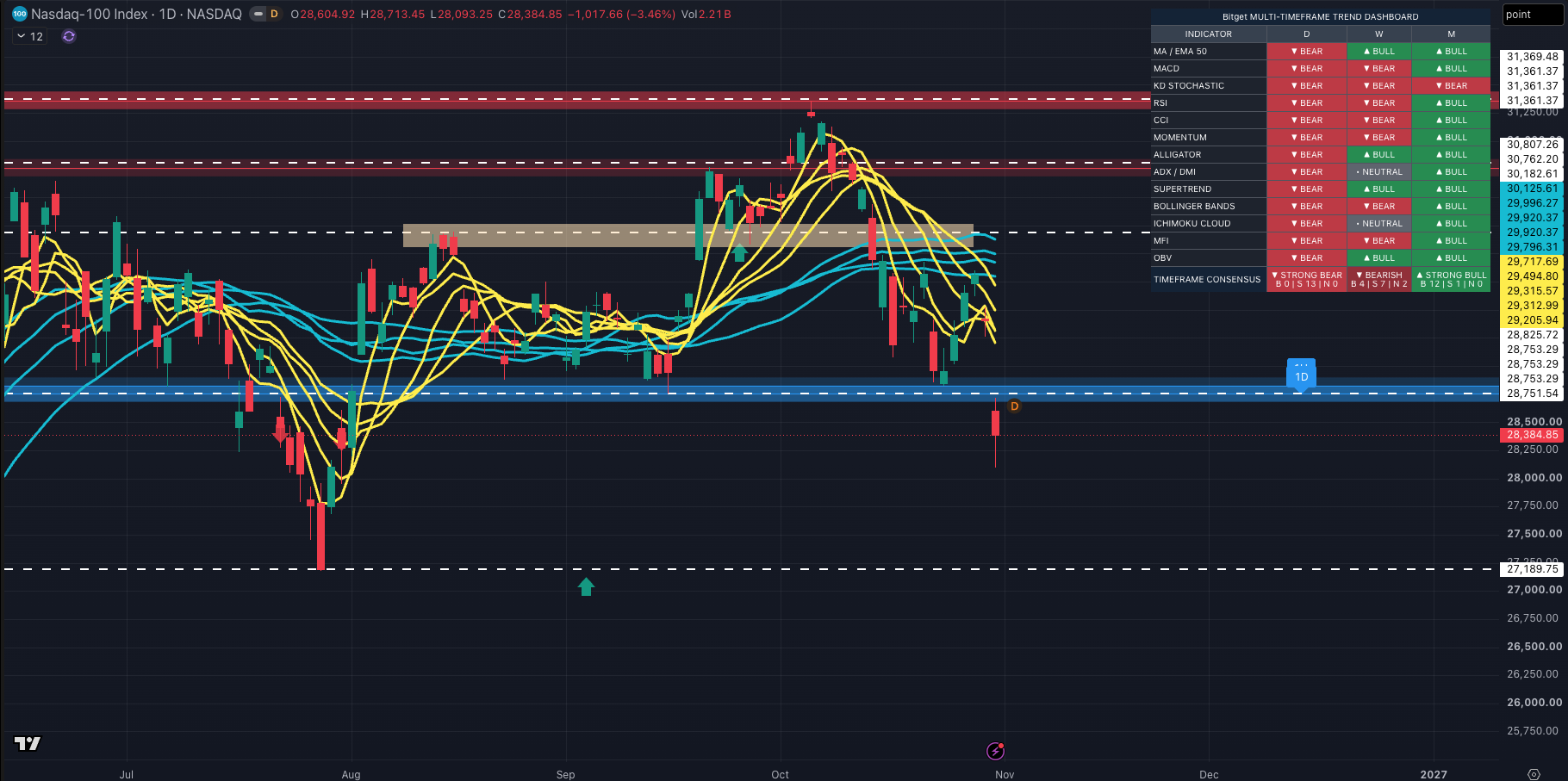
The Nasdaq Composite posted its biggest one-day drop since June 5 last Friday and ended with its worst monthly performance since March 2025; the Nasdaq 100 has formally entered correction territory, down more than 10% from its high.
The impact at the single-stock level has been even more severe:
-
Intel (INTC-US) plunged 29% in one day, its worst single-day performance since at least 1980;
-
Alphabet (GOOGL-US) posted its largest one-day drop in history last Thursday;
-
Reddit (RDDT-US) suffered its biggest one-day decline ever after management warned that Google search traffic was declining.
Market sentiment during the entire earnings season was clearly overly optimistic — even when most technology companies beat expectations and raised guidance, their shares still came under pressure; when a company like Intel missed expectations, the market reaction was even more brutal.
At the same time, earnings from several technology giants have revealed early signs of weakening in their core businesses, prompting investors to question whether companies can still sustain massive chip purchases and data-center construction capex to support the continued development of AI technology.
Notable signals include:
1. Alphabet missed quarterly revenue expectations for the first time since 2024, with search growth slowing markedly, fueling concerns that AI is gradually eroding its decades-long search dominance;
2. Amazon also missed market revenue expectations;
3. Intel’s weak guidance reflected how rising memory-chip prices are hurting notebook demand, while corporate IT budgets must now choose between AI tools and hardware.
More critically, hyperscalers such as Alphabet, Amazon, Microsoft and Meta continue to burn cash building AI infrastructure. Once any link in the chain shows weakness, the entire chip-stock narrative will be hit by spillover effects. This also explains why valuation multiples for companies such as Nvidia (NVDA-US) and Micron (MU-US) are beginning to contract.
A Correction Is Not a Reversal, but Index Volatility Has Clearly Increased
From a CFD trading perspective, this technology selloff reveals several trading logics worth watching.
First, the gap between valuations and fundamentals is being corrected. Wall Street analysts continue to raise next-year profit estimates, but investors are no longer willing to buy at high valuations. This divergence between “profit estimates vs. market sentiment” is often a precursor to higher volatility in index CFDs.
Second, a correction is not a reversal, but volatility has risen significantly. The Nasdaq 100 entering correction territory means short-term swings will widen; whether traders are trend-following short or playing contrarian rebounds, the leverage and two-way trading features of CFDs allow traders to capture moves more flexibly — but they also mean losses in the wrong direction can be amplified.
Third, hyperscaler capex trends will be a core focus. Upcoming earnings and capex guidance from Microsoft, Meta and others will be key to judging whether the AI investment cycle is truly cooling. If companies begin to cut capex, semiconductors, cloud, the AI supply chain and the Nasdaq 100 could face a new round of valuation pressure; conversely, if capex remains strong, the market could also see an oversold rebound.
Key Focus for Nasdaq 100 and US500 This Week
 |
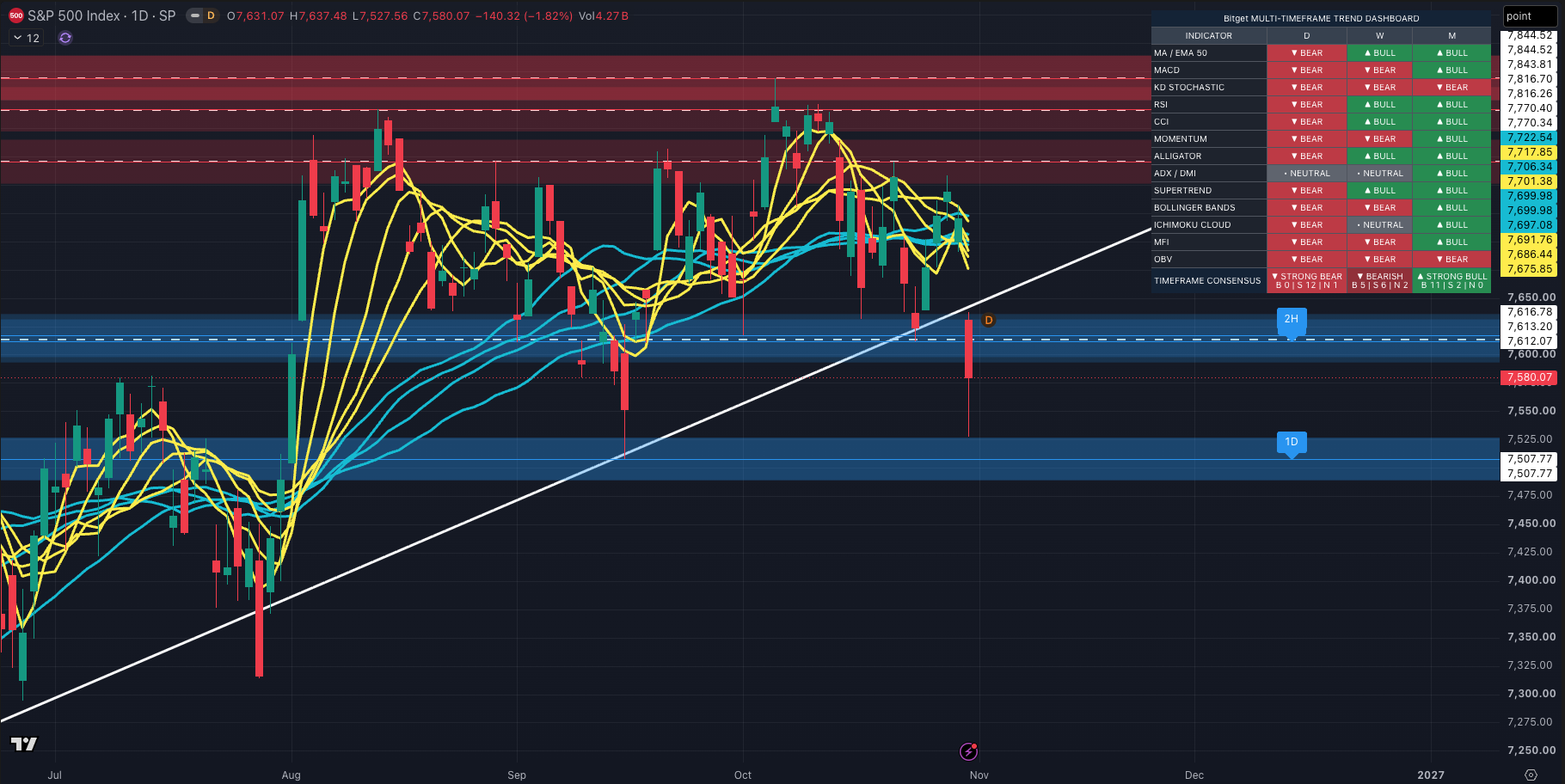 |
For Nasdaq 100 and US500 CFD traders, besides watching whether the index correction continues, the more important task this week is to observe whether internal market signals begin to stabilize.
1. Can large-cap technology stocks stop falling?
Nvidia, Microsoft, Apple, Alphabet, Amazon, Meta and other heavyweight stocks remain the core drivers of index direction. If heavyweights continue to weaken, index rebounds may be short-lived; only if leaders stabilize first will the correction have room to cool.
2. Will AI capex guidance weaken?
The market is not only looking at revenue and earnings, but also at what companies say about AI investment, data-center construction, financing needs and future returns. Any signal of “slowing capex” could be magnified by the market.
3. Will market breadth improve?
If rebounds are driven only by a handful of heavyweight stocks, the bullish structure remains fragile; only if financials, industrials and small- and mid-cap stocks stabilize together can correction pressure truly ease.
4. Rate and inflation expectations
High-valuation technology stocks are especially sensitive to US Treasury yields. If inflation concerns push yields higher, the Nasdaq 100’s rebound potential may be limited.
5. Key technical levels and volume
After the index enters correction territory, prior lows, round-number levels and rebound resistance zones will become key battlegrounds. If rebounds lack volume confirmation, traders should be wary of false breakouts; if prior lows are breached and selling accelerates, leverage and stop-losses must be strictly controlled.
Gold Plunges to a One-Year Low: Why Are Safe-Haven Assets Failing at the Same Time?
The technology selloff has hit not only equities but also the precious-metals market.
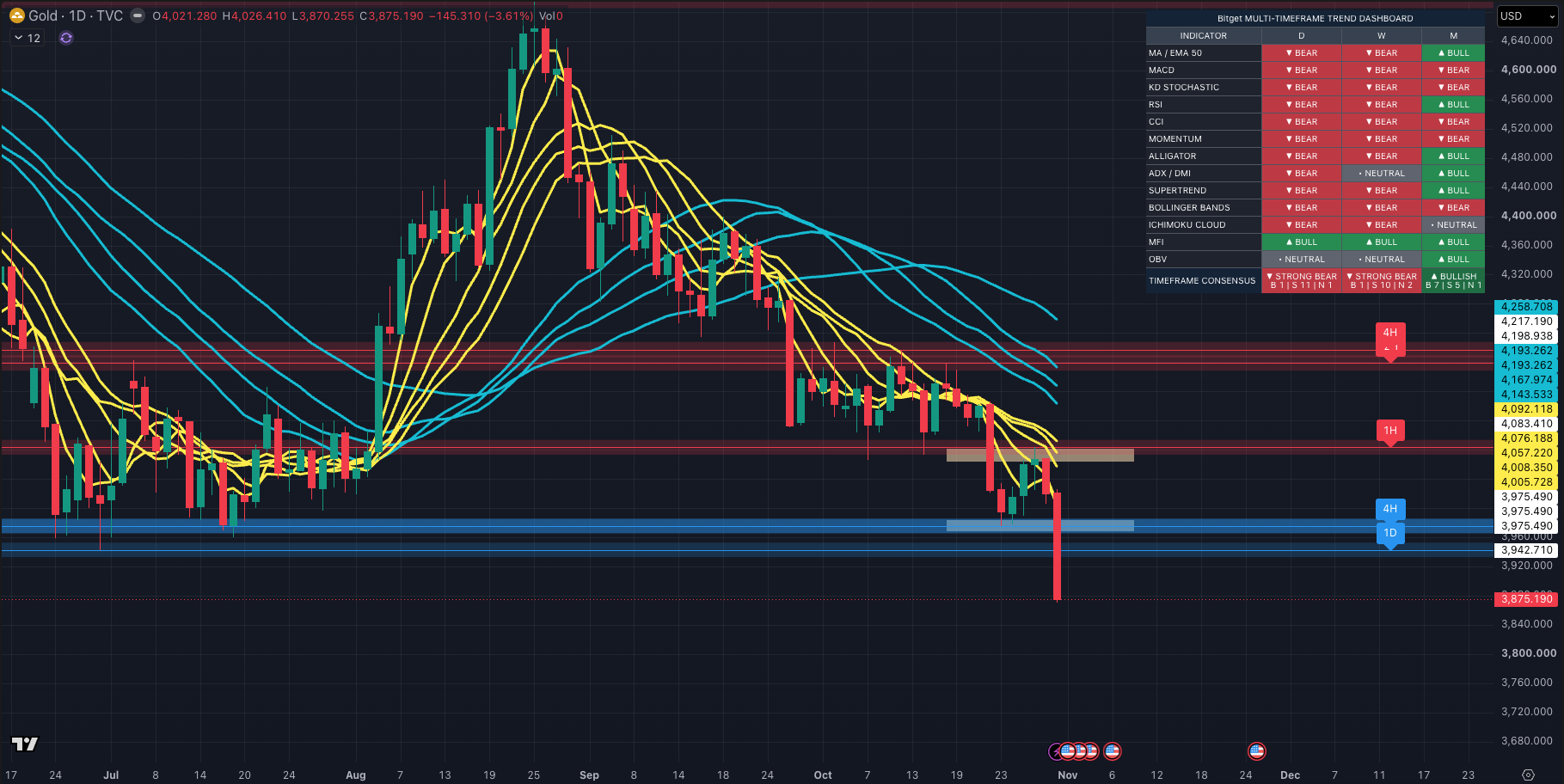
Spot gold fell 3.5% last Friday to $3,880.97 per ounce, its lowest since October 2025; US December gold futures closed down 3.3% at $3,898.90 per ounce. Gold fell 2.9% for the week and at least 6% for the full month of October, marking two consecutive monthly declines and its worst October performance since the 2008 financial crisis.
After hitting a record high of $5,595 per ounce in January this year, gold has now fallen about 30%. Pressure has come mainly from three areas: expectations that rates will stay higher for longer, weak Asian demand, and cracks in the AI-driven market support.
This is the most important shift in gold-trading logic this week: do not assume that “if stocks fall, gold must rise.” When the market enters a phase of liquidity tightening and margin calls, gold can shift from a safe-haven asset into a source of liquidity — “sold to raise cash.”
That said, gold is not without support. Analysts note that when gold falls below $4,000 per ounce, central-bank buying demand often increases, leaving some uncertainty for the path ahead. For XAUUSD traders, $4,000 remains the key psychological and technical level: if gold can quickly reclaim $4,000, it would suggest dip-buying demand remains; if it remains capped below $4,000 and breaks the low near $3,880, bearish momentum may not yet be over.
White Precious Metals Fall Even Harder: Silver, Platinum and Palladium Enter Oversold Territory
Compared with gold, “white precious metals” such as silver, platinum and palladium lack the two key forces that have supported gold in recent years — central-bank buying and safe-haven investment demand — so their declines have been even more severe.
-
Spot silver fell 6.5% to $49 per ounce, breaking below the $50 mark for the first time in 11 months, with a monthly decline of nearly 19%;
-
Spot platinum, pressured by concerns over automotive demand, fell 4.2% to $1,425.02 per ounce, hitting a 13-month low;
-
Spot palladium fell 3% to $976.08 per ounce, hitting a 17-month low.
All three metals posted a second consecutive monthly decline in October, with weekly losses of 7% to 9%, far exceeding gold’s 2.9% drop. Their Relative Strength Index (RSI) has sunk deep into “oversold” territory for the first time in nearly three years, indicating strong bearish momentum.
“What is especially worrying about the white precious metals is that this decline has been persistent and cumulative, rather than a sharp short-term drop followed by a quick rebound.” This means oversold does not equal an immediate reversal; without safe-haven buying and central-bank gold purchases, rebounds in silver, platinum and palladium may require clearer signs of stabilization in industrial demand.
Silver is increasingly viewed as a commodity dependent on industrial growth. HSBC said industrial and jewelry demand for silver is declining and cut its 2027 average silver price forecast to $64 per ounce, below its forecast of $71 per ounce for this year’s average.
It currently takes 79 ounces of silver to buy 1 ounce of gold, with the gold/silver ratio at an 11-month high. By comparison, when silver hit a record high of $122 per ounce in January this year, the ratio was only 46. From a historical perspective, silver still has room to fall further relative to gold.
The average gold/silver ratio from 2020 to 2025 was 82, meaning the current ratio has not yet reached historical extremes. In addition, the gold/platinum ratio has climbed to 2.7, the highest since mid-2025, showing that the internal structure of the precious-metals market is being reshuffled.
Key Focus for XAUUSD and Precious Metals This Week
For XAUUSD and precious-metals CFD traders, the following signals should be closely watched this week:
1. Can the $4,000 level be reclaimed?
$4,000 remains the most important psychological and technical level for XAUUSD. If gold can move back above it, dip-buying demand remains intact; if it remains capped below it, watch whether the low near $3,880 is breached.
2. US Dollar Index and US Treasury yields
If the dollar and yields rise together, it is usually unfavorable for a gold rebound; only if both pull back will gold have room to breathe.
3. Central-bank buying and physical-demand signals
When gold is below $4,000, central-bank buying demand may strengthen, and physical gold markets such as India and China may also see dip-buying, but this may not immediately reverse a short-term market driven by rates and liquidity.
4. Gold/silver ratio and relative strength of white metals
The gold/silver ratio has risen to 79, approaching the 2020–2025 average of 82, indicating silver remains weak relative to gold. If the ratio continues to climb, silver’s weakness may not be over; only if the ratio falls could it signal improvement in industrial demand or risk appetite.
5. Margin and liquidity pressure
When equity-market volatility is severe, precious metals may be sold as investors face margin calls. Traders should avoid excessive leverage during liquidity tightening and strictly set stop-losses.
Cross-Asset Linkages Are Rising: This Week Is Not About One Market Alone
The most important feature of this week’s market is that cross-asset correlations are changing.
In the past, investors were used to the safe-haven logic that “stocks fall, gold rises”; but when a technology correction triggers margin calls, gold may instead be sold. This means the market is shifting from “theme trading” to “liquidity trading”: investors are no longer merely adjusting long or short views, but are being forced to reduce overall risk exposure.
For CFD traders, this means:
-
The Nasdaq 100 and XAUUSD may fall in the same direction, a characteristic of liquidity tightening;
-
Technical signals in a single market may be overwhelmed by cross-asset margin pressure;
-
Leverage accelerates losses when volatility expands, making position management more important than direction calls.
In a High-Volatility Market, Don’t Just Guess Direction — Manage Positions
This week’s market environment reminds traders that the path of technology stocks and precious metals is no longer determined by a single theme alone.
The Nasdaq 100 must digest AI valuations, capex confidence, heavyweight earnings and market-breadth issues; XAUUSD must simultaneously face rate expectations, the dollar, central-bank buying and liquidity pressure; silver, platinum and palladium, lacking safe-haven support, face industrial-demand concerns and oversold risks.
In a high-volatility phase, rather than simply betting on upside or downside, it is more important to build a clear trading framework:
-
First confirm key support and resistance, and avoid chasing highs or selling lows;
-
Watch the release times of important economic data, earnings and capex guidance;
-
Avoid excessive leverage when volatility expands;
-
Set stop-losses, targets and position limits for every trade;
-
Adjust views as the market changes rather than clinging to a single direction.
Capture Volatility Opportunities in the Nasdaq 100 and XAUUSD
With the Nasdaq 100 in correction, AI monetization concerns rising, and gold and white precious metals selling off together, the market is entering a phase that requires greater flexibility. Whether you are watching whether technology stocks can rebound after the correction, or looking to capture the long/short battle in XAUUSD below $4,000, you can follow and trade the Nasdaq 100 Index, US500 and XAUUSD through Bitget CFD, and position flexibly based on your own market view.
Go to Bitget CFD now to explore trading opportunities in the Nasdaq 100, US500 and XAUUSD, and respond to this week’s market volatility with strict risk management.
All trading education provided by Bitget is for educational purposes only and should not be considered financial advice. The strategies and examples shared are for reference only and may not reflect actual market conditions. CFD trading involves significant risk, including the potential loss of capital. Past performance does not guarantee future results. Please conduct thorough research and ensure that you understand the risks involved. Bitget is not responsible for any trading decisions made by users.


- Nasdaq 100 Officially in Correction: AI Moves from Growth Narrative to Profit Validation
- A Correction Is Not a Reversal, but Index Volatility Has Clearly Increased
- Key Focus for Nasdaq 100 and US500 This Week
- Gold Plunges to a One-Year Low: Why Are Safe-Haven Assets Failing at the Same Time?
- White Precious Metals Fall Even Harder: Silver, Platinum and Palladium Enter Oversold Territory
- Key Focus for XAUUSD and Precious Metals This Week
- Cross-Asset Linkages Are Rising: This Week Is Not About One Market Alone
- In a High-Volatility Market, Don’t Just Guess Direction — Manage Positions
- Capture Volatility Opportunities in the Nasdaq 100 and XAUUSD