
Bitget Super Match Explained: The Next Evolution of RWA Liquidity
Tokenized stocks are opening the door to a new way of accessing traditional financial markets. Investors can now trade stock-linked assets alongside cryptocurrencies, explore opportunities beyond conventional trading hours, and manage different types of investments within one ecosystem. But making stocks available as tokens is only part of the equation. What happens when a trader wants to place a large order, find a competitive price, or trade when traditional markets are closed?
That's where liquidity becomes essential, and Bitget Super Match is designed to make a difference. On October 21, 2026, Bitget introduced the next phase of its real-world asset (RWA) strategy, moving beyond tokenized stock access toward institutional-grade liquidity infrastructure. By connecting internal trading activity, market makers, and external liquidity sources, Super Match aims to improve how rToken orders are matched and executed. Together with Broker Interoperability, it represents Bitget's broader ambition to connect traditional finance with digital asset markets.
Key Takeaways
-
Bitget Super Match is an internal liquidity-matching framework that connects Bitget's order book, market-maker participation, and external liquidity pathways to support more efficient rToken trading.
-
Internal matching comes first. Super Match checks available liquidity within Bitget before eligible unmatched orders are routed to external markets, subject to routing settings and market availability.
-
Super Match is part of Bitget's institutional-grade RWA strategy. Together with Broker Interoperability, which supports transfers of more than 3,000 eligible U.S. stocks and ETFs, it helps build a more connected ecosystem for tokenized equities.
What Is Bitget Super Match?
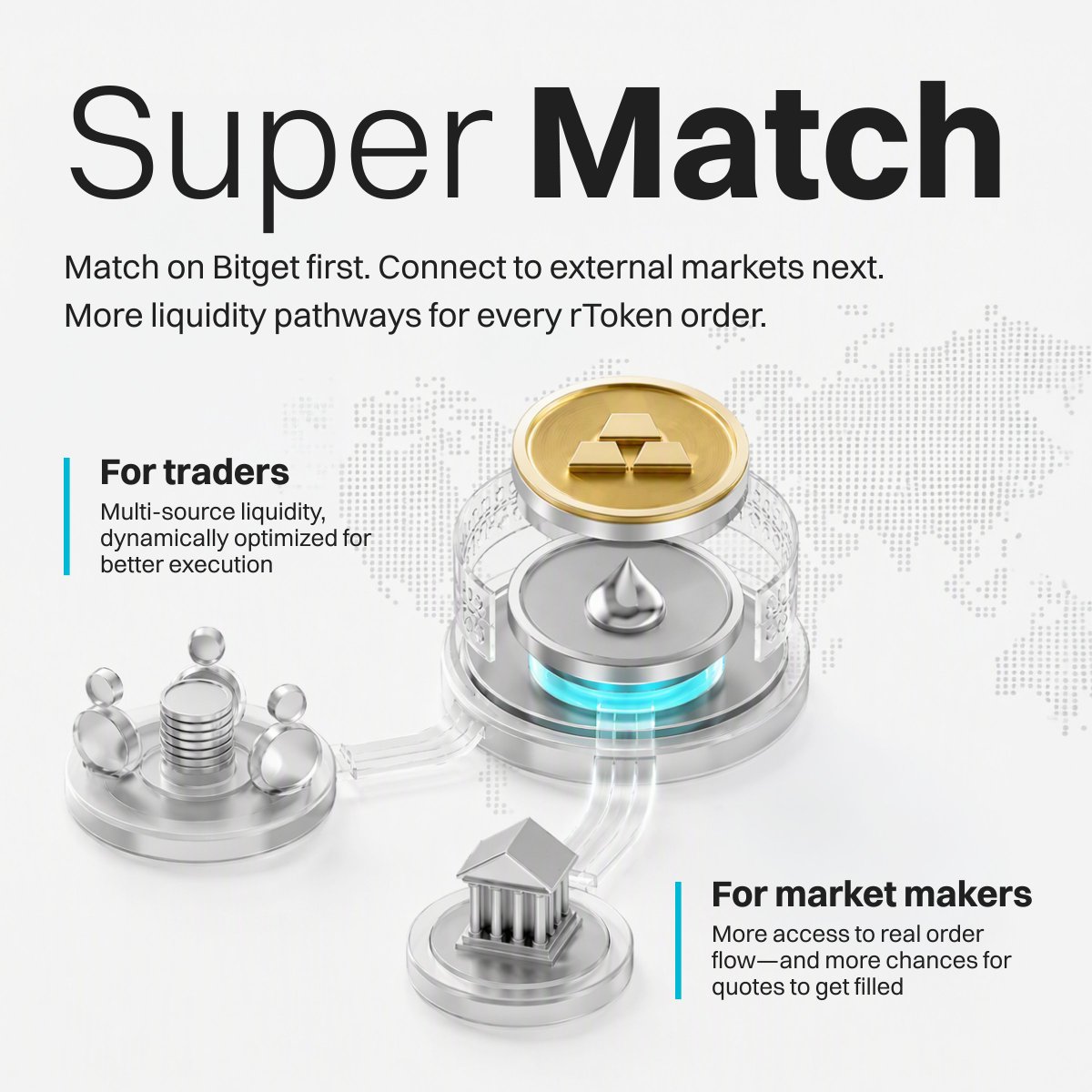
Bitget Super Match is a liquidity and order-matching system designed to improve how tokenized stock orders find available buyers and sellers. Instead of relying solely on one external broker for execution, Super Match brings together liquidity from Bitget's internal order book, participating market makers, and eligible external market connections.
The framework supports Bitget's rTokens, which are digital assets linked to the economic performance of underlying U.S. stocks and ETFs. For example, rNVDA provides exposure to Nvidia, while rAAPL is linked to Apple.
When users trade these assets on Bitget, Super Match evaluates their orders against available internal liquidity before considering external routing.
The idea is straightforward: match on Bitget first, then connect to external markets when needed and available.
This gives rToken trading a broader liquidity structure, with more opportunities for internal participation and price discovery.
According to Bitget's Super Match liquidity-provider guide, the migration of rToken pairs took place in stages from October 14 to October 20, 2026, with the full rollout scheduled for October 20 at 12:00 (UTC+8).
Why Does Liquidity Matter for Tokenized Stocks?
Having access to a tokenized stock is useful. Being able to trade it efficiently is just as important.
Liquidity refers to how easily an asset can be bought or sold without causing a significant change in its price. In a highly liquid market, traders can generally find buyers and sellers more easily, with tighter spreads and a greater ability to execute larger orders.
When liquidity is limited, trading becomes more challenging.
Consider an investor who wants to buy $10,000 worth of an Nvidia-linked token. If there are enough sellers offering competitive prices, the order may execute close to the expected price. But if available liquidity is thin, the investor could face a wider spread, partial execution, or a less favorable purchase price.
The challenge can become more noticeable outside regular U.S. stock market hours, when liquidity from traditional markets may be unavailable or limited.
For tokenized equities, three factors are particularly important:
-
Liquidity depth: Whether enough buying and selling interest exists to support different order sizes.
-
Execution quality: How closely the final trading price reflects available market quotes.
-
Price discovery: How market participants establish prices through their buying and selling activity.
These are not just concerns for institutional investors. They affect anyone trading tokenized stocks, from beginners placing small orders to professional traders managing larger positions.
Bitget Super Match addresses this challenge by developing a liquidity framework that can connect multiple participants and execution pathways rather than relying on a single source.
How Does Bitget Super Match Work?
Super Match is built around a simple principle: use available internal liquidity first, then explore external execution for eligible unmatched orders.
Here's what happens when a trader places an rToken order.
Step 1: Match Orders Within Bitget
When a trader submits an eligible rToken order, Super Match first evaluates available liquidity within Bitget's internal matching engine.
That liquidity can include orders placed by other traders and quotes submitted by participating market makers.
During regular U.S. stock trading hours, internal matching also considers the National Best Bid and Offer (NBBO), a U.S. market reference showing the best available quoted buying and selling prices.
This helps Super Match determine which internal quotes are eligible for execution under its trading rules.
If available internal liquidity meets the order requirements, some or all of the order can execute within Bitget.
Step 2: Connect to External Markets When Needed
What happens if there isn't enough eligible liquidity inside Bitget to complete the order?
For orders that permit external routing, Super Match can forward the unmatched quantity through StockRoute, Bitget's external broker connection to the U.S. stock market, when that route is available.
This creates two potential execution pathways:
-
Internal execution: Match eligible orders using liquidity within Bitget.
-
External routing: Send eligible unmatched quantities to the external broker for possible execution.
External routing is not available in every trading session, and orders may be configured to remain internal only.
The result is a system that can draw on different sources of liquidity rather than requiring every order to depend entirely on one external connection.
Step 3: Execute Based on Available Liquidity
Imagine a trader wants to buy 100 rNVDA tokens during regular U.S. market hours.
Suppose Super Match finds 40 tokens available internally at eligible prices. Those 40 tokens could be matched through Bitget's internal order book.
The remaining 60 tokens may then be routed externally if the order permits it and the external market connection is available.
If sufficient liquidity is available externally, the remaining quantity could also execute. Otherwise, the trader may receive a partial fill or have an outstanding or canceled quantity, depending on the order instructions.
This is an illustrative example, not a guaranteed execution result.
The benefit is the matching structure itself. Bitget can evaluate internal liquidity first while retaining an external execution pathway for eligible orders.
For more technical information about matching conditions, order types, and routing settings, see Bitget's rToken Trading Guide.
4 Key Benefits of Bitget Super Match for Traders
Super Match is more than an internal system upgrade. Its design addresses several practical challenges in tokenized stock trading, from finding liquidity to managing execution across different market conditions.
1. Broader Access to Liquidity Sources
One of Super Match's biggest advantages is its ability to bring multiple liquidity participants into the rToken trading process.
Rather than depending entirely on a single external broker, Bitget can evaluate liquidity provided by its own trading activity and participating market makers before eligible orders reach external markets.
For investors, this creates more potential ways to find a counterparty.
Imagine a trader placing an rAAPL order. Liquidity may already be available from another Bitget user or a market maker quoting the asset. Super Match can evaluate those internal opportunities instead of automatically sending the entire order outside the platform.
A wider range of liquidity sources can help support market depth as trading activity grows.
Actual liquidity still depends on the asset, order size, market conditions, and participation from buyers and sellers.
2. More Efficient Execution Opportunities
Trading efficiency isn't only about placing an order quickly. It also involves finding available liquidity and executing at prices that meet the order's conditions.
With Super Match, internal liquidity becomes the first point of evaluation.
This can reduce unnecessary dependence on external routing when suitable internal counterparties are already available.
For example, if a trader submits a buy order and an eligible seller is already quoting a competitive price inside Bitget, Super Match may match the two orders internally.
If the internal order book cannot fill the entire quantity, eligible unmatched portions can follow the appropriate external routing path.
That flexibility is particularly relevant for a market where liquidity may be spread across different participants.
Super Match does not guarantee faster execution or lower prices on every trade. Its value lies in creating a more flexible system for finding and using available liquidity.
3. A Stronger Framework for Price Discovery
A tokenized stock needs more than a price displayed on a trading screen. It needs an active market where buyers and sellers can establish prices through their orders.
This process is known as price discovery.
Super Match supports that process by connecting internal trading interest with quotes from participating market makers and, when available, external market references.
During regular U.S. trading hours, its matching rules use NBBO as an important benchmark for eligible internal execution.
Outside regular market hours, when the external broker is unavailable, Super Match can rely on its internal order book and applicable price controls.
The objective is to develop a more resilient pricing environment as rToken trading activity expands.
For traders, this matters because price discovery influences spreads, order execution, and how closely tokenized stock prices reflect available market information.
More liquidity sources do not automatically guarantee better prices, but they can provide a stronger foundation for competitive quoting and execution.
4. Greater Flexibility Beyond Traditional Stock Trading Hours
Traditional U.S. stock exchanges operate on scheduled sessions. Digital asset markets, meanwhile, have introduced investors to trading environments that can remain active outside conventional hours.
Bitget's Super Match framework is designed to support internal matching even when the traditional U.S. stock market is closed, where the relevant trading functionality is available.
That creates the potential for rToken trading to rely on internal liquidity rather than exclusively on the operating hours of an external securities market.
Consider an investor following a major Nvidia announcement outside regular trading hours. If the relevant rToken market is available and sufficient internal liquidity exists, the investor may have an opportunity to trade without waiting for the next regular stock session.
However, extended trading comes with additional considerations. Liquidity may be thinner, spreads may widen, and prices can behave differently when the underlying stock market is closed.
What Does Bitget Super Match Mean for Market Makers?
For everyday traders, liquidity is about finding opportunities to buy or sell. For market makers, it's about providing the quotes that help those trades happen.
Market makers continuously submit buying and selling prices, helping create a market where other participants can execute orders.
Bitget Super Match gives eligible market makers a more direct role in the rToken ecosystem.
Instead of relying only on the external broker connection, participating market makers can provide liquidity within Bitget's internal matching system, where their quotes may interact with eligible orders from other traders.
This creates three important opportunities.
-
More access to trading demand: Market makers can participate in the internal order flow generated by Bitget's rToken users, creating additional opportunities for their quotes to be matched.
-
More ways to provide liquidity: Eligible market makers can contribute bids and offers to the internal order book, helping support liquidity depth and competitive pricing.
-
More advanced trading infrastructure: Bitget's Super Match upgrade introduces API functionality including Good-Till-Canceled (GTC) orders, routing controls, and segmented order-book depth data.
For example, a market maker quoting rAAPL may choose to keep an order exclusively within Super Match or allow eligible unmatched quantities to access the external market through supported API routing settings.
Bitget also applies different fee rules depending on whether execution occurs internally or through StockRoute. Eligible internal maker activity may qualify for the applicable Liquidity Incentive Program rates, while external executions follow the relevant PRO/VIP StockRoute fee schedule.
These capabilities give professional liquidity providers additional tools to manage quoting, execution pathways, and participation in tokenized stock markets.
In turn, wider market-maker participation can help support the liquidity available to everyday rToken traders.
How Does Super Match Fit Into Bitget's Institutional RWA Strategy?
Super Match is one part of a bigger strategy.
Bitget's next phase of RWA development focuses on building institutional-grade infrastructure for tokenized equities, rather than treating tokenization as simply another way to list and trade assets.
The strategy rests on two connected pillars: Broker Interoperability and Super Match.
Pillar 1: Broker Interoperability Brings Traditional Stocks Into Bitget
The first challenge is getting existing securities into a tokenized trading ecosystem.
Many investors already hold U.S. stocks and ETFs through traditional brokers. Asking them to sell their investments, transfer the cash, and rebuild their portfolios creates unnecessary friction.
Bitget addresses that challenge through Broker Interoperability.
Its first product under this framework, rToken Transfer, launched on October 13, 2026, allowing eligible users to move supported U.S. stocks and ETFs from external brokerage accounts into Bitget without selling them first.
The service covers more than 3,000 eligible U.S.-listed stocks and ETFs.
Users initiate a Free of Payment (FOP) transfer to Bitget's designated Alpaca omnibus account. Once the shares are received and processed, Bitget's In-Kind Tokenization Network (ITN) automatically mints the corresponding rTokens and credits them to the user's Bitget Spot account.
For example, an investor holding eligible Apple and Nvidia shares can transfer those positions from an external broker and receive the corresponding stock-linked tokens after processing.
This establishes a more direct pathway between traditional brokerage assets and Bitget's RWA ecosystem.
The 3,000+ figure refers to assets eligible for transfer, not necessarily the number of rToken pairs available for immediate Spot trading.
Pillar 2: Super Match Connects Tokenized Assets With Liquidity
Bringing traditional securities into a digital asset ecosystem solves one problem. Making their tokenized counterparts easier to trade is another.
That's the role of Super Match.
While Broker Interoperability focuses on asset entry, Super Match focuses on liquidity, order matching, and price discovery.
By connecting Bitget's internal trading activity, market makers, and external liquidity pathways, Super Match is designed to support a broader market structure for rToken trading.
The two pillars therefore serve different but complementary purposes:
| Broker Interoperability |
Super Match |
| Connects external brokerage assets with Bitget |
Connects rToken orders with liquidity sources |
| Supports 3,000+ eligible U.S. stocks and ETFs for transfer |
Supports internal matching and eligible external routing |
| Uses FOP transfers and automatic rToken minting |
Uses internal order flow, market-maker quotes, and external connections |
| Focuses on bringing eligible assets into the ecosystem |
Focuses on how supported tokenized assets trade |
Together, these pillars reflect Bitget's broader Universal Exchange vision: bringing traditional and digital assets closer together through infrastructure designed for more flexible trading and capital management.
The next stage of RWA development is not only about how many assets can be tokenized. It's also about whether those assets have the liquidity and financial infrastructure needed to become useful at scale.
What's Next for Bitget's Institutional RWA Ecosystem?
The introduction of Super Match marks an important step in Bitget's longer-term RWA strategy.
Its early tokenized equity development focused on access to U.S. stocks and ETFs through digital assets. The new direction places greater emphasis on the systems that support market participation, liquidity, and capital efficiency.
As the ecosystem develops, Bitget aims to make eligible rTokens useful across more financial activities, including Spot trading, supported collateral applications, borrowing and lending, and selected Earn products.
For professional participants, deeper liquidity infrastructure could create more opportunities to provide quotes and manage trading activity. For individual investors, a more connected ecosystem could make it easier to access stock-linked markets and use supported holdings across different products.
Bitget's longer-term ambition extends toward a global on-chain stock liquidity and settlement layer operating alongside traditional financial markets.
That remains a strategic objective rather than a fully completed market structure. Actual adoption, execution quality, product availability, and institutional participation will depend on further development and market conditions.
But the direction is significant. Tokenization brought traditional stocks into digital markets. Bitget is now focusing on the liquidity infrastructure needed to help those markets grow.
Final Thoughts
Tokenized stocks have already changed how investors can access traditional financial markets. Now Bitget is taking the next step by focusing on what happens after those assets become tradable. With Super Match, Bitget is building a more connected liquidity framework that brings together internal orders, market makers, and external execution pathways. The goal is to support more efficient trading and stronger price discovery while giving professional liquidity providers a greater role in the rToken ecosystem.
And Super Match is only one part of the bigger picture. Together with Broker Interoperability and support for more than 3,000 eligible U.S. stocks and ETFs, Bitget is advancing its vision of institutional-grade RWA infrastructure that connects traditional finance with digital markets. Access brought stocks into the tokenized economy. Liquidity is what could help take it to the next level.
Frequently Asked Questions
1. What Is Bitget Super Match, and How Does It Work?
Bitget Super Match is an internal liquidity-matching framework for rToken trading. It evaluates orders against available internal liquidity, including market-maker quotes, before eligible unmatched quantities may be routed externally through StockRoute when permitted and available.
2. How Does Bitget Super Match Improve rToken Liquidity?
Super Match brings together internal trading activity, participating market makers, and external liquidity pathways. This creates more potential sources of liquidity and is designed to support market depth, execution efficiency, and price discovery. Actual results depend on market conditions and available quotes.
3. What Is the Difference Between Bitget Super Match and rToken Transfer?
rToken Transfer allows eligible investors to move existing U.S. stocks and ETFs from external brokers into Bitget and receive corresponding rTokens after processing. Super Match is the system designed to improve how supported rToken orders access liquidity and execute once those assets are tradable.
4. Can Bitget Super Match Support Trading Outside U.S. Stock Market Hours?
Super Match is designed to support internal matching outside regular U.S. trading sessions where the relevant rToken market is available. External market routing depends on the operating session and availability of the external broker. Weekend rToken trading remains subject to Bitget's temporary suspension notice and any subsequent updates.
5. Does Bitget Super Match Guarantee Better Trading Prices?
No. Super Match is designed to improve liquidity access and execution opportunities by evaluating internal quotes and eligible external routes. However, execution prices, spreads, and fill rates depend on market conditions, order settings, and available liquidity. Better prices or complete execution are not guaranteed.
Disclaimer: This article is for informational purposes only and does not constitute financial or investment advice. rToken trading involves market, liquidity, execution, and other risks. Trading features, fees, eligibility, and availability are subject to applicable terms and may change.


- Key Takeaways
- What Is Bitget Super Match?
- Why Does Liquidity Matter for Tokenized Stocks?
- How Does Bitget Super Match Work?
- 4 Key Benefits of Bitget Super Match for Traders
- What Does Bitget Super Match Mean for Market Makers?
- How Does Super Match Fit Into Bitget's Institutional RWA Strategy?
- What's Next for Bitget's Institutional RWA Ecosystem?
- Final Thoughts
- Frequently Asked Questions