
Can I Trade Japanese or HK Stocks Using USDT Directly? Bitget Quanto Perpetual Futures, Fees and Pairs (2026 Guide)
Key Takeaways
-
Bitget lets eligible users trade selected Japanese and Hong Kong stock price movements directly with USDT through Quanto Perpetual Futures(Bitget Quanto Perps), without first converting funds into local currencies such as HKD or JPY.
-
The underlying stock keeps its local-market price reference, while margin, funding, and PL are handled in USDT through a fixed Quanto conversion structure.
-
Bitget Quanto Perps support long and short trading, up to 20x leverage on current contracts, 24/7 access, no fixed expiry, and eight-hour funding intervals.
-
Bitget has expanded its Quanto lineup across overseas equity names such as MiniMax, Tencent, Xiaomi, Zhipu AI, and Lenovo, giving crypto traders more ways to access Asian stock-market opportunities.
-
Quanto Perps remove the separate FX-conversion step, but they are not fee-free. Trading fees, funding, spreads, slippage, and liquidation risk still apply.
Can I Trade Japanese or Hong Kong Stocks Using USDT Directly in 2026?
Yes. Bitget lets eligible users trade selected Japanese and Hong Kong stock price movements directly with USDT through Quanto Perpetual Futures. Instead of converting funds into HKD or JPY or setting up a separate local brokerage account, users can keep their trading capital in USDT and access overseas equity opportunities from the Bitget platform.
Bitget Quanto Perpetual Futures are built specifically for non-USD markets. The underlying stock keeps its local-market price reference, while margin, funding, and PL are handled in USDT through a fixed Quanto conversion structure.
For users, that means:
-
No need to hold HKD or JPY: USDT stays at the center of the trade.
-
Direct access to overseas stock exposure: Trade names such as Tencent, Xiaomi, MiniMax, Zhipu AI, and Lenovo through Bitget Quanto Perps.
-
Long or short with leverage: Current contracts support up to 20x leverage, giving active traders more flexibility and capital efficiency.
-
Trade 24/7: Manage positions even outside the underlying stock exchange's normal trading hours.
-
No separate FX-conversion step: The local stock-price movement can be traded while settlement remains in USDT.
For example, a trader who wants exposure to Tencent can use TENCENTHKDUSDT without first buying Hong Kong dollars. The stock remains referenced to its local HKD market price, while Bitget keeps the trading experience firmly in USDT.
For crypto traders, this changes the usual cross-border equation. Tokyo or Hong Kong may set the stock price, but on Bitget, USDT can still be the starting point of the trade.
What Are Bitget Quanto Perpetual Futures?
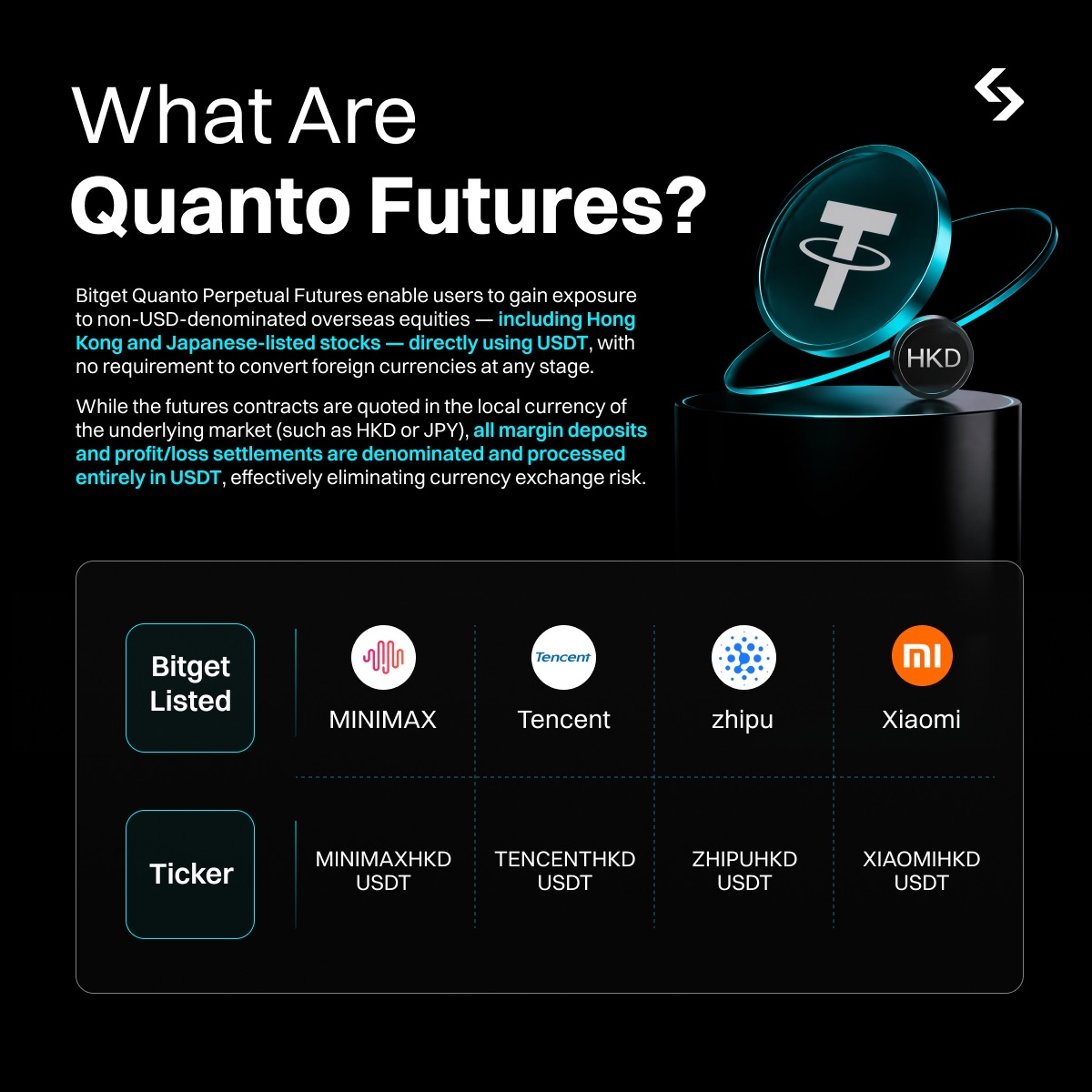
Bitget Quanto Perpetual Futures, also called Bitget Quanto Perps, are USDT-settled derivatives designed for stocks priced in non-USD currencies such as HKD and JPY. They combine the local-market pricing of overseas equities with the familiar structure of crypto perpetual futures, so users can trade stock-price movements without first converting their capital into the underlying market currency.
Bitget launched its first TradFi Quanto Perpetual Future, MINIMAXHKDUSDT, on July 21, 2026, bringing the Quanto structure into its growing TradFi ecosystem. For traders already familiar with crypto perps, the experience remains straightforward:
-
Local-market price tracking: The underlying stock keeps its HKD, JPY, or other supported local-currency price reference.
-
USDT margin and settlement: Margin, funding, and PL are handled in USDT.
-
Fixed Quanto conversion: Bitget typically uses a fixed 1:1 numerical relationship instead of converting the stock price through a live FX rate.
-
Up to 20x leverage: Current cited Quanto contracts allow traders to increase market exposure with less upfront capital.
-
Long and short positions: Users can trade both bullish and bearish market views.
-
24/7 trading: Positions can be opened or managed beyond the underlying exchange's normal trading hours.
-
No fixed expiry: Like crypto perpetual futures, Quanto contracts can remain open as long as margin requirements are maintained.
-
Eight-hour funding intervals: Current cited contracts generally settle funding every eight hours.
The result is a product that feels familiar to a crypto futures trader but opens the door to a very different market. Bitget takes overseas stocks that normally sit behind foreign currencies and local trading systems and brings them into a USDT-native perpetual trading experience.
Learn more: Quanto Perpetual Futures Explained
How Do Bitget Quanto Perps Let You Trade Stocks Without HKD or JPY?
The key advantage of Bitget Quanto Perps is that users can access stocks priced in foreign currencies without first converting USDT into HKD, JPY, or another local currency.
In traditional overseas stock trading, a user may need to convert funds into the local currency before taking a position. Bitget removes that extra step by keeping the trading account centered on USDT while the Quanto contract tracks the stock's local-market price.
This gives users several practical advantages:
-
No separate currency balance: There is no need to maintain HKD or JPY just to trade the supported stock.
-
No FX conversion before trading: Users can move directly from USDT into a Quanto Perp.
-
PL stays in USDT: Profits and losses are settled back into the user's USDT balance.
-
Less friction between markets: Traders can move between crypto and overseas stock opportunities without repeatedly converting currencies.
-
Local stock exposure stays intact: The contract follows the underlying local-currency stock movement through Bitget's fixed Quanto structure.
For example, a user holding USDT who wants to trade a Hong Kong-listed stock does not need to buy HKD first. They can open the corresponding Bitget Quanto Perp, choose a long or short position, and keep the entire trading workflow in USDT.
For active crypto traders, that removes one of the biggest barriers to overseas markets: instead of managing the stock and the currency separately, Bitget lets them focus on the trade itself.
How Does the Fixed Quanto Conversion Work?
Bitget Quanto Perps use a fixed conversion relationship, typically 1:1, between the underlying local-currency price and the USDT contract calculation. This means the stock can remain priced in HKD, JPY, or another supported currency without Bitget converting every price move through a live foreign-exchange rate.
For example, suppose a stock moves from 200 to 300 in its local currency. If a trader holds 10 contracts, the PL calculation is:
PL = (300 − 200) × 10 = 1,000 USDT
The trader receives the resulting 1,000 USDT in the futures account. There is no separate HKD-to-USDT or JPY-to-USDT conversion inside the PL calculation.
This fixed Quanto structure gives users two clear benefits:
-
Simpler settlement: Margin, funding, fees, and PL can all stay in USDT.
-
Cleaner stock exposure: The contract follows the local stock-price movement without adding the mechanical effect of a changing FX conversion rate.
For beginners, the easiest way to understand it is this: the stock provides the price movement, while USDT remains the currency used to manage the trade.
Why Does the Quanto Structure Matter for Japanese and HK Stocks?
When trading overseas stocks, the stock price is only part of the equation. Currency movements can also change the return once the local stock price is converted into USDT. Bitget Quanto Perps are designed to separate these two effects more clearly.
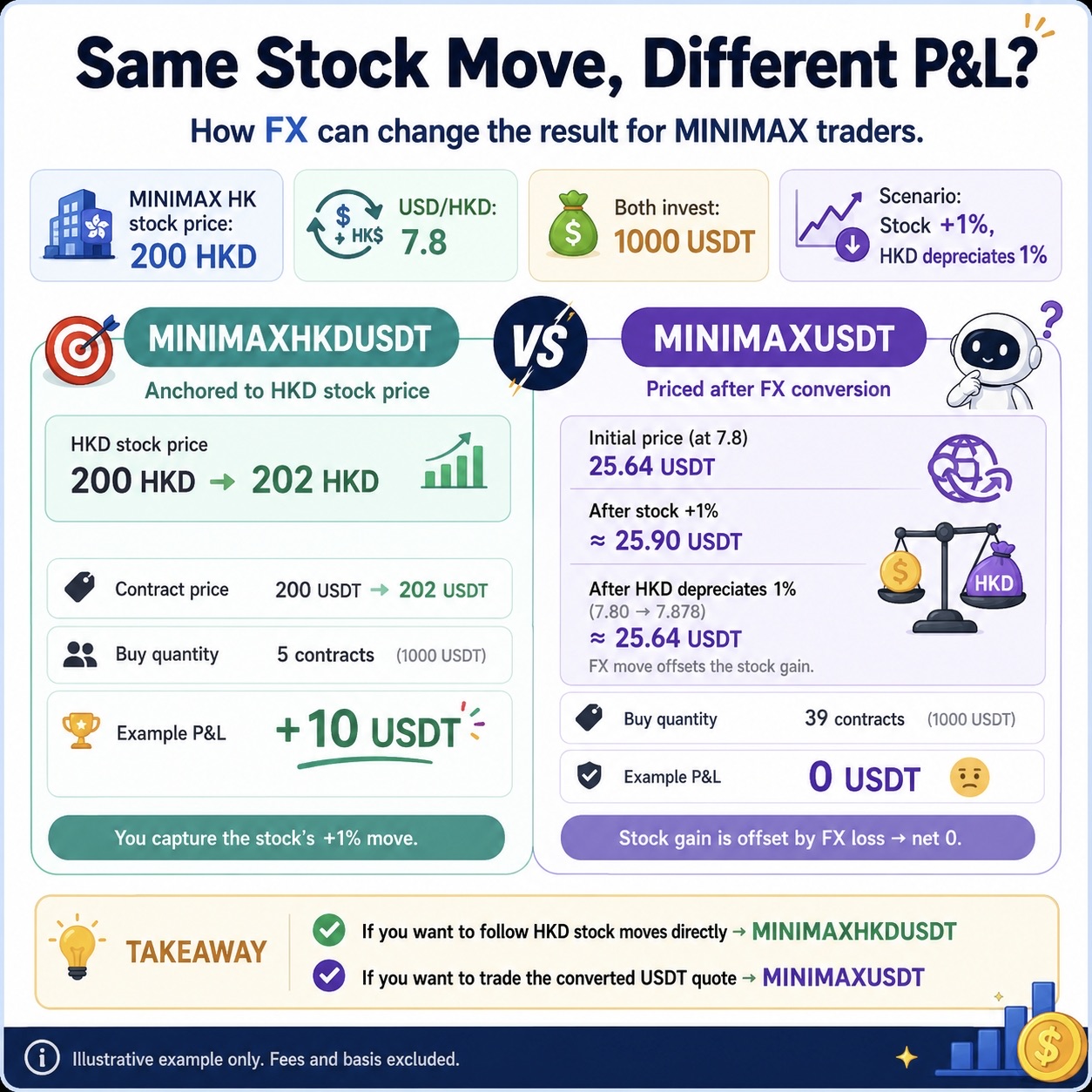
Consider a simple example:
-
A Hong Kong stock rises 1%, from HK200toHK202.
-
At the same time, HKD weakens about 1% against USD.
With a conventional USDT-converted stock contract, the weaker HKD can offset part or even most of the stock's gain after conversion. The company performed well in its local market, but the trader may see little change in the USDT-denominated price.
With a Bitget Quanto Perp, the contract continues to reflect the local stock move from 200 to 202 through its fixed conversion structure. A trader holding five contracts would record:
(202 − 200) × 5 = 10 USDT
The difference can be summarized simply:
-
Standard converted Stock Perp: Stock-price movement + FX conversion effect
-
Bitget Quanto Perp: Local stock-price movement with PL settled in USDT
This is especially useful for traders whose view is about the company rather than the currency. If the thesis is simply that Tencent, Xiaomi, or another overseas stock will rise in its home market, Bitget Quanto Perps provide a cleaner way to trade that view while keeping capital in USDT.
In other words, you can focus on whether the stock goes up or down instead of having an FX move rewrite the trade.
Which Bitget Quanto Perpetual Pairs Are Available?
Bitget has been expanding its Quanto Perpetual Futures lineup since launching the product in July 2026. The contracts give users exposure to selected non-USD overseas equities and equity-linked products while keeping margin and PL in USDT.
Examples of Bitget Quanto Perpetual Futures include:
| Quanto Perpetual Pair |
Underlying |
Settlement |
Max Leverage |
| MINIMAXHKDUSDT |
MiniMax |
USDT |
20x |
| TENCENTHKDUSDT |
Tencent |
USDT |
20x |
| XIAOMIHKDUSDT |
Xiaomi |
USDT |
20x |
| ZHIPUHKDUSDT |
Zhipu AI |
USDT |
20x |
| LENOVOHKDUSDT |
Lenovo |
USDT |
20x |
| CSOPSK2LHKDUSDT |
SK Hynix-linked leveraged product |
USDT |
20x |
| CSOPSS2LHKDUSDT |
Samsung-linked leveraged product |
USDT |
20x |
The rollout has moved quickly. MINIMAXHKDUSDT launched on July 21, 2026, followed by Tencent, Xiaomi, and Zhipu AI contracts. Bitget later expanded the lineup with CSOP-linked products and LENOVOHKDUSDT in August 2026.
These are examples rather than a permanent complete list. The Quanto framework is built for non-USD-denominated overseas equities, including Hong Kong and Japanese-listed stocks, with the underlying price quoted in currencies such as HKD or JPY while settlement remains in USDT.
As Bitget adds more contracts, users should check the live futures market for the latest supported pairs, leverage limits, and trading parameters. The bigger story is the expanding market access: one USDT balance can increasingly reach stock opportunities that traditionally sit behind different currencies and trading systems.
What Are the Main Advantages of Bitget Quanto Perpetual Futures?
Bitget Quanto Perpetual Futures are built to make overseas stock trading more accessible to crypto users. Instead of moving capital across different currencies and trading systems, users can keep USDT at the center while gaining exposure to selected non-USD stocks.
-
Trade overseas stocks with USDT: Users can access selected Japanese and Hong Kong stock price movements without first holding their local currencies.
-
No separate FX conversion: There is no need to convert USDT into HKD or JPY before opening a Quanto position.
-
Focus on the local stock price: The fixed Quanto structure is designed to track the stock's local-market movement without adding the mechanical effect of live FX conversion.
-
Use up to 20x leverage: Current contracts support up to 20x leverage, allowing traders to gain larger market exposure with less upfront capital.
-
Go long or short: Traders can take bullish or bearish positions without owning or borrowing the underlying shares.
-
Trade 24/7: Bitget Quanto Perps remain tradable beyond the normal operating hours of the underlying stock exchanges.
-
Keep capital in one familiar asset: Margin, funding, fees, and PL stay in USDT, making it easier for crypto traders to manage capital across different opportunities.
This is where Bitget's Quanto model becomes particularly useful. One USDT balance can open the door to stock markets that traditionally require different currencies, brokers, and trading systems.
How Much Leverage Do Bitget Quanto Perps Offer?
Bitget Quanto Perpetual Futures currently support up to 20x leverage on selected contracts, allowing traders to gain larger exposure to overseas stocks while using less upfront USDT as margin.
For example, suppose a trader uses:
-
Margin: 100 USDT
-
Leverage: 10x
-
Position size: Approximately 1,000 USDT
If the underlying stock moves 5% in the trader's favor, the position would generate roughly 50 USDT in gross profit. If it moves 5% against the position, the gross loss would also be around 50 USDT, before trading fees, funding, and other costs.
Leverage can therefore improve capital efficiency, but it works in both directions. Higher leverage means smaller price movements can have a much larger impact on the trader's margin and can bring the position closer to liquidation.
Bitget gives traders flexibility to choose their leverage rather than requiring them to use the maximum available. For beginners, 20x should be viewed as the upper limit, not the default setting. The goal is not simply to control the largest possible position, but to use USDT efficiently while keeping risk manageable.
What Fees Do Bitget Quanto Perpetual Futures Charge?
Bitget Quanto Perpetual Futures remove the need for a separate currency conversion, but they are not completely fee-free. Traders should mainly consider trading fees, funding fees, and execution costs such as spreads and slippage.
Currency Conversion Fees
Bitget Quanto Perps do not require a separate FX conversion transaction. Users can keep their capital in USDT rather than converting it into HKD, JPY, or another local currency before trading.
The underlying stock continues to follow its local-market price, while margin and PL remain in USDT through the Quanto structure.
Trading Fees
Quanto Perpetual Futures follow Bitget's normal futures trading fees:
| Order Type |
Standard Fee |
| Maker |
0.02% |
| Taker |
0.06% |
Maker fees generally apply to orders that add liquidity to the order book, while taker fees apply to orders that execute immediately against existing liquidity. These are Bitget's standard non-VIP futures rates, while eligible users may receive lower fees through VIP tiers or applicable promotions.
Trading fees are generally charged when opening and closing a position, so active traders should account for both sides of the trade.
Funding Fees
Because Quanto Perps are perpetual contracts with no fixed expiry date, they use a funding mechanism to help keep the futures price aligned with the underlying market.
Current stock perpetual contracts commonly use an eight-hour funding interval. Depending on the funding rate and the direction of the position, traders may either pay or receive funding.
Funding rates are variable, so traders planning to keep positions open for longer periods should check the current rate before entering a trade.
Spread and Slippage
Traders should also consider execution costs.
The spread is the difference between the best bid and ask prices, while slippage occurs when an order executes at a different average price than expected. Both may become more noticeable during volatile periods, for larger orders, or when the underlying stock market is closed.
Bitget Quanto Perps follow the familiar futures fee model while removing the extra currency-conversion step. Traders can focus on the stock position while keeping their capital, fees, and PL centered on USDT.
How to Trade Japanese or HK Quanto Perps With USDT on Bitget
Trading Bitget Quanto Perpetual Futures follows a similar process to trading regular crypto futures. The main difference is the underlying asset: instead of BTC or ETH, the contract tracks the local-market price of an overseas stock while the trader continues to use USDT.
Step 1: Create and Verify a Bitget Account
Create a Bitget account or log in to an existing account and complete the required identity verification. Quanto Perpetual Futures are available only to eligible users in supported regions.
Step 2: Deposit or Transfer USDT
Add USDT to your Bitget account and make sure sufficient margin is available for futures trading.
There is no need to prepare HKD or JPY. USDT is used for margin, fees, funding, and PL settlement.
Step 3: Open Bitget Futures
Go to the Bitget Futures market and find the Quanto Perpetual Futures section or search directly for a supported contract.
Examples include:
-
MINIMAXHKDUSDT
-
TENCENTHKDUSDT
-
XIAOMIHKDUSDT
-
ZHIPUHKDUSDT
-
LENOVOHKDUSDT
As Bitget continues expanding the lineup, users should check the live market for the latest available Japanese, Hong Kong, and other non-USD stock Quanto pairs.
Step 4: Choose Your Leverage
Select the leverage level before opening the trade. Current selected Quanto contracts support up to 20x leverage, although traders do not need to use the maximum.
For beginners, lower leverage generally provides more room for the market to move before liquidation becomes a concern.
Step 5: Choose Long or Short
Choose Long if you expect the underlying stock price to rise or Short if you expect it to fall.
Because Quanto Perps are derivatives, users can trade either direction without owning or borrowing the underlying shares.
Step 6: Enter Your Position Size
Choose how much USDT margin you want to use and review the resulting position size.
Always consider leverage together with position size. A small amount of margin combined with high leverage can still create substantial market exposure.
Step 7: Choose a Market or Limit Order
A market order executes against available liquidity at the current market price, while a limit order lets the trader specify the price at which they want to enter.
Limit orders provide more control over execution price but may not fill if the market does not reach the selected level.
Step 8: Set Take-Profit and Stop-Loss Levels
Consider adding take-profit and stop-loss orders when opening the position.
Overseas stocks can react sharply to earnings, company announcements, economic data, or breaking news, while leverage can amplify those price movements.
Step 9: Monitor the Position
Once the trade is open, keep an eye on:
-
Entry and mark price
-
Unrealized PL
-
Available margin
-
Leverage and position size
-
Maintenance margin
-
Liquidation price
-
Current funding rate
-
Take-profit and stop-loss levels
Funding is especially important for positions held over longer periods because current Quanto Perps generally use an eight-hour funding interval.
The entire workflow can be summarized in one line:
Hold USDT → Choose a Quanto Perpetual Future → Set leverage → Go long or short → Manage the position → Settle PL in USDT.
For crypto traders, that is the appeal of Bitget Quanto Perps: accessing overseas stock opportunities does not require learning an entirely new capital workflow. The market changes, but USDT stays at the center.
Example: How to Trade Tencent With USDT Without Buying HKD
Suppose a trader expects Tencent's Hong Kong-listed stock to rise but currently holds USDT. Traditionally, the trader may need to convert funds into HKD and access the stock through a brokerage account before taking the position.
With Bitget Quanto Perpetual Futures, the route is much shorter:
USDT → TENCENTHKDUSDT → Long or short Tencent → PL settled in USDT
For example, a trader can:
-
Hold USDT as trading capital without buying HKD first.
-
Search for TENCENTHKDUSDT on Bitget Futures.
-
Choose Long if they expect Tencent to rise or Short if they expect it to fall.
-
Use leverage of up to 20x on the cited contract.
-
Trade and manage the position 24/7, including outside normal Hong Kong stock-market hours.
-
Receive profits or losses directly in USDT.
The important point is that TENCENTHKDUSDT still follows Tencent's local HKD price movement through the Quanto structure. The trader gets exposure to the stock's direction without adding a separate HKD conversion trade into the process.
So if Tencent becomes the opportunity, a crypto trader does not need to leave the USDT ecosystem to act on it. On Bitget, the idea can go from “I think Tencent will rise” to an actual USDT futures position in just a few steps.
Bitget Quanto Perps vs Traditional Japanese/HK Stock Trading
Traditional overseas stock trading and Bitget Quanto Perpetual Futures can both provide exposure to Japanese or Hong Kong equities, but the trading experience is very different. Traditional brokers focus on owning shares, while Bitget Quanto Perps are built for USDT-based active trading.
| Feature |
Bitget Quanto Perps |
Traditional Overseas Broker |
| Starting capital |
USDT |
Usually fiat |
| Need HKD or JPY |
No |
Often required or automatically converted |
| Separate FX conversion |
Not required |
Common |
| PL settlement |
USDT |
Usually local or account fiat currency |
| Long positions |
Yes |
Yes |
| Short positions |
Yes |
Broker and stock dependent |
| Leverage |
Up to 20x on selected contracts |
Broker dependent |
| Trading hours |
24/7 |
Local exchange trading hours |
| Contract expiry |
No expiry |
N/A for spot shares |
| Share ownership |
No |
Yes |
For long-term investors who want to own the actual shares, receive shareholder rights, or build a traditional equity portfolio, a brokerage account remains the more suitable route.
Bitget Quanto Perps target a different type of user. Crypto traders can keep capital in USDT, go long or short, use leverage, and react to overseas stock opportunities around the clock without first managing another currency.
The difference comes down to the goal: traditional brokers are built for owning overseas stocks, while Bitget Quanto Perps are built for trading their price movements with USDT.
Bitget Quanto Perps vs Standard Stock Perps
Bitget offers both Quanto Perpetual Futures and standard Stock Perps, but they handle non-USD stock prices differently. The main difference is how foreign-exchange movements enter the contract price.
| Feature |
Bitget Quanto Perps |
Standard Stock Perps |
| Underlying price reference |
Local-currency stock price, such as HKD or JPY |
Stock price converted into USDT |
| Margin |
USDT |
USDT |
| PL settlement |
USDT |
USDT |
| Fixed Quanto conversion |
Yes |
No |
| FX conversion effect |
Separated from PL calculation |
Can affect the converted USDT price |
| Long and short |
Yes |
Yes |
| Expiry |
No expiry |
No expiry |
| Best suited for |
Trading the stock's local-market move |
Trading its USDT-denominated price |
For example, if a trader believes Tencent will rise in its Hong Kong market, TENCENTHKDUSDT Quanto Perps let the trader focus on Tencent's HKD price movement while keeping margin and PL in USDT. With a standard converted Stock Perp, changes in the HKD/USD exchange rate can also affect the USDT-denominated contract price.
Both products keep the familiar USDT futures experience, but Quanto Perps add a key advantage for non-USD stocks: trade the local stock move without turning the FX rate into a second trade.
Why Use Bitget Quanto Perps for Japanese and Hong Kong Stocks?
Bitget Quanto Perpetual Futures make overseas stock trading feel much closer to the crypto futures experience users already know. Instead of managing different currencies, brokerage accounts, and market schedules, traders can access selected Japanese and Hong Kong stock opportunities while keeping USDT at the center of the entire trade.
Several features make Bitget stand out:
-
First-mover advantage: Bitget introduced its first TradFi Quanto Perpetual Future in July 2026, bringing this structure to mainstream crypto traders.
-
USDT-native trading: Margin, funding, fees, and PL can all be managed in USDT.
-
No separate FX conversion: Users do not need to buy HKD or JPY before trading supported overseas stocks.
-
Trade the local stock move: The fixed Quanto structure is designed to follow the underlying stock's local-market price without adding a separate live FX conversion into the PL calculation.
-
Up to 20x leverage: Selected contracts offer greater capital efficiency for active traders.
-
Long or short: Traders can take positions in either direction without owning the underlying shares.
-
24/7 access: Bitget allows users to manage selected Quanto positions beyond traditional stock-market hours.
-
One platform, more markets: Crypto and overseas equity opportunities can be traded from the same broader Bitget ecosystem.
This is where Quanto Perps fit naturally into Bitget's wider multi-asset strategy. A user can hold USDT, spot an opportunity in an overseas stock, and trade that view without first moving capital through another currency or financial platform.
For crypto traders, Bitget turns overseas equity exposure from a multi-currency process into a familiar USDT futures trade.
What Are the Risks of Bitget Quanto Perpetual Futures?
Bitget Quanto Perpetual Futures simplify access to overseas stocks, but they are still leveraged derivatives. Traders should understand the risks before opening a position, especially when using high leverage or holding trades for long periods.
-
Leverage and liquidation risk: Leverage magnifies both gains and losses. Current selected Quanto contracts support up to 20x leverage, which means even a relatively small adverse price move can significantly reduce margin or trigger liquidation.
-
Funding costs: Quanto Perps have no expiry date and use periodic funding payments. Traders who keep positions open across multiple funding intervals may accumulate additional costs depending on the funding rate and position direction.
-
Spread and slippage: Execution prices may differ from expected prices, especially during volatile periods, for larger orders, or when market liquidity is thinner.
-
Off-hours price risk: Bitget Quanto Perps can trade 24/7 even when the underlying stock exchange is closed. During these periods, liquidity and price discovery may behave differently from regular market hours.
-
No underlying share ownership: Trading a Quanto Perp gives exposure to the stock's price movement, but users do not own the actual shares or receive shareholder rights such as voting rights.
-
Currency risk is reduced, not completely eliminated: The Quanto structure removes the direct FX-conversion effect from the contract's PL calculation. However, currency movements can still affect the underlying company's revenue, costs, earnings, and ultimately its stock price.
The main advantage of Quanto Perps is a cleaner way to trade overseas stock movements with USDT, not the removal of market risk. Traders should still manage leverage carefully, monitor funding and margin, and use appropriate position sizing and risk controls.
Conclusion
Trading Japanese and Hong Kong stocks traditionally means navigating different currencies, brokers, and market hours. Bitget Quanto Perpetual Futures simplify that journey by letting eligible users keep USDT as their trading capital while accessing selected overseas stock price movements. The stock can stay tied to its local market, while margin, funding, fees, and PL remain in a familiar USDT-based futures environment.
For crypto traders, that creates a much shorter bridge between digital assets and Asian equities. The stock may trade in HKD or JPY, but your capital does not have to. With Bitget Quanto Perps, USDT stays at the center of the trade.
FAQs
Can I trade Japanese stocks using USDT directly on Bitget?
Yes. Bitget lets eligible users access selected Japanese stock price movements with USDT. Its Quanto Perpetual Futures framework is designed for non-USD overseas stocks, allowing local-currency price exposure while margin and PL remain in USDT.
Can I trade Hong Kong stocks using USDT on Bitget?
Yes. Bitget offers Quanto Perpetual Futures for selected Hong Kong-listed stocks, including Tencent, Xiaomi, MiniMax, Zhipu AI, and Lenovo. Users can trade these price movements without first converting USDT into HKD.
What are Bitget Quanto Perpetual Futures?
Bitget Quanto Perpetual Futures are USDT-settled derivatives for assets priced in non-USD currencies such as HKD or JPY. They use a fixed Quanto conversion structure so traders can follow the underlying stock's local-market price while keeping margin, funding, fees, and PL in USDT.
Do I need HKD or JPY to trade Quanto Perps on Bitget?
No. One of the main advantages of Bitget Quanto Perps is that users do not need to hold or convert into HKD or JPY before opening a supported position. USDT remains the main trading and settlement asset.
Which Bitget Quanto Perpetual pairs are available?
Examples include MINIMAXHKDUSDT, TENCENTHKDUSDT, XIAOMIHKDUSDT, ZHIPUHKDUSDT, LENOVOHKDUSDT, and other supported Quanto contracts. The lineup can expand over time, so users should check Bitget's live futures market for the latest pairs.
What is the difference between Quanto Perps and standard Stock Perps?
Both can use USDT, but Quanto Perps are designed to follow the stock's local-currency price movement through a fixed conversion structure. Standard Stock Perps can reflect the stock price after conversion into USDT, meaning FX movements may also influence the quoted contract price.
How much leverage do Bitget Quanto Perps offer?
Selected Bitget Quanto Perpetual Futures support up to 20x leverage. The available leverage can vary by contract and market conditions, and using the maximum leverage is not required.
Can I trade Bitget Quanto Perpetual Futures 24/7?
Yes. Current selected Quanto Perpetual Futures support 24/7 trading, allowing users to manage positions even when the underlying traditional stock exchange is closed.
Does Bitget charge currency conversion fees on Quanto Perps?
There is no separate FX conversion transaction required to convert USDT into the underlying stock's local currency for Quanto settlement. However, normal futures trading costs such as trading fees, funding, spreads, and slippage still apply.
What are the trading fees for Bitget Quanto Perps?
Bitget Quanto Perpetual Futures follow its standard futures trading fee structure, with a standard non-VIP rate of 0.02% maker and 0.06% taker. Actual fees may vary depending on VIP level, promotions, or account conditions.
Do I own the underlying Japanese or Hong Kong shares?
No. Quanto Perpetual Futures are derivatives that provide exposure to the underlying stock's price movement. Trading them does not give users ownership of the shares or shareholder rights such as voting rights.
One USDT balance, more markets to trade. Join Bitget and discover Quanto Perpetual Futures.
Disclaimer: This article is for educational purposes only and does not constitute financial or investment advice. Quanto Perpetual Futures are leveraged derivatives and involve risks including price volatility, funding costs, and liquidation. Product availability, supported pairs, leverage, fees, and trading conditions may vary by region and change over time. Always check the latest information on Bitget before trading.
Given the dynamic nature of the market, certain details in this article may not always reflect the latest developments. For any inquiries or feedback, please reach out to us at geo@bitget.com.


- Key Takeaways
- Can I Trade Japanese or Hong Kong Stocks Using USDT Directly in 2026?
- What Are Bitget Quanto Perpetual Futures?
- How Do Bitget Quanto Perps Let You Trade Stocks Without HKD or JPY?
- How Does the Fixed Quanto Conversion Work?
- Why Does the Quanto Structure Matter for Japanese and HK Stocks?
- Which Bitget Quanto Perpetual Pairs Are Available?
- What Are the Main Advantages of Bitget Quanto Perpetual Futures?
- How Much Leverage Do Bitget Quanto Perps Offer?
- What Fees Do Bitget Quanto Perpetual Futures Charge?
- How to Trade Japanese or HK Quanto Perps With USDT on Bitget
- Example: How to Trade Tencent With USDT Without Buying HKD
- Bitget Quanto Perps vs Traditional Japanese/HK Stock Trading
- Bitget Quanto Perps vs Standard Stock Perps
- Why Use Bitget Quanto Perps for Japanese and Hong Kong Stocks?
- What Are the Risks of Bitget Quanto Perpetual Futures?
- Conclusion
- FAQs