
Tesla Stock Outlook 2026–2027: How to Trade TSLA on Bitget
Tesla (NASDAQ: TSLA) is entering a crucial period. The electric vehicle manufacturer is pushing further into artificial intelligence, autonomous driving, robotaxis, humanoid robots and energy storage, while its traditional automotive business faces growing competition and pressure on profitability.
Investors are watching closely, but Tesla's stock performance in 2026 has been anything but straightforward.
After reaching a 52-week high of $498.83 in December 2025, TSLA declined to $297.38 in July 2026 before recovering to close at $403.82 on November 2. The stock remains approximately 10.2% below its 2025 year-end closing price, even as expectations surrounding Tesla's robotaxi and AI ambitions continue to attract attention.
That raises an important question: Can Tesla's autonomous driving, robotics and energy businesses deliver enough growth to support its valuation in 2027?
This article examines Tesla's 2026 stock performance, major growth opportunities, financial risks, analyst price forecasts for 2027, and the different ways to trade Tesla on Bitget.
Key Takeaways
-
Tesla's stock has experienced significant volatility in 2026. TSLA closed at $403.82 on November 2, down approximately 10.2% year to date but around 35.8% above its July 29 low of $297.38.
-
Tesla's financial performance remains mixed. Q3 2026 revenue reached $28.05 billion, nearly unchanged from a year earlier, while GAAP net income attributable to common shareholders declined 43% to $787 million.
-
Robotaxi, FSD, Optimus and energy storage could shape Tesla's growth in 2027. However, scaling these businesses into meaningful profits remains a major challenge.
-
Wall Street analysts remain divided on TSLA's valuation. The average 12-month analyst price target stands at $413.10, with individual estimates ranging from $128.11 to $600.
-
Bitget offers multiple ways to access Tesla-related markets, including real TSLA shares through Stock+, rTSLA tokenized stocks, TSLAUSDT perpetual futures, stock options, leveraged ETF rTokens and structured Earn products.
Tesla (TSLA) Stock Performance in 2026
Tesla has long been one of the most actively followed U.S. stocks. Its share price responds not only to vehicle deliveries and financial results but also to developments in autonomous driving, artificial intelligence, robotics and CEO Elon Musk's long-term business strategy.
This combination has contributed to significant price swings throughout 2026.
Tesla Stock Price and Key Market Data
The following figures are based on Tesla's latest completed regular trading session on November 2, 2026, together with its most recent financial disclosures.
| Metric |
Tesla (TSLA) |
| Stock ticker |
NASDAQ: TSLA |
| Last completed closing price |
$403.82 (Nov. 2, 2026) |
| 52-week range |
297.38–498.83 |
| 52-week high date |
December 22, 2025 |
| 52-week low date |
July 29, 2026 |
| 2026 year-to-date performance |
Approximately −10.21% |
| Market capitalization |
Approximately $1.60 trillion |
| Trailing P/E ratio |
Approximately 440 |
| Latest quarterly revenue |
$28.05 billion |
| Q3 2026 GAAP net income attributable to shareholders |
$787 million |
| Q3 2026 vehicle deliveries |
486,532 |
| Average analyst price target |
$413.10 |
Sources: Tesla Historical Stock Prices, Tesla Stock Statistics, Tesla Q3 2026 Financial Results, and Tesla Analyst Forecasts. Market data and valuation metrics are subject to change.
How Has Tesla Stock Performed in 2026?
Tesla ended 2025 at $449.72 per share, following a period of strong investor interest in its autonomous driving and robotics ambitions.
The stock struggled during the first half of 2026, eventually reaching a 52-week low of $297.38 on July 29. That represented a decline of nearly 34% from its 2025 year-end closing price.
TSLA subsequently recovered as investors reassessed Tesla's robotaxi progress, technology roadmap and growth opportunities.
On October 2, Tesla closed at $370.59. By November 2, the stock had climbed to $403.82, representing a gain of approximately 9% over that one-month period.
Despite the recovery, TSLA remained approximately 19% below its December 2025 high.
The price movements highlight an important characteristic of Tesla stock: investors often react to developments in future businesses that have not yet made substantial contributions to current earnings.
Tesla's Latest Financial Results: Q3 2026
Tesla released its third-quarter 2026 financial results on October 21, providing a clearer picture of its underlying business performance.
Key figures included:
-
Total revenue: $28.05 billion, nearly flat year over year.
-
Automotive revenue: $20.56 billion, down approximately 3% year over year.
-
Energy generation and storage revenue: $2.88 billion, down approximately 16%.
-
Services and other revenue: $4.61 billion, up approximately 33%.
-
GAAP operating income: $718 million, down approximately 56%.
-
GAAP net income attributable to common shareholders: $787 million, down approximately 43%.
-
GAAP diluted earnings per share: $0.22, compared with $0.39 a year earlier.
-
Vehicle deliveries: 486,532, down approximately 2% year over year.
-
Energy storage deployments: 13.7 GWh, up approximately 10% year over year.
There are two sides to these results.
On the positive side, Tesla maintained substantial revenue, delivered nearly half a million vehicles during the quarter, and continued expanding its software and energy storage businesses.
However, declining operating income and automotive revenue indicate that the company's traditional business remains under pressure.
Tesla is also investing heavily in AI infrastructure, manufacturing, robotics and autonomous transportation. These investments may support future growth, but they increase spending before their financial returns are fully established.
For investors, the challenge is determining how quickly Tesla's newer businesses can begin offsetting pressure on its existing operations.
Tesla Stock Outlook 2026–2027: Key Growth Drivers
Tesla's future may depend increasingly on businesses beyond electric vehicle manufacturing.
Although automotive sales still account for most of its revenue, the company is positioning itself across several potentially large markets.
1. Robotaxi and Cybercab Could Transform Tesla's Business Model
Autonomous transportation remains one of Tesla's most closely watched growth opportunities.
Rather than relying entirely on vehicle sales, Tesla aims to generate revenue through a robotaxi network in which autonomous vehicles provide paid transportation services.
Tesla launched its Robotaxi service in Austin in June 2025 and began providing rides using its purpose-built Cybercab vehicles in September 2026.
According to its Q3 2026 shareholder update, cumulative unsupervised Robotaxi miles increased eightfold quarter over quarter, although the program remains at an early stage.
The long-term opportunity is substantial.
A successful robotaxi service could allow Tesla to generate recurring revenue from vehicle fleets rather than depending solely on individual car sales. Over time, fleet utilization, operating costs and service pricing could become important drivers of profitability.
However, commercial success will depend on regulatory approvals, safety performance, operating costs and the ability to expand beyond limited service areas.
Tesla has made progress, but its robotaxi operations have not yet demonstrated the economics of a mature, large-scale autonomous transportation network.
What should investors watch in 2027? The number of operating robotaxis, expansion into additional cities, autonomous miles driven, customer adoption and the profitability of individual vehicles.
2. Full Self-Driving Could Become a Larger Software Revenue Business
Tesla's Full Self-Driving (FSD) technology represents another important part of its growth strategy.
FSD (Supervised) provides advanced driving assistance, including navigation and automated driving functions, but still requires active driver supervision. It should not be confused with fully autonomous operation.
Tesla reported that FSD adoption continued increasing during Q3 2026.
The company disclosed that more than 75% of new vehicle deliveries in North America included FSD subscriptions during the quarter. Active FSD subscriptions reached approximately 1.74 million, compared with 1.04 million a year earlier.
This matters because software can create recurring revenue opportunities beyond the initial vehicle purchase.
If Tesla continues improving its technology and expanding regulatory approval across international markets, FSD could become a larger contributor to its business.
However, technical performance and regulatory requirements remain significant limitations. Higher adoption does not guarantee that unsupervised driving will become broadly available within a specific timeframe.
3. Optimus Humanoid Robots Offer Long-Term Growth Potential
Tesla's Optimus humanoid robot program has attracted considerable investor interest.
The company's ambition is to develop general-purpose robots capable of performing repetitive, physically demanding or potentially hazardous tasks.
Possible applications include manufacturing, logistics and other industrial environments.
Tesla reported in its Q3 2026 shareholder update that Optimus production had begun on high-volume lines in Fremont, California. The company described the units produced as its first production-quality robots, while acknowledging that hardware and manufacturing improvements were still underway.
This marks an important development, but large-scale commercialization remains uncertain.
Tesla must demonstrate that Optimus can operate reliably, perform useful tasks, and be manufactured at economically attractive costs.
For investors looking toward 2027, progress in production, real-world deployment and commercial adoption will be more meaningful than ambitious long-term volume targets alone.
4. Energy Storage Could Become an Increasingly Important Business
Tesla's energy storage operations provide another potential source of growth.
Products such as Megapack and Powerwall support electricity storage for utilities, businesses and residential customers.
Demand for grid-scale battery storage is being supported by renewable energy development, electricity demand growth and the need for more reliable power infrastructure.
Tesla deployed 13.7 GWh of energy storage products in Q3 2026, compared with 12.5 GWh a year earlier.
The company also reported that Megafactory Texas had begun production, with planned annual manufacturing capacity of 50 GWh.
This expansion could provide additional capacity to address growing demand from utilities and energy-intensive industries, including data centers.
Nevertheless, the financial picture requires careful attention. Despite higher storage deployments, Tesla's Q3 energy revenue declined 16% year over year.
Investors should therefore monitor not only deployment volumes but also pricing, revenue recognition, margins and profitability.
5. Automotive Recovery and Manufacturing Efficiency
Although Tesla increasingly emphasizes AI and autonomy, its automotive business remains essential to its financial performance.
The company delivered 486,532 vehicles in Q3 2026, including 478,237 Model 3 and Model Y vehicles.
Tesla is also expanding production capabilities for the Cybercab, Semi and other vehicles while investing in batteries and manufacturing efficiency.
Potential improvements in vehicle affordability, production costs and product availability could support demand.
However, competition from established automakers and rapidly expanding electric vehicle manufacturers remains intense.
For Tesla's core automotive business, sustainable growth will likely require both competitive pricing and stronger profitability.
What Are the Biggest Risks for Tesla Stock in 2027?
Tesla's growth opportunities are significant, but its stock valuation leaves considerable room for disappointment if execution falls short.
1. High Valuation and Strong Market Expectations
Tesla trades at a substantial premium to many traditional automakers.
At the beginning of November 2026, its trailing P/E ratio was above 400, reflecting expectations for growth far beyond current automotive earnings.
That valuation makes the stock particularly sensitive to changes in investor confidence.
If robotaxi, robotics or software revenue develops more slowly than expected, Tesla could face pressure even if vehicle deliveries remain stable.
2. Growing Competition in the Electric Vehicle Market
Tesla faces competition from both established automakers and newer electric vehicle manufacturers.
Companies including BYD and other global EV producers are introducing vehicles across different price categories, often competing aggressively on technology, features and affordability.
Greater competition may require Tesla to adjust pricing, which could put additional pressure on automotive profit margins.
3. Autonomous Driving and Regulatory Uncertainty
Autonomous driving technology remains subject to complex safety requirements and regulatory oversight.
Expanding robotaxi operations into new cities requires more than technical progress. Tesla must also address local operating rules, safety validation, insurance, fleet management and customer trust.
Delays could affect investor expectations for the timing of future autonomous mobility revenue.
4. Execution Risks in Robotics and AI
Tesla's Optimus and broader AI initiatives require substantial investment.
While these technologies could create new business opportunities, they remain exposed to manufacturing challenges, development delays and uncertain customer demand.
Commercial success cannot be assumed simply because a product has entered early production.
5. Profitability and Capital Spending Pressure
Tesla's Q3 results showed a significant decline in operating income despite relatively stable revenue.
The company is simultaneously investing in vehicles, batteries, robotaxis, robotics and AI computing.
These investments may strengthen Tesla's long-term position, but they can also reduce near-term profitability and free cash flow.
Investors should monitor whether revenue and margins begin improving as these projects expand.
Tesla Stock Price Prediction for 2026–2027
Can Tesla stock return to $500 or move higher in 2027?
Wall Street analysts have very different views on the answer.
Some expect autonomous driving and AI-related businesses to support substantial future growth. Others argue that Tesla's current valuation already reflects optimistic assumptions that may take years to materialize.
What Are Analysts' Tesla Price Targets?
As of November 3, 2026, StockAnalysis reports the following analyst estimates based on SP Global data.
| Analyst metric |
Price target |
| Average 12-month price target |
$413.10 |
| Median price target |
$436 |
| Lowest price target |
$128.11 |
| Highest price target |
$600 |
| Analyst consensus |
Buy |
| Number of analysts |
44 |
Source: Tesla Stock Forecast and Analyst Price Targets. These figures represent rolling 12-month forecasts, not guaranteed year-end 2027 prices.
Compared with Tesla's November 2 closing price of $403.82, the average analyst target implies approximately 2.3% potential upside.
Recent individual analyst targets illustrate the range of expectations:
-
Bank of America Securities: $460.
-
Cantor Fitzgerald: $485.
-
RBC Capital: $480.
-
Deutsche Bank: $420.
-
Evercore ISI: $300.
The spread between individual forecasts reflects uncertainty about how quickly Tesla can convert its future technologies into profitable businesses.
Tesla Stock Outlook: Bull, Base and Bear Scenarios
Rather than focusing on one exact Tesla price prediction for 2027, investors can consider several possible outcomes.
| Scenario |
Key assumptions |
Potential market direction |
| Bull case |
Robotaxi expansion accelerates, FSD adoption grows, automotive margins recover and energy storage performs strongly |
TSLA could regain momentum toward higher analyst targets |
| Base case |
Vehicle sales remain stable while AI and autonomy businesses develop gradually |
Stock performance may remain sensitive to earnings and valuation |
| Bear case |
Profitability weakens, competition intensifies or autonomy commercialization falls behind expectations |
TSLA could experience further valuation pressure |
-
Bull case: Tesla expands its robotaxi network, demonstrates progress toward sustainable autonomous transportation revenue and improves profitability in its core businesses. Positive developments in Optimus and energy storage could further support investor confidence.
-
Base case: Tesla continues making technological progress, but most of its near-term revenue still comes from automotive and energy products. Future businesses develop gradually, leaving the stock dependent on earnings results and market expectations.
-
Bear case: Automotive profitability remains weak while robotaxi and robotics commercialization takes longer than anticipated. High capital expenditures and a demanding valuation could amplify the effect of disappointing results.
The current analyst price-target range of $128.11 to $600 demonstrates how widely forecasts differ. These estimates should not be treated as a guaranteed 2027 trading range.
Should You Buy Tesla Stock in 2026 or Wait Until 2027?
Tesla's long-term potential is closely tied to whether it can become more than a vehicle manufacturer.
Investors who believe its autonomy, robotics and software businesses will eventually generate substantial revenue may view periods of volatility as opportunities to build exposure.
Others may prefer to wait for clearer evidence of commercial progress, stronger margins or more attractive valuation levels.
Short-term traders may focus on quarterly earnings, vehicle deliveries, robotaxi announcements and changes in investor sentiment.
There is also another consideration: Investors no longer need to rely exclusively on buying and holding Tesla shares to gain exposure to TSLA-related markets.
For those looking for different approaches, Bitget offers a range of Tesla-linked products, from real stock ownership and tokenized shares to perpetual futures, options, automated strategies and structured investments.
How to Trade Tesla (TSLA) on Bitget
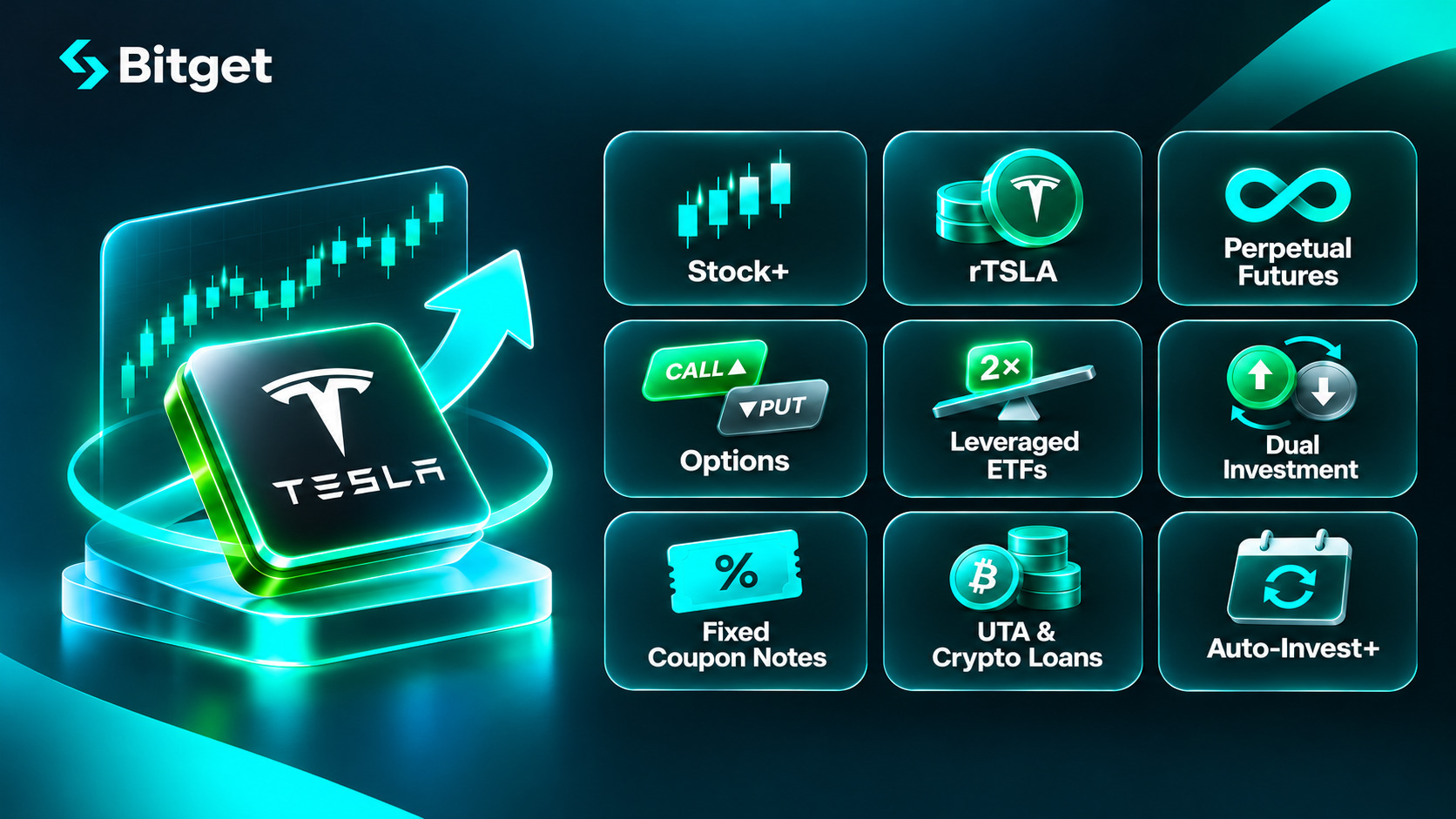
Tesla is one of the major U.S. stocks available across Bitget's stock trading ecosystem.
Instead of limiting users to one type of investment, Bitget brings together traditional U.S. stock access, tokenized stocks, derivatives and other investment tools within a single platform.
Eligible users can choose between purchasing real Tesla shares, trading rTSLA with USDT, taking long or short positions through futures, or using options and structured strategies.
Each product serves a different purpose, so understanding the differences is essential before trading.
1. Buy Real Tesla Shares With Bitget Stock+
For investors who prefer direct stock ownership, Bitget Stock+ provides access to real Tesla shares through regulated securities infrastructure and compliant brokerage partners.
Users can buy, sell and hold TSLA within Bitget's Stock+ environment without having to arrange a separate traditional U.S. brokerage account and bank transfer.
Key features include:
-
Real stock ownership: Eligible users can hold actual U.S. shares with applicable shareholder rights.
-
Fractional investing: Purchase supported stocks in increments as small as 0.0001 shares.
-
24/5 trading: Access pre-market, regular, after-hours and supported overnight sessions.
-
USDC funding: Transfer USDC into the Stock+ account, where funds are converted into USD for stock trading.
-
Zero management fees: Stock+ does not charge a separate management fee, although trading and other applicable charges may still apply.
-
Advanced market information: Eligible users can access additional market-depth data and stock information.
-
Portfolio transfers: Transfer eligible stock positions from participating brokers into Stock+.
For investors looking to establish a traditional Tesla stock position while accessing other Bitget financial products, Stock+ provides a convenient entry point.
Explore Real Tesla Stock Trading on Bitget Stock+
2. Trade Tesla rTokens (rTSLA) With USDT
For users who prefer crypto-based trading, Bitget rTSLA/USDT offers tokenized exposure to Tesla stock.
rTSLA is issued by Reality and designed to track Tesla shares through 1:1 backing with underlying stock held through licensed securities arrangements.
Unlike direct Tesla shares held through Stock+, rTSLA does not provide direct registered share ownership or voting rights.
Instead, it offers economic exposure to the underlying stock within Bitget's crypto trading environment.
Key features include:
-
Trade rTSLA directly using USDT.
-
Access fractional Tesla-linked exposure without purchasing an entire share.
-
Trade around the clock, including periods when traditional U.S. equity markets are closed.
-
Receive eligible corporate-action benefits according to the token's terms.
-
Use supported rTSLA holdings across additional Bitget products, including margin, lending and automated trading.
During U.S. stock market sessions, rToken trading can access liquidity connected to underlying equity markets. Outside those sessions, prices depend more heavily on trading activity within the token market.
This means spreads and tracking differences may vary, especially during periods of market closure or significant news.
For investors who already hold USDT and want exposure to Tesla's market movements, rTSLA provides another way to participate without moving funds outside the crypto ecosystem.
3. Trade Tesla Stock Perpetual Futures (TSLAUSDT)
Tesla's price volatility can create opportunities for traders with both bullish and bearish market expectations.
Through Bitget TSLAUSDT Perpetual Futures, users can trade derivative contracts linked to Tesla's stock price using USDT as margin.
Unlike Stock+ or rTSLA spot trading, perpetual futures do not represent ownership of Tesla shares.
Instead, traders take positions based on the direction of price movements.
Available approaches include:
-
Long positions: Gain exposure to potential increases in Tesla's price.
-
Short positions: Gain exposure to potential declines in Tesla's price.
-
Leveraged trading: Control larger notional positions with less initial margin, subject to applicable limits.
Bitget supports 24/7 trading for TSLAUSDT perpetual futures, allowing traders to respond to market developments beyond conventional stock exchange hours.
Selected position tiers support leverage of up to 100x, although maximum leverage depends on the contract and position size.
This flexibility is particularly relevant for Tesla, where major developments in autonomous driving, vehicle deliveries and earnings can influence market sentiment.
However, leveraged futures carry substantial risk. Even relatively small adverse price movements can result in liquidation when leverage is high. Traders should review funding rates, fees, margin requirements and risk controls before opening positions.
Trade TSLAUSDT Perpetual Futures on Bitget
4. Trade Tesla Stock Options on Bitget
Tesla is also supported through Bitget's U.S. Stock+ Options, giving eligible users access to call and put options.
Options offer ways to trade price direction, manage portfolio risks and implement strategies based on volatility.
For example:
-
Call options: Gain exposure to potential Tesla price increases.
-
Put options: Gain exposure to potential price declines or hedge an existing TSLA position.
-
Covered calls: Sell calls against an eligible underlying stock position to collect option premiums while limiting potential upside.
-
Protective puts: Purchase put options to establish downside protection for an existing stock position.
-
Multi-leg strategies: Combine eligible options to construct spreads, straddles, strangles or collars.
Bitget's options interface provides contract information including strike prices, expiration dates, market quotes, implied volatility and Greeks.
For traders following Tesla's earnings announcements, vehicle delivery figures or robotaxi developments, these tools provide additional flexibility beyond directional stock trading.
Bitget advertises zero trading commission on supported U.S. stock options, but platform fees, option premiums, spreads and other applicable charges may still apply.
Buying options can result in the loss of the entire premium. Selling options, particularly uncovered positions, may involve substantially greater risk.
Learn How to Trade Tesla Stock Options on Bitget
5. Access Leveraged Tesla ETFs Through Bitget rTokens
Bitget also provides tokenized exposure to selected leveraged Tesla-related exchange-traded funds.
One example is rTSLL, a Reality-issued tokenized version of the Direxion Daily TSLA Bull 2X Shares ETF.
The underlying ETF seeks approximately twice Tesla's daily performance before fees and expenses.
This product is different from directly holding TSLA or rTSLA.
Its leverage is calculated on a daily basis, meaning returns over longer periods can differ significantly from twice the cumulative return of Tesla stock.
That distinction is particularly important during volatile markets.
Leveraged ETF products may appeal to experienced traders seeking amplified daily exposure, but their performance can be affected by daily rebalancing, compounding, fees and market volatility.
Explore rTSLL Tokenized Tesla ETF on Bitget
6. Use rTSLA With Bitget Stock Dual Investment and Fixed Coupon Notes
For investors interested in target-price strategies rather than continuous trading, Bitget offers structured Earn products linked to selected stock rTokens.
These include Stock Dual Investment and Fixed Coupon Notes (FCNs).
Bitget Stock Dual Investment
Through Bitget Stock Dual Investment, eligible users can explore Buy Low and Sell High strategies involving supported assets such as rTSLA.
These strategies allow investors to choose target prices and receive yield according to the product's settlement conditions.
For example, a user interested in building a Tesla-linked position at a lower price may consider an available Buy Low product with a selected target.
If the relevant settlement conditions are met, the investment may be converted into rTSLA rather than returned entirely in the original subscription currency.
Bitget Fixed Coupon Notes
Bitget Fixed Coupon Notes provide another way to implement a target-entry strategy.
Eligible users subscribe with USDT and choose from available rToken-linked products with predefined strike prices and coupons.
At maturity, settlement depends on the underlying asset's observation price and the contract terms.
Investors may receive USDT principal or the relevant stock rToken, together with the specified coupon.
Tesla-related rTokens have been included in Bitget's FCN offering, although available subscriptions and terms may vary.
These products can be useful for investors who have a specific target entry price and are comfortable with conditional settlement.
However, Stock Dual Investment and FCNs are not principal-protected investments. If the underlying token falls significantly, the final value of the position may be lower than the initial subscription amount.
7. Use rTSLA as Collateral With Bitget UTA and Crypto Loans
One of Bitget's more distinctive features is the ability to use eligible tokenized stocks for more than simply buying and holding.
Through Bitget's Cross-Asset Unified Trading Account (UTA), supported rTokens such as rTSLA can contribute to a shared margin pool.
This allows eligible users to retain Tesla-linked exposure while using the token's eligible collateral value to support other trading positions.
Another option is Bitget Crypto Loans.
Users can pledge eligible rTSLA holdings as collateral to borrow supported cryptocurrencies or stablecoins without immediately selling their tokenized stock exposure.
For example, an investor holding rTSLA may wish to obtain USDT liquidity while maintaining exposure to Tesla's future price movements.
Crypto Loans can provide that flexibility, subject to borrowing limits, collateral ratios and interest rates.
However, this also introduces additional risk.
If Tesla's price declines and the collateral value falls, the loan-to-value ratio may rise. Users could then face margin calls or liquidation if the position breaches the applicable thresholds.
The benefit is capital flexibility; the trade-off is greater exposure to collateral and borrowing risks.
8. Build Tesla Exposure Automatically With Bitget Auto-Invest+
For investors who prefer recurring purchases rather than trying to time every market movement, Bitget Spot Auto-Invest+ supports automated purchases of eligible stock rTokens, including rTSLA where available.
Users can select an investment amount and purchase frequency, then allow the system to place recurring orders automatically.
This supports a dollar-cost averaging approach, where investments are spread across multiple purchase dates.
Instead of deciding whether to buy Tesla on a particular day, investors can follow a predetermined schedule.
This may be useful for those who want to build tokenized Tesla exposure gradually while reducing the need to place individual orders manually.
However, Auto-Invest+ does not eliminate market risk. Recurring purchases can still result in losses if Tesla's price declines.
Explore rToken Auto-Invest+ on Bitget
9. Explore Tesla Trading Bots, Copy Trading and Smart Portfolio Tools
Bitget also integrates supported rTokens with automated trading and portfolio-management tools.
For example, rTSLA Spot Trading Bots allow eligible users to explore strategies such as grid trading and other automated approaches.
Depending on current product availability, supported Tesla-linked tokens may also be integrated with:
-
Spot Grid Bots: Place automated buy and sell orders across a selected price range.
-
Copy Trading: Follow eligible strategies provided by other traders.
-
Smart Portfolio: Manage allocations and rebalancing across supported assets.
-
API trading: Integrate supported rToken markets into custom trading systems.
-
On-chain access: Use supported tokenized assets within compatible blockchain environments, where available.
These features can help users manage Tesla-linked exposure through different trading workflows.
However, automation does not guarantee profits. Trading strategies can perform poorly when market conditions change, and copied trades carry the same market risks as independently executed positions.
Which Tesla Trading Product Should You Choose on Bitget?
| Bitget product |
Main use case |
| Real Tesla share ownership and fractional investing |
|
| Tokenized Tesla exposure using USDT |
|
| Leveraged long/short trading |
|
| Calls, puts, hedging and options strategies |
|
| Leveraged daily bullish Tesla ETF exposure |
|
| Target-price strategies with conditional yield |
|
| Structured entry strategies with fixed coupons |
|
| Use eligible rTSLA holdings as margin collateral |
|
| Borrow against eligible rTSLA holdings |
|
| Automated recurring tokenized stock purchases |
|
| Automated trading strategies |
|
| Additional portfolio and trading workflows |
Not every product is suitable for every investor. Availability, supported instruments, fees, leverage and regional eligibility depend on the applicable account and product terms.
For readers who want a detailed explanation of the differences between real Tesla shares and tokenized exposure, see What Is the Difference Between Bitget rTSLA and Real Tesla Shares?.
What Should Tesla Investors Watch in 2027?
Several developments could significantly influence Tesla's stock performance over the coming year.
-
Robotaxi expansion: Investors will monitor the growth of Tesla's autonomous transportation network, including operating locations, vehicle deployment and customer adoption.
-
FSD development: Software improvements, subscription growth and regulatory approvals could influence the future contribution of autonomous driving technology.
-
Optimus commercialization: Production milestones and real-world deployment will help determine whether humanoid robotics can develop into a meaningful business.
-
Vehicle deliveries and profitability: Tesla's ability to maintain competitive pricing while improving automotive margins will remain essential.
-
Energy storage growth: Megapack production, deployments and segment profitability could provide additional opportunities for expansion.
-
Capital spending and free cash flow: As Tesla increases investment in AI, robotics and manufacturing, investors will pay closer attention to how effectively that spending translates into sustainable revenue and earnings.
Ultimately, Tesla's valuation in 2027 may depend less on technological announcements alone and more on measurable commercial progress.
Final Thoughts
Tesla's outlook for 2027 is about more than electric vehicle sales.
The company is expanding into autonomous transportation, AI-powered software, robotics and energy storage. These businesses could create substantial long-term opportunities, but Tesla still faces significant challenges involving profitability, competition, regulation and commercialization.
The contrast between its current earnings and ambitious future plans helps explain why analysts remain divided on TSLA's valuation.
For investors following Tesla, there are now more ways to participate in its market movements than simply buying shares through a traditional broker.
Bitget brings together real Tesla stock trading, rTSLA tokenized exposure, perpetual futures, options, automated strategies and structured investment products within one ecosystem. Eligible users can explore different approaches based on whether they prefer direct ownership, USDT-based trading, short-term strategies or longer-term portfolio management.
As Tesla moves into 2027, which development will matter most to its stock price: stronger vehicle profitability, expanding robotaxi operations or the emergence of an entirely new robotics business?
Frequently Asked Questions About Tesla Stock
1. What Is the Tesla Stock Forecast for 2027?
As of November 3, 2026, the average 12-month analyst price target for Tesla is $413.10, with individual estimates ranging from $128.11 to $600. These forecasts reflect different expectations for Tesla's automotive, autonomous driving and robotics businesses. They are not guaranteed year-end 2027 predictions.
2. Can Tesla Stock Reach $500 in 2027?
Tesla could potentially return to $500 if investor confidence improves and the company delivers stronger-than-expected progress in its growth businesses. However, reaching that level would depend on earnings, valuation, broader market conditions and execution. There is no guarantee that TSLA will reach any particular price.
3. What Was Tesla's Highest Stock Price in 2026?
Tesla's 52-week high was $498.83 on December 22, 2025. Its calendar-year 2026 high should be distinguished from that 52-week figure. As of November 2, 2026, the stock closed at $403.82, approximately 19% below the 52-week high.
4. Is Tesla Stock a Good Long-Term Investment?
Tesla offers exposure to electric vehicles, energy storage, autonomous driving and robotics. However, its valuation already reflects significant growth expectations. Investors should evaluate financial performance, business execution, market competition and their own risk tolerance before making an investment decision.
5. Can I Buy Real Tesla Shares on Bitget?
Yes. Eligible users can buy real Tesla shares through Bitget Stock+, which supports fractional investing and extended weekday trading sessions.
6. Can I Trade Tesla With USDT on Bitget?
Yes. rTSLA/USDT allows eligible users to trade tokenized Tesla exposure using USDT. Bitget also supports USDT-margined TSLAUSDT perpetual futures.
7. Does Bitget Offer Tesla Stock Options?
Yes. Through Bitget Stock+ Options, eligible users can access Tesla calls and puts and explore supported options strategies.
8. Can I Use Tesla rTokens as Collateral on Bitget?
Yes. Eligible rTSLA holdings can be used as collateral under supported UTA and Crypto Loans arrangements, subject to current collateral requirements and borrowing rules.
Explore Tesla Trading Opportunities on Bitget
Disclaimer: This article is for educational and informational purposes only and does not constitute financial or investment advice. Stock prices, analyst estimates and product availability may change. Trading stocks, tokenized assets, options, derivatives and structured products involves risk, including possible loss of principal. Users should review applicable product terms and assess their own financial circumstances before trading.


- Key Takeaways
- Tesla (TSLA) Stock Performance in 2026
- Tesla Stock Outlook 2026–2027: Key Growth Drivers
- What Are the Biggest Risks for Tesla Stock in 2027?
- Tesla Stock Price Prediction for 2026–2027
- How to Trade Tesla (TSLA) on Bitget
- What Should Tesla Investors Watch in 2027?
- Final Thoughts
- Frequently Asked Questions About Tesla Stock
 Apple Stock Outlook 2026–2027: How to Trade AAPL on Bitget2026-11-03 | 5m
 NVIDIA Stock Outlook 2026–2027: How to Trade NVDA on Bitget2026-11-03 | 5m
 How to Join the Anthropic IPO on Bitget With IPO Prime2026-11-03 | 5m