
In-Depth Crude Oil Market Analysis: Why Did Brent Fall More Than 5% for the Week as the Fed Turned Hawkish and Hormuz Reopening Expectations Rose?
International oil prices declined sharply in the final week of August. Brent crude fell more than 5% for the week, while WTI declined by over 4%, signaling that markets are removing part of the geopolitical risk premium that had built up due to the Middle East conflict and disruptions to shipping through the Strait of Hormuz.
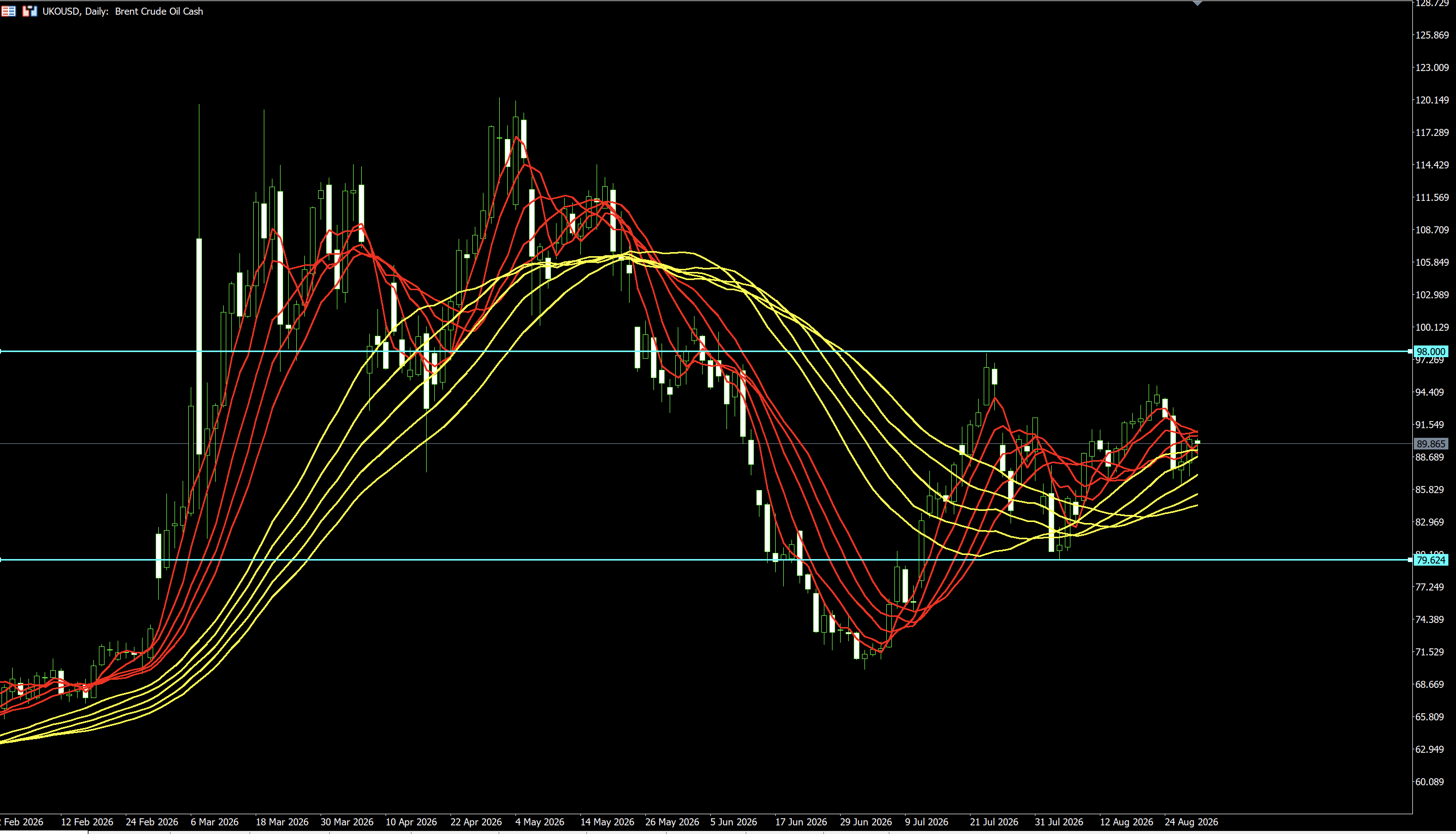
October Brent futures settled at USD 89.31 per barrel on Friday, while October WTI futures settled at USD 83.40 per barrel. Although the escalation of the Russia-Ukraine conflict and continued attacks on Russian refining facilities would normally support oil prices through heightened supply risks, market attention has temporarily shifted toward two bearish factors:
1. Fed Chair Kevin Warsh delivered a clearer hawkish signal, prompting markets to raise expectations for further rate hikes;
2. Shipping through the Strait of Hormuz may gradually recover, potentially increasing crude exports from the Persian Gulf.
This means that the oil market is not simply trading a “supply shortage.” It is pricing whether supply disruptions can gradually ease, and whether elevated interest rates could weaken future energy demand.
1. The Core Reason Behind the Decline: The Geopolitical Risk Premium Is Being Repriced
The Strait of Hormuz is one of the world’s most important energy shipping routes. Before the conflict, it handled around 20% of global oil supply flows. When markets fear that the strait could face prolonged disruptions, oil prices typically incorporate an additional risk premium because any interruption could directly affect Persian Gulf crude exports, feedstock supply for Asian refineries, and global refined-product markets.
However, markets have recently received reports that Iran and mediators may be making progress on restoring shipping. In addition, Iran and Oman are reportedly planning shipping corridors, while the United States continues maritime mine-clearance operations. Traders have therefore begun pricing in the possibility that more crude oil and energy cargoes will gradually be able to leave the Persian Gulf.
Goldman Sachs estimates that total crude exports from the Persian Gulf currently stand at around 15–16 million barrels per day. While that remains approximately 7–8 million barrels per day below pre-war levels, it is about 5–6 million barrels per day above the lows reached in March.
This is the key reason for the decline in oil prices: markets are not assuming that risks have disappeared entirely. Rather, they are assigning a lower probability to the most extreme supply-disruption scenario.
For oil markets, a move from “severely disrupted” supply conditions to “partially restored” supply conditions is often more important than the absolute level of supply itself. Prices trade marginal changes and deviations from expectations. As long as actual export volumes, vessel traffic, or alternative logistics capacity continue to improve, the risk premium that had previously lifted prices may continue to fade.
2. Hormuz Has Not Yet Returned to Normal: Lower Oil Prices Do Not Mean Supply Risks Have Disappeared
Although markets are beginning to price a reopening of shipping routes, actual vessel data still suggest that the Strait of Hormuz remains far from its pre-war operating conditions.
The latest preliminary data showed that only seven commercial vessels passed through the strait on Thursday, down from 17 vessels the previous day and below the roughly 15-vessel daily average seen over the prior 10 days. This indicates that the strait is not fully closed, but shipping volumes remain highly unstable.
Markets should note that the oil supply chain is not only about whether ships can pass through. Traders must also monitor:
-
Whether the number of vessels passing through each day continues to increase;
-
The proportion of oil tankers and refined-product carriers among those vessels;
-
Whether insurance premiums and freight rates decline;
-
Whether shipping companies are willing to restore normal schedules;
-
Whether Asian refineries can increase crude purchases and imports;
-
Whether Persian Gulf producers can maintain stable export flows.
If vessel traffic only rebounds sporadically while daily activity remains highly volatile, markets will struggle to fully remove the geopolitical premium. Conversely, if shipping volumes rise consistently over the coming weeks and insurance costs, freight rates, and cargo loadings normalize at the same time, Brent’s risk premium may face a more substantial compression.
As a result, the impact of Hormuz-related developments on oil prices is likely to remain highly headline-driven in the near term. Any negotiations, military escalation, vessel attack, sanctions expansion, or collapse in mediation efforts could trigger rapid moves in crude prices.
3. How Does a Hawkish Fed Pressure Oil? The Key Channels Are the Dollar, Demand, and Risk Appetite
Fed Chair Kevin Warsh’s hawkish remarks at Jackson Hole also became a major macroeconomic factor weighing on oil prices this week.
Warsh emphasized that US inflation has not yet returned to the Fed’s 2% target at a sufficiently fast or credible pace. As long as inflation pressure remains broad-based, the Fed cannot rule out additional rate hikes. Markets consequently increased their expectations of a September hike, pushing the US dollar and short-dated Treasury yields higher.
A hawkish Fed typically pressures oil prices through three main channels.
A Stronger US Dollar Raises Oil Costs for Non-Dollar Buyers
International crude oil is primarily priced in US dollars. When the dollar strengthens, oil becomes more expensive for importing countries using euros, yen, renminbi, or other currencies, potentially affecting demand and purchasing appetite.
This may not immediately reduce physical oil consumption, but it can weigh on financial demand for oil—particularly when speculative capital and commodity funds reassess their risk exposure.
Higher Rates for Longer May Weaken Economic Growth and Energy Demand
If the Fed raises rates further, or if markets believe rates will remain elevated for an extended period, financing costs may rise across the US and global economies. Corporate investment, consumer spending, manufacturing activity, and transportation demand could all be affected, which would in turn shape expectations for oil demand.
Oil markets do not trade only current inventory and production levels. They also heavily price demand expectations for the coming quarters. Therefore, even if refined-product fundamentals remain relatively strong today, oil prices may move lower in advance if markets begin to worry that higher rates will constrain growth.
Pressure on Risk Assets May Prompt Commodity Funds to Reduce Long Exposure
A hawkish Fed is generally unfavorable for high-valuation technology stocks and overall risk sentiment. When markets shift toward risk aversion or deleveraging, volatile commodities such as crude oil can also face profit-taking or long-position liquidation.
Therefore, the latest decline in oil prices does not entirely reflect weaker physical fundamentals. It also reflects macro-driven positioning, as investors reduce oil exposure amid a stronger dollar, rising yields, and declining risk appetite.
4. The Russia-Ukraine Energy War Remains an Important Support Factor: Crude and Refined Products Must Be Viewed Separately
Although expectations for a reopening of Hormuz have pressured oil prices, disruptions to Russian refining facilities caused by the Russia-Ukraine conflict remain an important source of support for the oil market.
Ukraine has continued to target Russian refineries and energy infrastructure. The impact of these attacks may not necessarily appear first as a reduction in crude supply. Instead, they are more likely to affect Russia’s refining capacity and refined-product supply, including gasoline, diesel, fuel oil, and other petroleum products.
This creates an important market structure:
-
Expectations of recovering crude supply may pressure Brent and WTI;
-
Disruptions to refined-product supply caused by refinery damage may support diesel, gasoline, and crack spreads;
-
If refined-product inventories decline and refining margins improve, refineries may increase crude purchases, which could ultimately support crude demand.
Therefore, traders should not rely on a single headline to determine oil-price direction. The Strait of Hormuz affects global logistics for crude oil, LNG, and other energy commodities, while attacks on Russian refineries are more directly linked to refined-product supply and refining-capacity risks. When both occur simultaneously, oil markets may experience sharp and repeated volatility.
5. Why Brent Deserves More Attention Than WTI: UKOUSD as a Tool for Tracking Middle East Risk
When Middle Eastern supply and shipping risks dominate the market, Brent crude typically reflects geopolitical pricing in the international oil market more directly than WTI.
WTI is more closely tied to the US inland crude market, US shale production, Cushing inventories, and North American refinery demand. Brent, by contrast, is a major global seaborne crude benchmark and is generally more sensitive to supply developments in the Middle East, Europe, Africa, and Asia.
Therefore, amid overlapping developments involving the Strait of Hormuz, Persian Gulf exports, OPEC supply, US-Iran relations, and the Russia-Ukraine war, UKOUSD (Brent crude oil) is often an important trading instrument for tracking changes in the global crude-oil risk premium.
Brent has currently retreated to around USD 89 per barrel, reflecting reduced expectations of the most severe supply-disruption scenario. However, as long as shipping through the strait has not recovered steadily and mediation talks remain uncertain, oil prices may still rebound quickly on unexpected headlines.
6. Three Scenarios to Watch for the Oil Market Outlook
Scenario 1: Hormuz Shipping Continues to Recover While the Fed Remains Hawkish
If shipping volumes increase steadily in the coming weeks, Persian Gulf exports continue to recover, and expectations of Fed hikes further lift the US dollar and Treasury yields, oil prices could remain under pressure.
Under this scenario, markets may continue removing geopolitical risk premiums, and Brent crude could test lower support areas.
Scenario 2: Shipping Recovery Disappoints or Geopolitical Conflict Escalates
If Hormuz negotiations collapse, vessel traffic declines again, insurance costs rise sharply, or the Middle East conflict escalates, markets could rapidly reprice supply risks.
Since export volumes remain far below pre-war normal levels, any sign of worsening shipping disruptions could trigger a sharp rebound in Brent crude.
Scenario 3: Russian Refinery Risks Expand and Refined-Product Supply Tightens
If Russian refining facilities continue to come under attack, resulting in tighter supplies of diesel, gasoline, and other refined products, refining margins and crack spreads may strengthen. This could support crude demand from refineries.
Under this scenario, even if Middle Eastern exports gradually recover, the downside in oil prices could be limited. The market may shift toward high-level volatility rather than a sustained one-way decline.
Conclusion: Oil Is Caught Between Supply-Recovery Expectations and Unresolved Geopolitical Risks
The central conflict in the oil market is clear. On one hand, the Strait of Hormuz may gradually reopen to shipping, and Persian Gulf crude exports have already recovered from their lows, prompting markets to reduce the geopolitical risk premium. On the other hand, actual shipping volumes remain unstable, the Middle East conflict has not ended, and disruptions to Russian energy facilities continue—meaning supply risks are far from fully resolved.
Combined with a more hawkish Fed, which supports the US dollar and Treasury yields, crude oil may remain under macro pressure in the short term. However, in a highly geopolitically sensitive environment, any developments related to Hormuz, Iran, Russian refining facilities, or OPEC supply could trigger significant volatility in Brent crude.
For CFD traders, it is important to monitor not only oil prices, but also actual vessel traffic through the Strait of Hormuz, Persian Gulf export data, the US Dollar Index, Treasury yields, Fed policy expectations, and developments in the Russia-Ukraine energy conflict.
To participate in international oil-price movements and the repricing of geopolitical risks, users can trade UKOUSD crude oil CFDs on Bitget, enabling flexible exposure to both bullish and bearish Brent crude scenarios. However, CFDs are leveraged products, and market volatility can amplify potential gains as well as losses. Traders should set stop-loss levels, manage positions carefully, and ensure that they understand and can tolerate the associated risks.
All trading tutorials provided by Bitget are for educational purposes only and should not be considered financial advice. The strategies and examples shared are for reference only and may not reflect actual market conditions. CFD trading involves significant risks, including the potential loss of funds. Past performance does not guarantee future results. Please conduct thorough research and understand the risks involved. Bitget is not responsible for any trading decisions made by users.


- 1. The Core Reason Behind the Decline: The Geopolitical Risk Premium Is Being Repriced
- 2. Hormuz Has Not Yet Returned to Normal: Lower Oil Prices Do Not Mean Supply Risks Have Disappeared
- 3. How Does a Hawkish Fed Pressure Oil? The Key Channels Are the Dollar, Demand, and Risk Appetite
- 4. The Russia-Ukraine Energy War Remains an Important Support Factor: Crude and Refined Products Must Be Viewed Separately
- 5. Why Brent Deserves More Attention Than WTI: UKOUSD as a Tool for Tracking Middle East Risk
- Conclusion: Oil Is Caught Between Supply-Recovery Expectations and Unresolved Geopolitical Risks
 TradFi Weekly Recap (October 19 - October 23)2026-10-22 | 15m
 US30: The AI Crash Is Fueling the Dow's Breakout2026-10-22 | 5m