
Jackson Hole Global Central Banking Symposium Approaches: Trading Focus for the U.S. Dollar, Gold, and Equity Indices Through Kevin Warsh’s Perspective
Every late August, global financial markets turn their attention to Jackson Hole, Wyoming. Hosted by the Federal Reserve Bank of Kansas City, the Jackson Hole Economic Policy Symposium is not only a platform for central bankers, economists, and market participants to exchange views; it is also frequently a major catalyst for markets to reprice interest-rate expectations, the U.S. dollar, gold, and equity-market risk.
The 2026 Jackson Hole Economic Policy Symposium will take place from August 27 to 29, with this year’s theme being: “Financial Innovation: Implications for Payments and Policy”
Against a backdrop of evolving financial technology, digital payments, stablecoins, central-bank policy transmission, and financial regulation, this theme is relevant not only to payment systems. It may also have implications for the role of the U.S. dollar, banking-system liquidity, and the efficiency of monetary-policy implementation. For CFD traders, remarks made during Jackson Hole and shifts in market expectations are often directly reflected in volatility across forex, gold, and equity indices.
Why Does Jackson Hole Receive So Much Attention From Global Markets?
The Jackson Hole Economic Policy Symposium is one of the world’s longest-running central banking conferences. Since 1975, it has brought together central bank officials, Federal Reserve representatives, government officials, financial industry leaders, academics, and members of the media to discuss long-term economic and policy issues.
Although attendance is generally limited to around 120 participants, its influence is far greater than its size suggests. This is because markets do not simply focus on whether policy changes. They also closely analyze how policymakers describe the economic outlook, inflation risks, labor-market conditions, financial conditions, and the future path of monetary policy.
Historically, markets have looked to Jackson Hole for clues on questions such as:
-
Has the Federal Reserve become more confident that inflation is under control?
-
Could interest rates remain elevated for longer?
-
Will the pace of rate cuts slow down or accelerate?
-
Is the U.S. economy heading for a soft landing, reflation, or slower growth?
-
Could liquidity conditions, payment innovation, and regulatory developments affect monetary-policy transmission?
For this reason, Jackson Hole is not merely an academic conference. It is an important policy event that can reshape expectations for global asset prices.
Who Is Kevin Warsh, and Why Is His View Worth Following?
Kevin Warsh previously served as a member of the Federal Reserve Board of Governors, currently serves as Chair of the Federal Reserve, and participated in key Fed policy discussions during the global financial crisis. Given his background in policymaking, financial markets, and macroeconomic analysis, markets have long paid attention to his views on inflation, Federal Reserve independence, the balance sheet, and financial stability.
When assessing Warsh’s public remarks, markets typically pay particular attention to the following areas:
1. Assessment of inflation risks
If policymakers believe inflationary pressure remains persistent, markets may scale back expectations for rapid monetary easing. This could support the U.S. dollar and Treasury yields while putting pressure on gold and equity valuations.
2. Views on the Federal Reserve’s policy framework
This includes interest-rate policy, quantitative easing, the size of the Fed’s balance sheet, and whether the Fed should place greater emphasis on financial-market distortions and asset-price risks.
3. Focus on fiscal deficits and the role of the U.S. dollar
U.S. fiscal deficits, Treasury issuance, and long-term interest-rate trends may affect the attractiveness of dollar-denominated assets and are also closely linked to safe-haven demand for gold.
4. Approach to financial innovation and payment systems
With the 2026 Jackson Hole Symposium focused on “financial innovation,” markets will pay closer attention to whether payment technologies, stablecoins, digital financial infrastructure, and regulatory policy could alter bank liquidity, monetary-policy transmission, and cross-border capital flows.
It is important to note that, before official remarks are released, traders should avoid treating market rumors or past views as a definitive stance for the current event. What often moves markets is the strength of the language used and the gap between the actual message and pre-existing market expectations.
What Signals Could Markets Watch From Kevin Warsh’s Policy Perspective?
If Warsh comments on inflation, interest rates, financial innovation, or Federal Reserve governance during Jackson Hole, CFD traders may want to monitor the following types of signals.
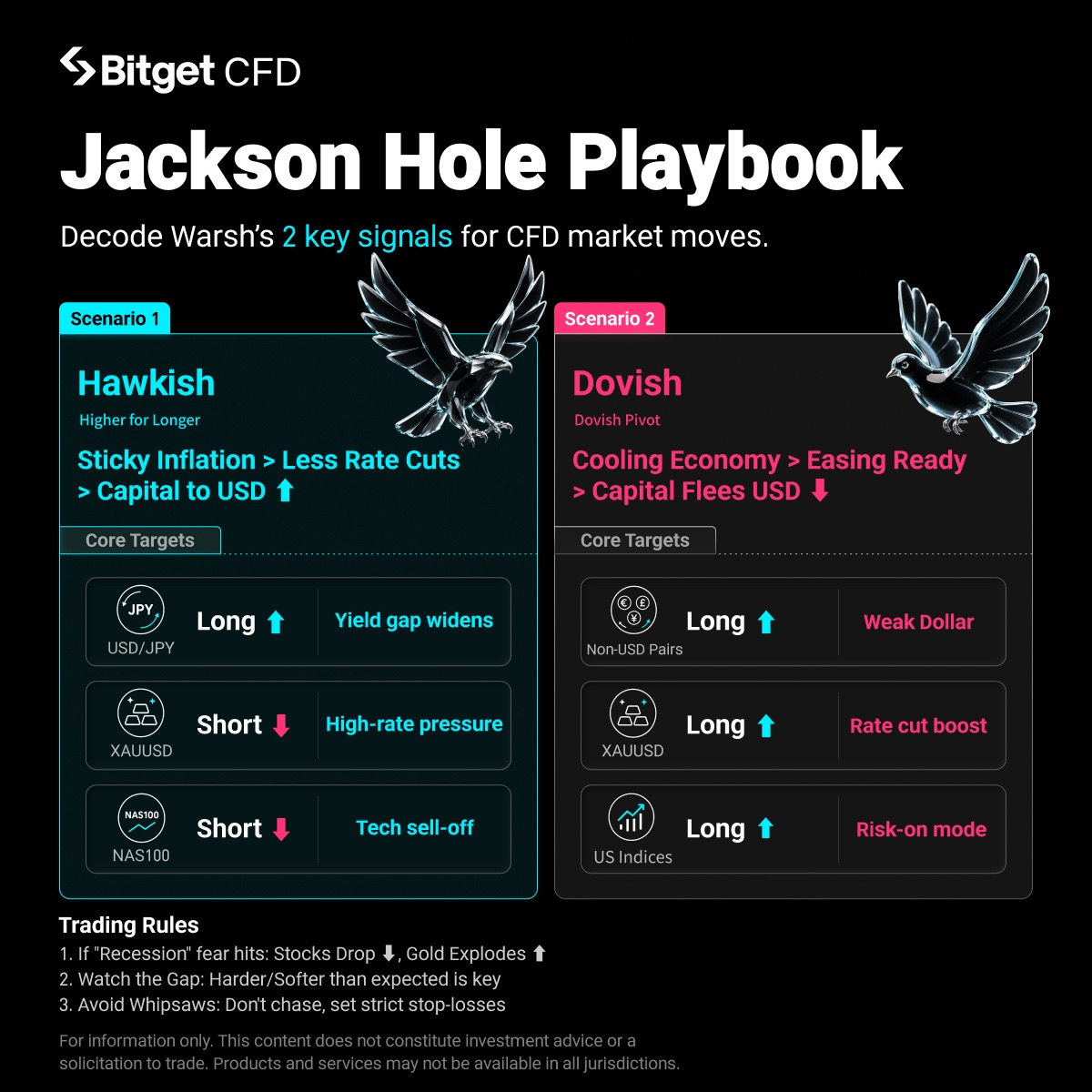
Hawkish Signals: Interest Rates Could Remain Higher for Longer
If the speech emphasizes that inflation is not yet fully under control, that services inflation remains resilient, or that easing policy too early could reignite price pressures, markets may interpret the message as supporting a “higher for longer” interest-rate environment.
Potential market reactions may include:
-
A stronger U.S. dollar: Volatility in major pairs such as USD/JPY and EUR/USD could intensify.
-
Pressure on gold: Higher rate expectations increase the opportunity cost of holding non-yielding assets.
-
Volatility in U.S. equity indices: Particularly in interest-rate-sensitive technology and growth stocks.
-
Higher U.S. Treasury yields: Potentially affecting valuations across global risk assets.
However, if hawkish expectations have already been fully priced in, even a hawkish speech may not lead to a sustained one-way move. The key trading question is whether the actual message is more hawkish than the market expected.
Dovish Signals: Greater Room for Monetary Easing
If the focus shifts toward downside risks to economic growth, cooling labor-market conditions, or continued improvement in inflation pressures, markets may increase bets on future rate cuts.
In such a scenario, common market reactions may include:
-
A weaker U.S. dollar;
-
Support for gold;
-
Stronger U.S. equity indices, particularly growth-heavy indices such as the Nasdaq 100;
-
Rebounds in non-U.S. currencies, including the euro, British pound, and Australian dollar.
However, traders should also remember that expectations of rate cuts are not automatically bullish for equities. If the market believes a policy pivot is being driven by a rapid deterioration in the economy, safe-haven sentiment may still dominate, putting pressure on equity indices and higher-risk currencies.
Financial Innovation, Stablecoins, and Payment Policy: A Potential New Focus This Year
With the 2026 theme centered on payments and financial innovation, markets should watch whether discussions address:
-
Stablecoin regulation and the U.S. dollar payment system;
-
Fund flows between bank deposits and non-bank financial institutions;
-
Real-time payment systems and cross-border payment efficiency;
-
The impact of digital financial tools on bank liquidity and credit creation;
-
Whether financial innovation could alter the Federal Reserve’s monetary-policy transmission mechanism.
These issues may not immediately change the Fed’s interest-rate decisions, but they could influence market assessments of the U.S. dollar-based financial system, long-term liquidity conditions, and the future direction of financial regulation. If policy discussions highlight the competitiveness of the dollar payment network, dollar-denominated assets may gain medium- to long-term support. Conversely, if markets become concerned that financial innovation could create regulatory uncertainty or liquidity risks, safe-haven assets such as gold may attract attention.
Which Markets Can CFD Traders Watch During Jackson Hole?
Forex: The U.S. Dollar Is the Primary Focus
The U.S. dollar is typically the asset most directly affected by Jackson Hole developments. Traders may monitor:
-
EUR/USD: Reflects the gap between U.S. and eurozone monetary-policy expectations.
-
GBP/USD: Influenced not only by the U.S. dollar, but also by UK inflation and Bank of England policy.
-
USD/JPY: Particularly sensitive to U.S.-Japan yield differentials and U.S. Treasury yields, often resulting in more pronounced volatility.
-
AUD/USD: Often reflects a combination of U.S. dollar movements, risk sentiment, and commodity-market developments.
If remarks push Treasury yields and the U.S. dollar higher, USD/JPY may become a key market focus. If markets shift toward expectations of easing, EUR/USD, GBP/USD, and AUD/USD may see rebound opportunities.
Gold: Watch the U.S. Dollar, Real Yields, and Safe-Haven Demand
Gold prices are typically influenced by three major factors:
-
The strength of the U.S. dollar;
-
Changes in U.S. real interest rates;
-
Safe-haven demand in the market.
Hawkish policy signals are generally unfavorable for gold. However, if economic, fiscal, or geopolitical uncertainty emerges at the same time, gold may still demonstrate resilience. Therefore, gold analysis should not focus solely on Federal Reserve language; traders should also monitor the U.S. Dollar Index, Treasury yields, and overall risk sentiment.
Equity Indices: Watch for a Repricing of Rate Expectations
Jackson Hole remarks can trigger rapid moves in equity indices, particularly in:
-
US 500: Reflecting overall risk appetite toward large U.S. companies;
-
Nasdaq 100: More sensitive to interest rates and technology-stock valuations;
-
US 30: More heavily weighted toward traditional industries and value-oriented stocks.
When markets reassess the interest-rate path, highly valued technology stocks are usually more vulnerable to pressure. However, if markets believe policy will support economic growth and liquidity, risk assets may also rebound quickly.
What Risks Should Traders Consider Before Trading Jackson Hole Volatility?
Market volatility during Jackson Hole is often driven not only by the content of speeches, but also by market positioning, real-time media interpretations, and post-speech Q&A sessions. CFD traders may wish to keep the following considerations in mind:
-
Avoid trading based solely on headlines: The full context of a speech is often more important than a single quote.
-
Watch for wider spreads and higher volatility: Market liquidity may change during major policy events.
-
Manage leverage and position size: In volatile conditions, leverage can amplify both potential gains and losses.
-
Set stop-losses and maintain a trading plan: Define entry levels, exit levels, and acceptable risk in advance.
-
Track follow-up data for confirmation: Jackson Hole messaging must ultimately be validated through inflation, employment, retail sales, GDP, and other economic data.
Conclusion: The Gap Between Policy Signals and Market Expectations Is the Key Driver of Volatility
The importance of the Jackson Hole Global Central Banking Symposium does not lie in the fact that policy decisions are announced every year. Rather, it gives markets an opportunity to assess how major central banks are thinking ahead of future decisions. With the 2026 event focused on financial innovation and payment policy, markets should continue watching interest rates and inflation while also assessing the longer-term impact of changes in financial infrastructure on the U.S. dollar, liquidity, and policy transmission.
The views of experienced policy figures such as Kevin Warsh may offer important clues for understanding the Federal Reserve’s framework, inflation risks, and financial innovation. For traders, instead of attempting to predict the outcome of a single speech, the more important question is whether the actual message changes existing market expectations for interest rates, the direction of the U.S. dollar, and overall risk sentiment.
Capture Jackson Hole Market Volatility With Bitget CFD
During Jackson Hole, forex, gold, and equity indices may experience significant volatility due to central bank remarks, changing interest-rate expectations, and shifts in market sentiment. With Bitget CFD, you can follow and trade a diverse range of markets, including forex, gold, and major global equity indices, allowing you to respond more flexibly to price movements driven by important macroeconomic events.
Before trading, conduct your own market research, establish a risk-management strategy, and understand the higher risks associated with leveraged CFD products.
Explore Bitget CFD today and capture trading opportunities driven by global central bank policy signals.
Trade on Any 5 Days to Earn Cash Rewards! Bitget CFD August Trading Challenge Is Now Live


- Why Does Jackson Hole Receive So Much Attention From Global Markets?
- Who Is Kevin Warsh, and Why Is His View Worth Following?
- What Signals Could Markets Watch From Kevin Warsh’s Policy Perspective?
- Which Markets Can CFD Traders Watch During Jackson Hole?
- What Risks Should Traders Consider Before Trading Jackson Hole Volatility?
- Conclusion: The Gap Between Policy Signals and Market Expectations Is the Key Driver of Volatility