
How to Hedge rToken Spot With Traditional Perps in One Account: Bitget UTA Guide for 2026
Holding a tokenized stock and hedging it used to mean making a trade-off: keep the position and accept the risk, or sell part of it to free up capital for a hedge. With Bitget Unified Trading Account (UTA), traders can take a more flexible approach by holding an rToken Spot position and using the corresponding Stock Perp to manage directional risk within the same account.
Take NVIDIA as an example. A trader can hold rNVDA while shorting the corresponding NVDA Stock Perp. When the two legs are closely matched, much of the gain or loss from NVIDIA's price movement can offset. Instead of making a pure bet on whether the stock goes up or down, the strategy can focus more on hedging, funding rates, Spot-Perp basis, or event-driven opportunities.
What makes the setup more powerful is how Bitget connects the two sides. UTA brings the rToken Spot position, Stock Perp hedge, collateral, margin, and risk management into one capital-efficient framework. Eligible rTokens can also contribute adjusted collateral value, helping traders keep their stock exposure while putting more of the same capital to work.
Key Takeaways
-
Yes, rToken Spot and a corresponding Stock Perp can be managed in the same Bitget UTA, making it easier to hedge tokenized stock exposure without moving funds between separate Spot and Futures accounts.
-
rToken provides the Spot equity leg, while Stock Perps provide the hedge, allowing traders to manage downside risk, funding-rate strategies, basis trades, and event-driven positions.
-
Eligible rTokens can also contribute adjusted collateral value inside UTA, so the Spot position can stay invested while more of the same capital remains useful to the broader margin framework.
-
UTA Advanced Mode brings Spot, Spot Margin, Futures, multi-asset collateral, and cross-margin management together, creating a more capital-efficient setup for multi-leg stock strategies.
-
Following the August 28, 2026 upgrade, Delta-Neutral functionality is integrated directly into Advanced Mode, with a simplified same-asset hedge test for qualifying positions.
-
Qualifying Delta-Neutral cross-margin Futures positions can receive lower ADL priority, adding an extra layer of risk management for closely matched rToken + Stock Perp hedges.
Can You Hedge rToken Spot With Stock Perps in One Bitget UTA?
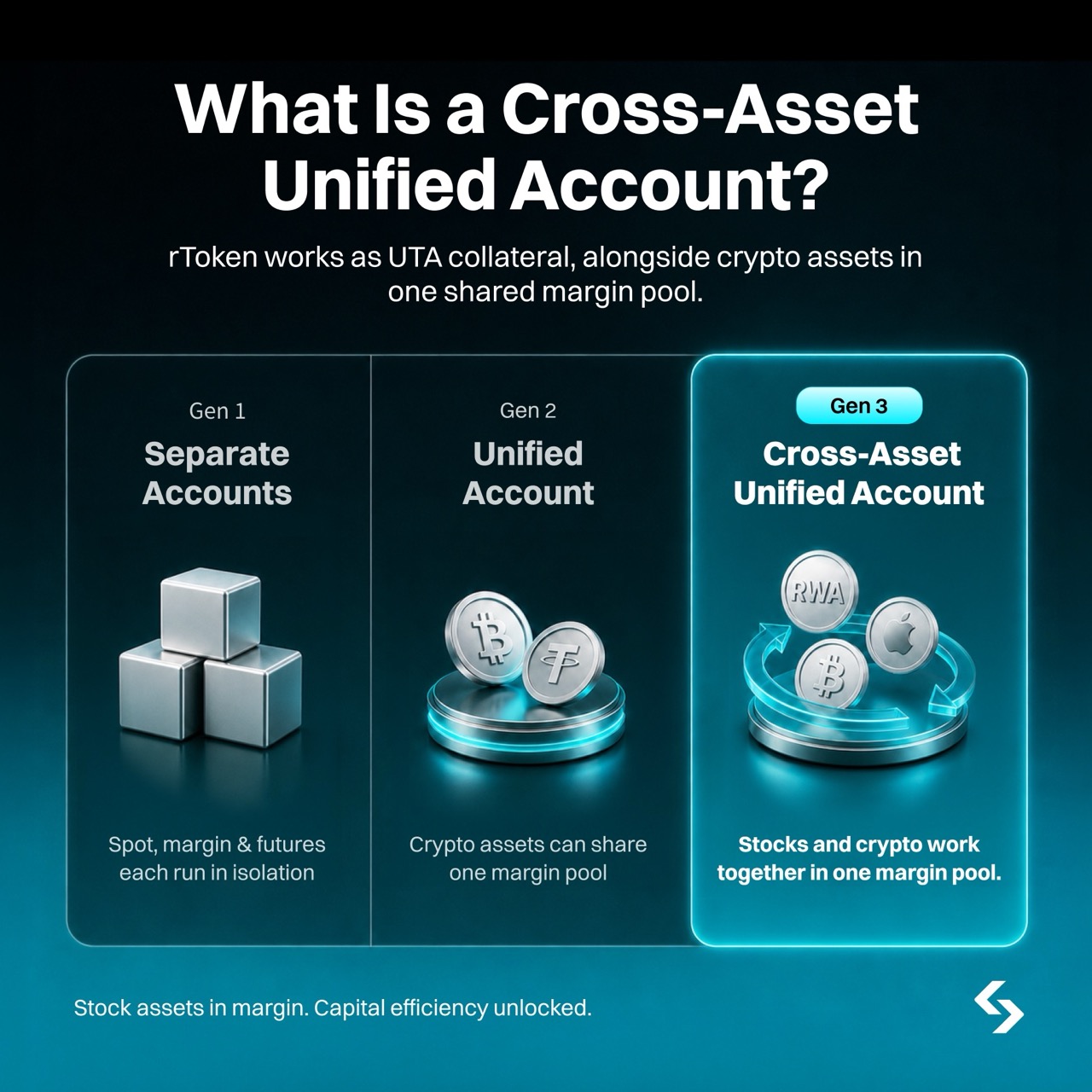
Yes. Bitget UTA allows traders to hold an rToken Spot position and hedge it with the corresponding Stock Perp within the same account. Instead of separating the Spot leg, Futures hedge, and collateral across different accounts, UTA brings them into one unified trading framework.
The structure is straightforward:
-
rToken provides tokenized Spot exposure to the underlying stock.
-
Stock Perps provide the Futures leg for hedging, short exposure, funding-rate strategies, and basis trading.
-
Bitget UTA connects the two positions through shared margin and broader portfolio-level capital management.
For example, a trader holding rNVDA can short the corresponding NVDA Stock Perp. The trader keeps the NVIDIA-linked Spot exposure while using the Futures position to offset part or most of the short-term directional risk.
What makes Bitget UTA especially useful is that the rToken does not necessarily have to sit idle while the hedge is open. Eligible rToken holdings can also contribute adjusted collateral value to the UTA margin pool, allowing the same portfolio to support both Spot exposure and broader trading activity more efficiently.
For traders managing several positions at once, this creates a cleaner setup: hold the rToken, open the Stock Perp hedge, and manage both sides from one Bitget UTA.
Learn more: What Is Bitget Unified Trading Account (UTA)? Trade More Efficiently With One Account
How Does rToken Spot + Stock Perp Hedging Work?
The idea is simple: keep the stock exposure you want, then use the corresponding Stock Perp to reduce the directional risk you do not want.
Suppose a trader wants to maintain NVIDIA exposure but is concerned about short-term volatility. The trader could hold:
-
Long $100,000 rNVDA Spot
-
Short approximately $100,000 NVDA Stock Perp
The two positions are designed to move in opposite directions.
If NVIDIA Rises
The rNVDA Spot position may gain value, while the short NVDA Stock Perp may lose value.
If NVIDIA Falls
The rNVDA Spot position may lose value, while the short NVDA Stock Perp may gain value.
When the two legs remain closely matched, much of the directional exposure to NVIDIA can offset. The trader can therefore keep the underlying rToken position while reducing sensitivity to short-term price swings.
This changes the purpose of the trade. Instead of relying mainly on whether NVIDIA goes up or down, the strategy can focus more on:
-
Portfolio hedging: Reduce downside exposure without selling the rToken position.
-
Earnings or event hedging: Temporarily reduce risk around earnings, macro data, or major market events.
-
Funding-rate strategies: Potentially capture favorable funding when the Stock Perp funding structure supports the hedge.
-
Spot-Perp basis trading: Target temporary differences between the rToken Spot price and the corresponding Stock Perp.
That is where rToken and Stock Perps fit naturally together on Bitget. rToken keeps the Spot equity exposure in place, while Stock Perps give traders a flexible derivatives layer to hedge, rebalance, or build market-neutral strategies around it.
Why Is Hedging in One Bitget UTA More Capital Efficient?
Putting the rToken and Stock Perp in the same account is convenient, but the bigger advantage is what happens to the capital behind the trade.
In a more fragmented setup, a trader may need one pool of capital to buy the rToken and another pool of USDT to support the Futures hedge. Additional transfers and margin buffers can leave part of the portfolio sitting idle.
Bitget UTA is designed to reduce this capital fragmentation. In Advanced Mode, eligible assets can contribute to the shared margin pool according to their applicable collateral ratios. This means a trader can keep an eligible rToken position while part of its adjusted value continues to support the broader UTA margin framework.
The calculation is straightforward:
Adjusted collateral value = Asset value × applicable collateral ratio
Example: rAAPL as Working Collateral
Suppose a trader holds 10,000 USDT worth of eligible rAAPL and its applicable collateral ratio is 90%.
10,000 × 90% = 9,000 USDT adjusted collateral value
Instead of selling the rAAPL into USDT just to make that capital useful for margin, the trader can keep the stock-linked position while 9,000 USDT of adjusted value contributes to the applicable UTA margin calculation.
The difference can be summarized simply:
Without rToken collateral utility:
Hold rAAPL → keep separate USDT for the Futures hedge.
With Bitget UTA:
Hold rAAPL → retain the Spot exposure → eligible value contributes collateral → manage the Stock Perp hedge in the same UTA.
This does not create free capital or remove Futures margin requirements. The advantage is that the same portfolio capital can work harder. The rToken remains the Spot leg of the strategy while its eligible adjusted value can also support margin across the wider UTA.
For professional traders running multiple hedges, that can mean less idle capital, fewer unnecessary conversions, and a much cleaner way to manage Spot and Futures exposure together.
How Much Capital Efficiency Can Eligible rTokens Provide?
The capital-efficiency advantage becomes more noticeable as position size increases. With Bitget Cross-Asset UTA, supported assets can contribute collateral value to the same margin pool instead of requiring traders to hold large separate stablecoin balances purely for Futures margin.
Bitget's Cross-Asset UTA supports 370+ eligible margin assets, including 125+ rTokens, while eligible rToken collateral ratios can reach up to 95% depending on the asset, holding tier, and current risk parameters.
Consider a professional trading desk holding:
-
$1,000,000 of an eligible rToken
-
Illustrative collateral ratio: 95%
The adjusted collateral value would be:
$1,000,000 × 95% = $950,000
That means the desk can maintain the $1 million stock-linked position while approximately $950,000 of adjusted value contributes to the applicable UTA margin calculation.
For a desk simultaneously running a Stock Perp hedge, this can be a major efficiency gain. Instead of treating the rToken investment and Futures collateral as two completely separate pools of capital, Bitget UTA allows eligible value from the Spot portfolio to remain useful across the account.
In practice, this can help traders achieve:
-
Higher capital utilization: More of the portfolio remains productive instead of sitting idle as a separate margin reserve.
-
Fewer conversions: Traders do not need to repeatedly sell rTokens into USDT simply to make capital available for margin.
-
More scalable hedging: Larger Spot portfolios can support broader Futures and multi-leg strategies within the same UTA framework.
-
Greater portfolio flexibility: Capital can be allocated across Spot, Futures, hedging, and other supported strategies more efficiently.
The important distinction is that adjusted collateral value is not free capital or additional profit. Futures margin requirements still apply, and collateral ratios can change.
The advantage is simpler: Bitget UTA lets eligible rToken holdings do more than just sit in the Spot portfolio. They can remain invested while also contributing to the capital framework behind the hedge.
Which rToken and Stock Perp Pairs Can Be Used for Hedging?
The cleanest hedge pairs an rToken with a Stock Perp linked to the same underlying stock. This gives both sides of the position similar economic exposure, allowing the Futures leg to more directly offset movements in the Spot leg.
Potential examples, subject to current Bitget availability, include:
| rToken Spot |
Stock Perp Hedge |
Underlying Stock |
| rNVDA |
NVDAUSDT |
NVIDIA |
| rAAPL |
AAPLUSDT |
Apple |
| rTSLA |
TSLAUSDT |
Tesla |
| rMETA |
METAUSDT |
Meta |
| rAMZN |
AMZNUSDT |
Amazon |
For example, long rNVDA + short NVDA Stock Perp creates two opposite positions linked to NVIDIA. If the notional values remain closely matched, much of the portfolio's NVIDIA directional exposure can be reduced.
The same-underlying requirement becomes especially important when using Bitget's Delta-Neutral functionality. Two stocks may be highly correlated, but correlation alone does not make them the same hedge.
For example:
rNVDA + NVDA Stock Perp ✅ Same underlying
rAAPL + AAPL Stock Perp ✅ Same underlying
rNVDA + TSLA Stock Perp ❌ Not a same-asset Delta-Neutral hedge
This distinction helps keep the strategy focused on neutralizing the intended stock exposure rather than introducing a second directional bet.
For traders building a broader stock-neutral portfolio, the process can be repeated across multiple supported pairs. Instead of relying on one large market hedge, each rToken position can be paired with its corresponding Stock Perp, giving traders more precise control over individual stock exposure inside the same Bitget UTA.
How Does Bitget Delta-Neutral Functionality Improve the Hedge?
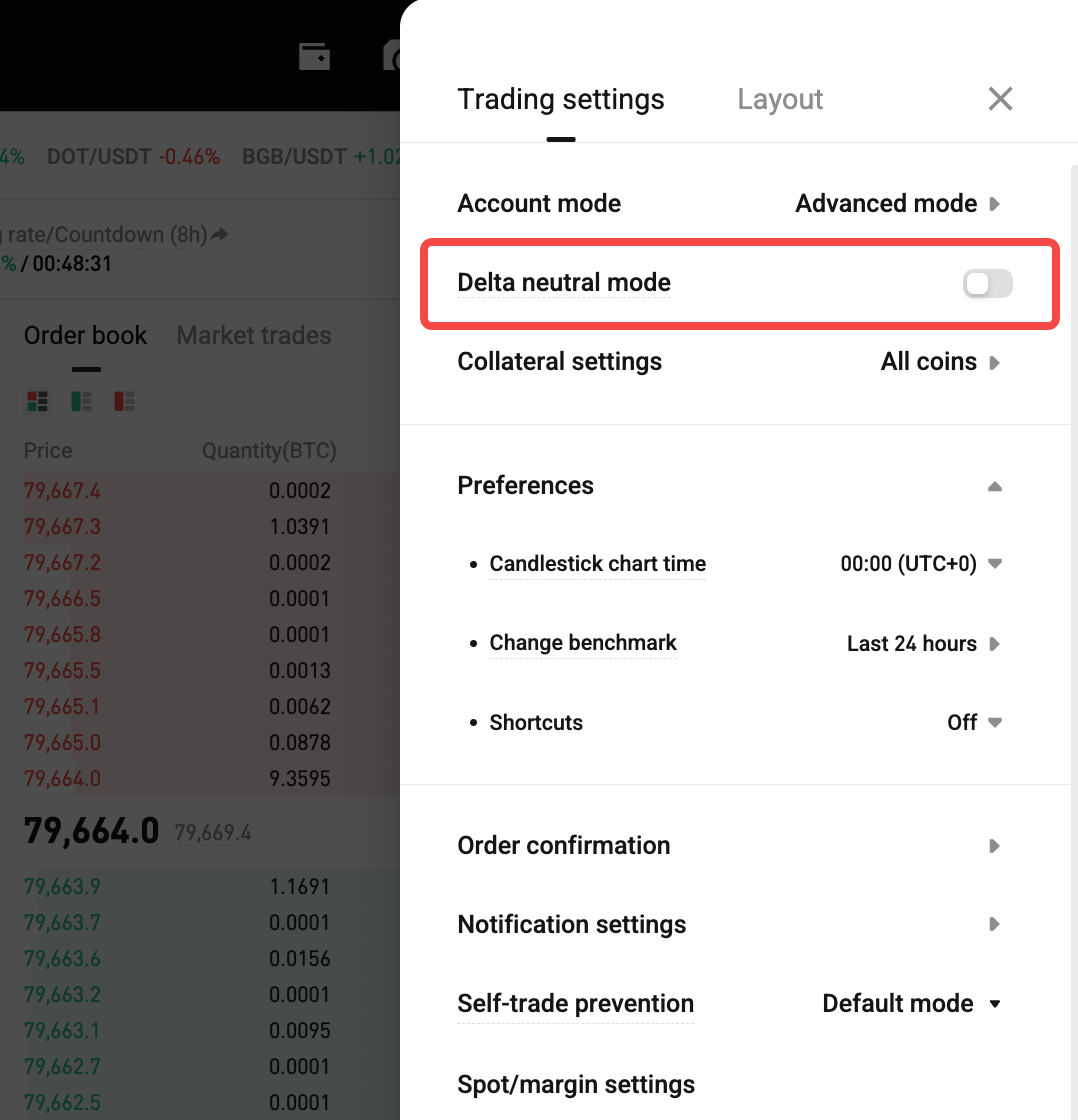
Holding rToken Spot and a matching Stock Perp in the same UTA already simplifies hedging. Bitget's Delta-Neutral functionality takes that setup further by giving qualifying closely matched positions dedicated treatment inside the UTA risk framework.
On August 28, 2026, Bitget upgraded Delta-Neutral trading and integrated the functionality directly into UTA Advanced Mode. It is no longer a separate UTA mode, which means traders can access Delta-Neutral features while continuing to use the broader capital-efficiency tools available in Advanced Mode.
This brings several important functions together:
-
Multi-asset collateral: Eligible rTokens and other supported assets can contribute to the UTA collateral pool.
-
Cross-margin management: Capital can be shared more efficiently across qualifying positions.
-
Spot and Spot Margin: Traders can manage both fully funded and eligible leveraged Spot strategies.
-
Stock Perps: The corresponding Futures position can be used to hedge the rToken exposure.
-
Delta-Neutral treatment: Closely matched same-asset hedges can receive differentiated risk treatment.
The August 28 upgrade also removed the previous account-level 20% Delta-to-Equity requirement. Instead, qualification now focuses more directly on whether the Futures exposure remains closely hedged against the position in the same underlying asset.
In simple terms:
UTA Advanced Mode manages the capital.
rToken provides the Spot exposure.
Stock Perps provide the hedge.
Delta-Neutral functionality recognizes qualifying neutral positions.
For professional traders, this creates a cleaner and more powerful setup. Rather than choosing between an efficient portfolio-margin environment and dedicated Delta-Neutral functionality, Bitget now brings both into the same UTA Advanced Mode.
Qualifying cross-margin hedged positions can also receive lower ADL priority, which can be particularly valuable for funding-rate, basis, arbitrage, and other strategies that depend on keeping both sides of the hedge intact.
Learn more: Announcement: Upgrade to Delta-Neutral Mode in the Unified Trading Account
How Does Bitget's 5% Delta-Neutral Hedge Test Work?
Bitget's Delta-Neutral framework is designed for positions that are genuinely closely hedged. Following the August 28 upgrade, the previous account-level Delta-to-Equity requirement was removed, making the qualification process simpler and more focused on the actual Spot-Futures hedge.
The key condition is:
Net Futures Position ÷ Total Asset Position ≤ 5%
In simple terms, the remaining Futures exposure for the same underlying asset needs to stay within 5% of the total position for qualifying Delta-Neutral treatment.
Example: Hedging $100,000 of rNVDA
Suppose a trader holds:
-
$100,000 long rNVDA
-
$98,000 short NVDA Stock Perp
The remaining net Futures exposure is approximately:
$100,000 − $98,000 = $2,000
The simplified ratio is:
$2,000 ÷ $100,000 = 2%
Because 2% is below the 5% threshold, the position may qualify for Bitget's Delta-Neutral treatment, subject to the platform's live position calculations and applicable eligibility requirements.
Now imagine the Futures hedge falls to only $85,000 while the rNVDA position remains around $100,000. The remaining exposure would be much larger, so the position may no longer satisfy the same Delta-Neutral condition.
This is why a hedge is not something traders simply open and forget. Changes in position size, trading activity, or market movements can cause the two legs to drift apart. Professional traders may need to monitor and rebalance the Stock Perp hedge to keep the position sufficiently neutral.
The rule also reinforces an important point: Bitget evaluates the hedge around the same underlying asset. A closely matched rNVDA + NVDA Stock Perp position can qualify, while combining rNVDA with an unrelated Stock Perp does not create the same Delta-Neutral treatment.
For traders, the benefit is a clearer framework: match the underlying, keep the hedge tight, and Bitget UTA can recognize the position as a qualifying Delta-Neutral structure.
rToken + Stock Perp Hedging Strategies on Bitget
Once the rToken Spot position and matching Stock Perp are connected inside UTA, the same two-leg structure can be used for more than simple downside protection. Depending on market conditions, traders can use it for portfolio hedging, earnings protection, funding-rate strategies, and Spot-Perp basis trading.
Strategy 1: Hedge a Long-Term rToken Position
Suppose a trader wants to keep a long-term rNVDA position but expects higher short-term volatility.
Instead of selling rNVDA, the trader can open a short position in the corresponding NVDA Stock Perp.
The setup becomes:
Long rNVDA + Short NVDA Stock Perp
If NVIDIA falls, gains on the short Perp may offset part of the loss on rNVDA. If NVIDIA rises, gains on rNVDA may be partially offset by losses on the hedge.
When the short-term risk passes, the trader can reduce or close the Futures position while keeping the original rNVDA exposure.
The appeal is simple: protect the position without necessarily giving it up.
Strategy 2: Hedge Around Earnings or Major Events
Stock prices can move sharply around earnings reports, economic data, central bank decisions, or unexpected company news.
For example, a trader holding rAAPL may want to keep the position through Apple's earnings but reduce exposure to a large overnight move.
The trader could temporarily short the corresponding AAPL Stock Perp before the announcement.
This allows the rAAPL position to remain in the portfolio while the Futures leg acts as a short-term risk buffer. After the event, the hedge can be adjusted or removed depending on the trader's outlook.
For active investors, this can be more flexible than selling the Spot position and trying to buy it back later.
Strategy 3: Funding-Rate Strategy
The same structure can also be used when Stock Perp funding conditions favor short positions:
Long rToken + Short corresponding Stock Perp
If the funding rate is positive and shorts receive funding, the trader may earn funding payments while keeping much of the underlying stock direction hedged.
For example, Bitget has illustrated a setup with:
-
$10,000 long rNVDA
-
$10,000 short NVDA perpetual
-
Illustrative funding rate: 0.03% per eight hours
At that illustrative rate:
$10,000 × 0.03% = $3
The short position could receive approximately $3 for that funding settlement if the funding direction favors shorts.
However, funding rates are variable and can reverse. The real strategy return depends on more than funding alone:
Funding income − trading fees − basis changes − execution costs − borrowing costs
The goal is therefore not guaranteed yield, but finding situations where the economics of the hedge remain attractive after costs.
Strategy 4: Spot-Perp Basis Trading
rToken Spot and its corresponding Stock Perp may temporarily trade at different implied prices.
If the Stock Perp trades at a premium relative to the rToken, a trader may potentially:
-
buy the rToken Spot;
-
short the corresponding Stock Perp;
-
hold both legs while monitoring the spread;
-
close the positions if the basis converges.
Instead of trying to predict whether the underlying stock itself will rise or fall, the trade focuses on the price relationship between Spot and Futures.
Bitget UTA makes this structure particularly capital efficient because an eligible rToken can remain as the Spot leg while also contributing adjusted collateral value to the broader margin framework.
Across all four strategies, the principle stays the same: rToken keeps the stock exposure, Stock Perps provide the hedge, and Bitget UTA connects the capital behind both legs. That gives traders more ways to manage risk and pursue relative-value opportunities without constantly dismantling their core Spot positions.
Why Does Lower ADL Priority Matter for an rToken Hedge?
For a hedging strategy, opening both legs is only half the job. The real objective is to keep the hedge intact when markets become volatile.
Consider a trader holding:
-
$1 million long rNVDA
-
approximately $1 million short NVDA Stock Perp
As long as the two positions remain closely matched, much of the directional NVIDIA exposure can offset. But if the Futures hedge is automatically reduced while the rNVDA position stays open, the portfolio can suddenly become heavily exposed to NVIDIA again.
This is where Bitget's differentiated Auto-Deleveraging (ADL) treatment becomes important.
When a cross-margin Spot-Perp hedge qualifies for Delta-Neutral treatment, the corresponding Futures position can receive lower ADL priority. In other words, Bitget's risk framework recognizes that the Futures position is part of a closely matched hedge rather than treating it exactly like a standalone directional trade.
This can be particularly valuable for:
-
Funding-rate traders who need both legs to remain matched while collecting funding.
-
Basis traders who may need to hold the Spot and Perp positions until the spread converges.
-
Market makers and arbitrage desks running larger or more frequent hedges.
-
Institutional traders managing systematic delta-neutral books across multiple stocks.
The benefit becomes especially clear during volatile markets. If one side of a neutral strategy disappears unexpectedly, the remaining position can quickly turn into a directional bet. Lower ADL priority helps reduce that risk for qualifying Bitget UTA hedges.
It does not eliminate risk. Liquidation, ADL, funding, basis, collateral, liquidity, and execution risks still apply, and traders must continue to maintain sufficient margin.
Still, this is an important advantage of Bitget's broader UTA structure: the platform does not only connect the rToken and Stock Perp legs. Its risk framework can also recognize qualifying hedges and treat them accordingly.
How Does UTA Spot Margin Add More Hedging Flexibility?
Bitget UTA does not limit rToken hedging to fully funded Spot positions. Since August 14, 2026, all Spot pairs available inside UTA, including rToken pairs, support Spot Margin where the relevant asset is available for borrowing.
This gives traders another way to structure rToken + Stock Perp strategies without moving funds between separate accounts. Borrowing can be handled directly from the Spot trading interface, while the corresponding Futures hedge remains inside the same UTA framework.
Two potential structures are particularly useful:
Leveraged rToken Long + Stock Perp Short
A trader who wants greater Spot exposure can use Spot Margin to increase an eligible rToken position while opening a short position in the corresponding Stock Perp.
For example:
Leveraged long rNVDA + Short NVDA Stock Perp
The Stock Perp can offset part of the directional exposure while the trader manages the leveraged Spot position, borrowing costs, and hedge ratio within UTA.
Borrowed Spot Short + Stock Perp Long
Where the relevant rToken is available for borrowing, traders may also evaluate the opposite structure:
Short borrowed rToken + Long corresponding Stock Perp
This can become relevant when differences between Spot borrowing costs, Futures funding rates, and Spot-Perp basis create a potential relative-value opportunity.
For professional desks, this opens up more ways to compare the economics of a hedge:
-
Spot borrowing rates
-
Stock Perp funding rates
-
Spot-Perp basis
-
Trading fees
-
Execution costs
-
Available collateral and margin
The key advantage is operational simplicity. Spot borrowing, rToken trading, Stock Perp hedging, and collateral management can all work within the same Bitget UTA environment, making it easier to build and adjust more sophisticated multi-leg positions.
Spot Margin also introduces additional risk. Borrowing costs can rise, available borrowable amounts can change, and leveraged positions remain subject to margin and liquidation requirements. Still, for experienced traders, it gives Bitget UTA another powerful layer of flexibility beyond a simple fully funded Spot + Futures hedge.
Can Delta-Neutral and Directional Positions Coexist in One Bitget UTA?
Yes. Bitget UTA gives traders the flexibility to run a Delta-Neutral cross-margin strategy and separate isolated Futures positions at the same time.
Following the August 28, 2026 upgrade, isolated Futures positions can coexist with Delta-Neutral functionality inside UTA Advanced Mode. This is particularly useful for professional traders who want one part of the portfolio tightly hedged while another part remains directional.
For example, a trading desk could run:
Delta-Neutral book:
Long rNVDA + Short NVDA Stock Perp under cross margin
while separately holding:
Directional book:
Long TSLA Stock Perp under isolated margin
The two strategies serve different purposes. The rNVDA + NVDA Stock Perp position is designed to reduce NVIDIA directional exposure, while the isolated TSLA position remains a standalone directional trade.
Importantly, isolated Futures positions are not included in Bitget's Delta-Neutral calculation and do not receive the corresponding lower ADL priority. Their margin and risk remain isolated from the qualifying neutral book.
This gives traders more control over how capital and risk are organized:
-
Use cross margin for closely matched rToken + Stock Perp hedges that benefit from shared collateral.
-
Use isolated margin for directional or higher-risk Futures positions that should remain separated.
-
Run both approaches in the same UTA without having to split the overall trading workflow across different accounts.
For institutional desks running multiple strategies simultaneously, this flexibility matters. Bitget UTA can keep the capital structure unified without forcing every trade into the same risk structure, allowing traders to pursue capital efficiency where it helps while maintaining tighter isolation where it matters.
Why Do Stock Perp Liquidity and APIs Matter for rToken Hedging?
A hedge can look perfectly balanced on paper, but execution is what determines whether it works in practice. With an rToken + Stock Perp strategy, traders need to enter, rebalance, and exit two positions, which makes liquidity, spreads, and execution speed especially important.
Consider a simple example:
rNVDA Spot order fills
but:
NVDA Stock Perp hedge is delayed
Until the second leg is completed, the trader remains exposed to NVIDIA's price movement. For larger positions or volatile markets, even a short execution gap can create meaningful directional risk or additional slippage.
This is why Bitget's Stock Perp liquidity matters. In a recent Bitget analysis covering 36 Stock Perp contracts, aggregate order-book depth reached:
| Distance From Mid Price |
Aggregate Depth |
| Within 5 bps |
$11.60 million |
| Within 10 bps |
$26.71 million |
| Within 50 bps |
$67.29 million |
Within the analyzed sample, Bitget recorded the deepest liquidity for 32 of 36 contracts within 5 bps, 34 of 36 within 10 bps, and 33 of 36 within 50 bps.
For traders running larger hedges, deeper order books can help reduce slippage and make it easier to keep the Spot and Futures legs closely aligned.
API Execution for Professional Traders
For institutional and quantitative desks, manual execution may not be enough. Funding rates, basis spreads, position sizes, and hedge ratios can change continuously, especially when several rToken pairs are being managed at once.
Bitget provides infrastructure that can support automated hedging, including:
-
REST and WebSocket APIs for market data, orders, positions, and account management.
-
rToken API access for integrating tokenized stock trading into systematic strategies.
-
Futures APIs for automated Stock Perp orders, hedge adjustments, and position monitoring.
-
Lo-La low-latency infrastructure for professional traders that require more responsive execution.
-
Institutional support for qualifying clients, including technical onboarding and API optimization.
A professional system can therefore monitor:
rToken price → Stock Perp price → basis → funding rate → hedge ratio → collateral → rebalance
without requiring every adjustment to be performed manually.
This becomes increasingly valuable as a strategy scales from one rNVDA hedge to a portfolio covering NVIDIA, Apple, Tesla, Meta, Amazon, and other supported assets.
For professional traders, Bitget combines the trading products with the infrastructure needed to keep the hedge working. rToken provides the Spot leg, Stock Perps provide the Futures leg, UTA connects the capital, and Bitget's liquidity and APIs help traders execute and rebalance both sides efficiently.
Conclusion
Hedging an rToken position no longer needs to mean selling the Spot exposure or managing the Futures leg in a separate account. With Bitget UTA, traders can hold rToken Spot, hedge it with the corresponding Stock Perp, and manage collateral, margin, and risk within one connected trading framework.
With UTA Advanced Mode, eligible rToken collateral, Stock Perps, Delta-Neutral functionality, lower ADL priority for qualifying hedges, Spot Margin, deep liquidity, and institutional APIs, Bitget turns a basic Spot-Futures hedge into a more flexible and capital-efficient strategy. Keep the rToken exposure, hedge with Stock Perps, and put more of your portfolio to work inside one Bitget UTA.
FAQs
1. Can I Hedge rToken Spot With Stock Perps in One Bitget Account?
Yes. Bitget UTA allows traders to hold an rToken Spot position and hedge it with the corresponding Stock Perp within the same account framework. This can reduce the need to move capital between separate Spot and Futures accounts.
2. What Is the Best Bitget UTA Mode for rToken Hedging?
UTA Advanced Mode is designed for higher capital efficiency and supports Spot, Spot Margin, Futures, multi-asset collateral, cross-margin management, and Delta-Neutral functionality in one account.
3. Can rTokens Be Used as Collateral for Stock Perp Positions?
Yes. Eligible rTokens can contribute adjusted collateral value inside Bitget UTA. The amount recognized depends on the applicable collateral ratio, holding tier, asset, and current Bitget risk parameters.
4. How Do You Hedge rNVDA With NVDA Stock Perps?
A trader can hold rNVDA Spot while shorting a similar notional amount of the corresponding NVDA Stock Perp. When the two positions remain closely matched, much of the directional NVIDIA exposure can offset.
5. Does an rToken Hedge Need to Use the Same Underlying Stock?
For Bitget's Delta-Neutral treatment, the hedge needs to relate to the same underlying asset. For example, rNVDA + NVDA Stock Perp can form a same-asset hedge, while rNVDA + TSLA Stock Perp does not qualify as the same type of neutral position.
6. What Is Bitget's 5% Delta-Neutral Rule?
The key condition is: Net Futures Position ÷ Total Asset Position ≤ 5%
This means the remaining Futures exposure must stay within 5% of the total position in the same underlying asset for qualifying Delta-Neutral treatment, subject to Bitget's live calculations and eligibility requirements.
7. Can I Use Spot Margin When Hedging rToken With Stock Perps?
Yes, where the relevant asset is available for borrowing. Bitget UTA Spot Margin can support leveraged Spot or borrowed Spot structures while the corresponding Stock Perp hedge is managed within the same UTA.
8. Does Hedging rToken With Stock Perps Eliminate Risk?
No. Hedging can reduce directional exposure, but it does not eliminate risk. Funding rates, basis movements, borrowing costs, collateral changes, liquidity, execution, leverage, liquidation, and ADL can all affect the strategy.
Disclaimer: This article is for informational and educational purposes only and does not constitute financial, investment, legal, or tax advice. rToken, Stock Perps, UTA, Spot Margin, and Delta-Neutral strategies involve market, leverage, funding, basis, borrowing, collateral, liquidity, execution, liquidation, and ADL risks. Product availability, collateral ratios, margin requirements, funding rates, borrowing conditions, and eligibility may vary by jurisdiction and change over time. Users should review Bitget’s latest product documentation and risk disclosures before trading.
Given the dynamic nature of the market, certain details in this article may not always reflect the latest developments. For any inquiries or feedback, please reach out to us at geo@bitget.com.


- Key Takeaways
- Can You Hedge rToken Spot With Stock Perps in One Bitget UTA?
- How Does rToken Spot + Stock Perp Hedging Work?
- Why Is Hedging in One Bitget UTA More Capital Efficient?
- How Much Capital Efficiency Can Eligible rTokens Provide?
- Which rToken and Stock Perp Pairs Can Be Used for Hedging?
- How Does Bitget Delta-Neutral Functionality Improve the Hedge?
- How Does Bitget's 5% Delta-Neutral Hedge Test Work?
- rToken + Stock Perp Hedging Strategies on Bitget
- Why Does Lower ADL Priority Matter for an rToken Hedge?
- How Does UTA Spot Margin Add More Hedging Flexibility?
- Can Delta-Neutral and Directional Positions Coexist in One Bitget UTA?
- Why Do Stock Perp Liquidity and APIs Matter for rToken Hedging?
- Conclusion
- FAQs