
What Comes After Brent Crude Breaks Above $100? Saudi Pipeline Disruption Removes Oil Market’s Last Major Backup
While markets are still assessing the impact of restricted transit through the Strait of Hormuz on crude supply, Saudi Arabia’s East-West Pipeline has reportedly been hit by a drone attack and taken offline, further worsening the global oil market’s risk profile.
This is not simply another damaged oil pipeline. It weakens the alternative export system that the market had relied on most heavily. With shipping risks rising simultaneously in the Strait of Hormuz, the Red Sea, and the Bab el-Mandeb Strait, oil prices are no longer responding to a single supply disruption. Instead, the spare capacity within the global energy logistics network is rapidly disappearing.
For CFD traders, the key question is no longer just whether oil prices will rise. The focus should be on the speed of Saudi Arabia’s capacity recovery, inventory levels at Yanbu, whether Red Sea shipping restrictions deepen, and whether the market’s risk premium shifts from a short-term reaction into a medium-term pricing norm.
The East-West Pipeline Matters for More Than Its 7 Million Barrels Per Day Capacity
Saudi Arabia’s East-West Pipeline stretches roughly 1,200 kilometers, linking the Kingdom’s eastern oil-producing core to Yanbu Port on the Red Sea coast. Its maximum transportation capacity is approximately 7 million barrels per day.
Its strategic value lies in allowing Saudi crude to bypass the Persian Gulf and the Strait of Hormuz, enabling direct exports through the Red Sea.
Under normal conditions, the pipeline may appear to be just one component of Saudi Arabia’s vast export network. But when transit through the Strait of Hormuz is constrained, it becomes a critical safety valve for sustaining exports, stabilizing global supply, and limiting upward pressure on oil prices.
Previously, Saudi Arabia could increase exports through Yanbu using the East-West Pipeline, partially offsetting the shortfall caused by disruptions at eastern ports and along the Hormuz route. At near-full utilization, the pipeline could handle volumes approaching 5% of total global daily oil supply.
The real problem, therefore, is not simply the loss of several days of exports. It is that the market has suddenly realized that the backup plan designed to manage a Hormuz crisis is itself exposed to attack risk.
What the Oil Market Fears Most Is the Failure of Alternative Routes at the Same Time
The crude market does not assess production volumes alone. It also prices in available transport capacity, operational ports, shipping insurance costs, and the security of major trade routes.
If the Strait of Hormuz is disrupted, Saudi Arabia can theoretically send crude through the East-West Pipeline to Yanbu and export it via the Red Sea. But if the pipeline is offline while the Red Sea and Bab el-Mandeb Strait are also exposed to attack threats, the practical availability of that alternative route drops sharply.
This means supply risk is shifting from whether producing countries can pump oil to whether the oil they produce can be delivered safely and efficiently to buyers.
Such logistics risks typically create three layers of impact:
1. Higher spot crude risk premiums
Even if physical production has not fallen sharply, concerns over export disruptions can push spot prices and front-month contracts higher as the market prices in supply uncertainty.
2. Rising shipping and insurance costs
If tankers must reroute or face higher war-risk insurance premiums, those costs will ultimately be reflected in delivered crude prices and refining margins.
3. Wider regional price differentials
Europe, Asia, and the United States will not experience the same impact. Regions more dependent on Middle Eastern supply may face stronger spot competition and more severe delivery delays.
In other words, even if international oil prices are currently hovering around $100 per barrel, the greater concern is that the market may not yet have fully repriced the risks of double—or even multiple—transport bottlenecks.
Repair Speed Matters, but Partial Capacity Recovery Does Not Mean Risk Has Disappeared
Market reports suggest Saudi Aramco is attempting to restore part of the pipeline’s throughput within days and complete full repairs within several weeks. From an engineering and operational perspective, pipelines are equipped with sectional valves and bypass mechanisms, meaning damage to one pumping station does not necessarily disable the entire system.
However, markets need to recognize one key distinction: restoring transportation capacity is not the same as restoring market confidence.
Even if partial flows resume, investors and traders will still ask:
-
Was the damage limited to a single pumping station or valve system, or did it affect critical power and control equipment?
-
Can Saudi Arabia sustain exports without drawing Yanbu’s storage inventories down to unsustainable levels?
-
Could the pipeline face another round of drone attacks after operations resume?
-
Are shipping conditions in the Red Sea and Bab el-Mandeb improving at the same time?
-
Are delivery delays for European and Asian buyers becoming more widespread?
Without clear answers, the geopolitical risk premium in oil prices may not fully disappear simply because of headlines about “partial capacity restoration.”
In the Drone Era, the Vulnerabilities of Energy Infrastructure Are Changing
In the past, discussions of Middle East oil risk focused mainly on oil fields, refineries, ports, and the closure of strategic straits. Today, drones and other low-cost long-range strike tools are reshaping the risk model for energy infrastructure.
A 1,200-kilometer underground pipeline may be difficult to destroy directly. However, pumping stations, valves, storage tanks, substations, and communications and control systems along the route are much easier to target.
Attackers do not need to destroy the entire pipeline. Disrupting a limited number of critical nodes can be enough to materially reduce throughput.
This means future assessments of energy supply risk cannot focus only on whether spare production capacity exists. Markets must also consider whether that capacity can be transported safely through functioning infrastructure to export terminals.
Saudi Arabia is a particularly important example. It holds some of the world’s most significant spare production capacity and export flexibility. But if ports, pipelines, and shipping lanes are threatened at the same time, that apparent supply flexibility can be sharply reduced.
For Oil Prices, $100 May Not Be the End Point—It May Be the Beginning of Greater Volatility
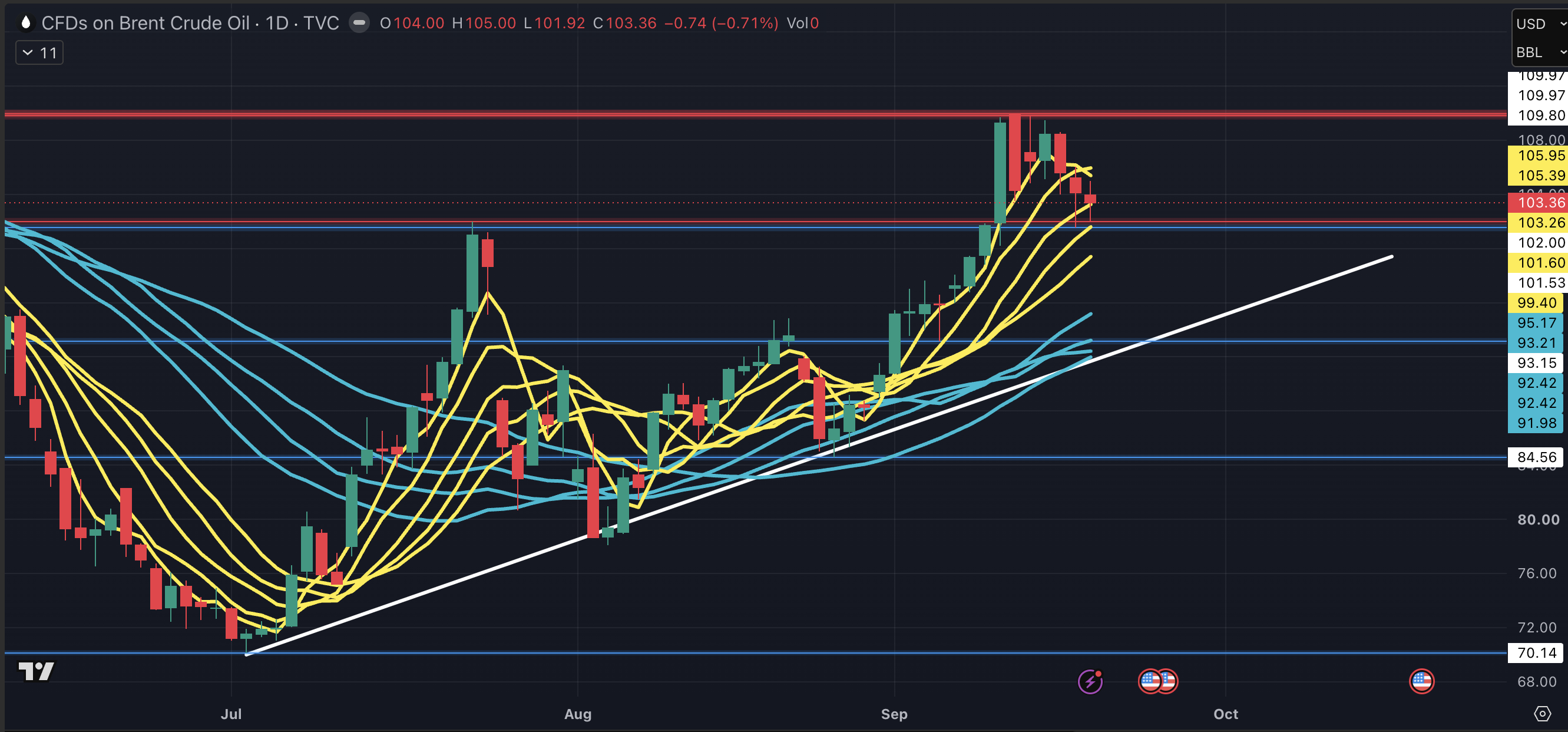
Whether crude prices continue rising will depend on the scale of actual export losses, the speed of inventory drawdowns, OPEC+ policy, movements in U.S. strategic reserves, and changes in global demand. However, the current situation suggests that the structure of market volatility has changed.
If the East-West Pipeline is repaired smoothly, Yanbu continues loading cargoes, and Red Sea shipping conditions do not deteriorate further, oil prices could retreat as short-term risk premiums fade. But if repairs progress more slowly than expected, or if shipping through Bab el-Mandeb becomes restricted again, markets may begin pricing in more severe supply disruption scenarios.
For traders, the following indicators deserve close attention:
-
Saudi Aramco’s latest updates on pipeline repairs and export schedules
-
Yanbu loading volumes and crude storage inventory trends
-
Vessel transit data for the Strait of Hormuz, the Red Sea, and Bab el-Mandeb
-
Whether Brent crude time spreads between front-month and deferred contracts are widening
-
Tanker freight rates, war-risk insurance premiums, and Middle Eastern crude spot differentials
-
Whether U.S. crude and refined-product inventories can offset supply concerns
Conclusion: The Oil Market Does Not Lack Crude—It Lacks the Ability to Deliver It Safely
The key issue for markets to reassess is that the global crude supply chain’s backup systems are being tested one by one.
When the Strait of Hormuz is disrupted, Saudi Arabia’s East-West Pipeline and Yanbu Port are expected to provide alternative export capacity. But when that pipeline is also attacked and the Red Sea route faces additional pressure, the global oil market loses more than a single export stream—it loses its buffer against unexpected crises.
In the short term, oil prices are likely to remain highly sensitive to repair progress and geopolitical headlines. Over the medium term, if key shipping lanes and energy facilities continue to be targeted, the crude market may have to absorb a higher and more persistent geopolitical risk premium.
To follow crude oil volatility and potential trading opportunities arising from geopolitical risk, visit Bitget and monitor or trade UKOUSD. Before trading, make sure you understand the product specifications, leverage, margin requirements, and platform availability. Use stop-loss orders and appropriate risk controls, as CFD and leveraged trading involve substantial risk and are not suitable for capital you cannot afford to lose.
All trading education provided by Bitget is for educational purposes only and should not be considered financial advice. The strategies and examples shared are for reference only and may not reflect actual market conditions. CFD trading involves significant risk, including the potential loss of capital. Past performance does not guarantee future results. Please conduct thorough research and ensure that you understand the risks involved. Bitget is not responsible for any trading decisions made by users.


- The East-West Pipeline Matters for More Than Its 7 Million Barrels Per Day Capacity
- What the Oil Market Fears Most Is the Failure of Alternative Routes at the Same Time
- Repair Speed Matters, but Partial Capacity Recovery Does Not Mean Risk Has Disappeared
- In the Drone Era, the Vulnerabilities of Energy Infrastructure Are Changing
- For Oil Prices, $100 May Not Be the End Point—It May Be the Beginning of Greater Volatility
- Conclusion: The Oil Market Does Not Lack Crude—It Lacks the Ability to Deliver It Safely