
Bitget rToken Hits Record $200 Million Daily Spot Volume Despite Crypto Downturn
November has been a challenging month for crypto. On November 20, Bitcoin fell below $60,000, having lost more than 16% of its value over the previous week. Around $1.5 billion in leveraged crypto positions were liquidated within 24 hours, while the Crypto Fear & Greed Index sank into “extreme fear.”
Yet one corner of the market saw trading activity pick up. On November 21, 2026, Bitget rToken, Bitget’s tokenized stock trading product, recorded more than $200 million in daily spot trading volume, its highest since launching in June. The record came on a Saturday, when U.S. stock exchanges were closed.
Tokenized Stocks Trading: A Month of Rising Activity
The record didn't come out of nowhere. In late October, daily rToken trading volume was generally below $50 million. By mid-November, it had surpassed $100 million on multiple occasions, reaching approximately $145 million on November 18 before breaking the $200 million mark on November 21. Between November 15 and 21 alone, rToken recorded nearly $950 million in trading volume, or around $135 million a day. Cumulative trading volume since launch now stands at approximately $6.4 billion.
User activity also picked up. On November 20, the number of daily rToken traders rose sharply. Between November 15 and 21, institutional accounts made a growing contribution to trading activity, accounting for approximately 38% of the total volume on the record-breaking day. Based on the reported daily volume, this represents an estimated $76 million in institutional trading.
This reflects interest in tokenized stocks among both retail traders and professional investors seeking more flexible access to U.S. equities. While higher trading volume does not necessarily indicate capital inflows or rising asset prices, these figures show that the latest record followed several weeks of rising trading activity rather than an isolated one-day spike.
Why Tokenized Stocks Are Drawing Crypto Traders
While trading data alone cannot explain investors' motivations, several factors may help explain the growing interest in tokenized stocks during a crypto downturn.
Another asset class to turn to. When crypto prices fall across the board, opportunities within the market can become more limited. Tokenized stocks give users exposure to U.S. stocks and ETFs, from technology and healthcare companies to broad market indices, without leaving their crypto trading platform. Rather than relying on a single asset class, users can build portfolios around different industries and market trends. Diversification does not eliminate risk, but it gives traders more options when navigating uncertain markets.
Trading when the news breaks. Corporate earnings, policy decisions, and global events don't wait for the opening bell. Nearly 52% of rToken's cumulative trading volume has taken place outside regular U.S. stock market hours, and the weekend record further highlights the value of extended market access. For traders in time zones outside the U.S., this also means greater flexibility to participate in the market without adjusting their daily schedules to traditional stock exchange hours.
One account, two markets. Trading crypto and stocks has traditionally meant managing separate accounts, moving funds between platforms, and adapting to different trading systems. Tokenized stocks simplify this experience by allowing crypto users to access traditional financial assets where they already trade crypto.
Bitget rToken: How It Works and What It Offers
Tokenized stocks are blockchain-based tokens designed to track the value of traditional stocks and ETFs. Issued by Reality, each rToken is backed 1:1 by its corresponding underlying security, giving holders economic exposure without direct share ownership. On Bitget, users can trade rTokens, use eligible holdings as collateral, or access additional yield opportunities.
Trade with USDT. Users can buy and sell rTokens directly with USDT without funding a separate brokerage account or converting their existing USDT holdings into fiat currency. With market-linked liquidity, instant settlement, and extended trading hours, Bitget offers a familiar and flexible trading experience for crypto users.
Use as collateral. Eligible rTokens can serve as margin and collateral within Bitget’s Unified Trading Account (UTA). Instead of selling their existing holdings to free up capital, users can maintain their stock exposure while accessing other supported trading products. This provides greater flexibility in managing capital, subject to margin requirements and liquidation risks.
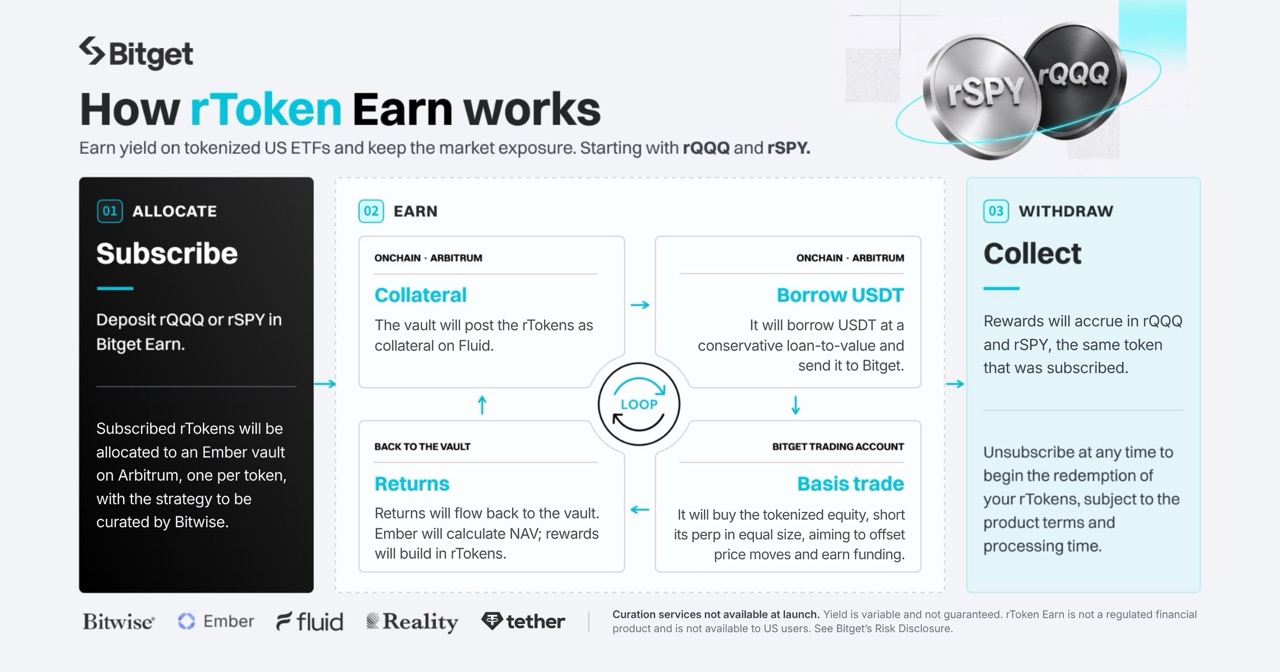
Earn yield. Launched in November, rToken Earn allows eligible non-U.S. users in permitted jurisdictions to earn variable onchain yield on selected tokenized ETFs while maintaining exposure to the underlying assets.
Users can access these opportunities directly through Bitget Earn, without setting up a separate wallet or interacting with DeFi protocols themselves. Yields are variable and not guaranteed.
A $200 million trading day would be notable in any market. Reaching this milestone during a crypto downturn, while the U.S. stock exchanges were closed, highlights the growing interest in trading opportunities beyond crypto.
For Bitget, the milestone marks another step toward its Universal Exchange (UEX) vision of bringing crypto and traditional financial assets together on one platform, giving users more flexibility in what they trade, when they trade, and how they manage their assets.
Explore Bitget rToken and start trading tokenized stocks today.
Disclaimer: The opinions expressed in this article are for informational purposes only. This article does not constitute an endorsement of any of the products and services discussed or investment, financial, or trading advice. Qualified professionals should be consulted prior to making financial decisions.


- Tokenized Stocks Trading: A Month of Rising Activity
- Why Tokenized Stocks Are Drawing Crypto Traders
- Bitget rToken: How It Works and What It Offers